
AI Evaluation Checklist: Test Accuracy, Risk and Mission Fit Before You Trust the Output
Freshness note: Prepared for publication on 2 October 2026. Review this guidance whenever your AI tools, vendor terms, privacy obligations, ministry context or business workflow changes.
AI can sound confident before it is correct. That is why wise leaders need an AI evaluation checklist before they trust an output, connect a tool to a workflow, or let a team depend on a generated answer. The question is not only, “Did the tool produce something impressive?” The better question is, “Have we tested whether this output is accurate, safe, useful, accountable and aligned with our mission?”
For pastors, ministry teams, nonprofits and small businesses, this matters because AI is now being used for sermon research, member communication, donor emails, proposals, customer support, operations, training, reporting and planning. One inaccurate summary, careless recommendation or unreviewed automation can damage trust. At Wisdom Highways, we believe wisdom comes before automation. Tools should save time, but never at the cost of truth, stewardship, confidentiality or human responsibility.
This checklist gives non-technical leaders a practical way to evaluate AI outputs and AI-assisted workflows before they are used publicly or operationally.
What is an AI evaluation checklist?
An AI evaluation checklist is a leadership review process for testing whether an AI output or AI-assisted workflow is fit for use. It looks beyond grammar and speed. It asks whether the result is accurate, evidence-based, appropriate for the audience, safe with sensitive data, free from obvious bias, clear about uncertainty, and connected to a human owner.
The NIST AI Risk Management Framework encourages organizations to map, measure and manage AI risks rather than treating AI as a magic productivity layer. The OECD AI Principles also emphasize human-centred, transparent, robust and accountable AI. In everyday leadership language: do not let the machine’s fluency outrun your responsibility.
When should leaders use this checklist?
Use this checklist before your team relies on AI for any output that could affect people, money, reputation, ministry care, client trust, policy, compliance, strategy or public communication. It is especially important when AI is helping with:
- sermon research, devotional material, theological explanation or discipleship content;
- pastoral, HR, volunteer, donor, client or customer communication;
- summaries of meetings, transcripts, contracts, reports or policies;
- customer support answers, FAQs, proposals, quotes or sales messages;
- financial, legal, medical, counseling or employment-sensitive topics;
- automated decisions, recommendations, scoring, routing or escalation.
If the output is low-risk and internal, the review can be light. If the output could shape a person’s decision, expose sensitive data or represent your organization publicly, the review should be deliberate.
The Wisdom Highways CLEAR evaluation framework
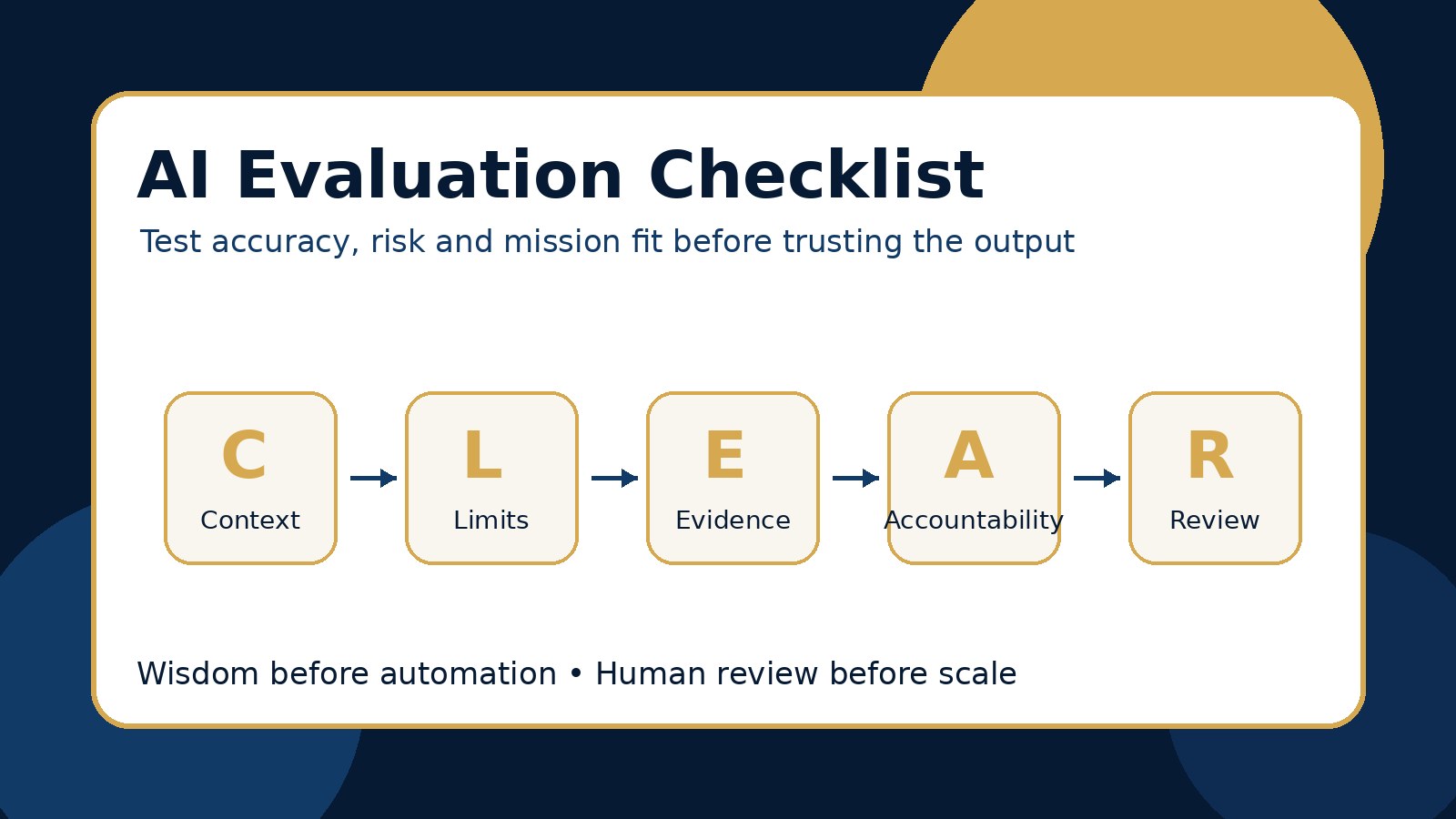
Use CLEAR as a simple memory aid: Context, Limits, Evidence, Accountability and Review.
1. Context: did the AI understand the real situation?
AI often answers the prompt it received, not the situation you actually face. Before using the output, ask: did we give the tool enough context about our audience, values, geography, policy, tone, workflow and constraints? A church announcement, a nonprofit donor update and a business client email may use similar words but carry different relational responsibilities.
Connect this step to your AI Data Classification practice. Never add sensitive information merely to get a better output. If the tool needs confidential details to perform well, that is a governance decision, not a shortcut.
2. Limits: where might the output be wrong or unsafe?
Every AI answer has limits. It may be outdated, incomplete, overly generic, biased toward common web patterns, weak in local context, or too confident about a subject that requires expert review. The NIST Generative AI Profile is a useful reminder that generative AI risk includes content, data, misuse and human oversight questions. Leaders should therefore ask: what could go wrong if this output were accepted as-is?
For ministry use, limits may include doctrinal nuance, pastoral sensitivity, confidentiality, cultural tone or scripture context. For business use, limits may include product accuracy, contractual language, customer promises, regulatory claims or technical detail.
3. Evidence: can important claims be verified?
An AI output may include claims, examples, summaries or recommendations that sound plausible. Do not publish or act on important claims until they are checked against reliable sources, internal records or a knowledgeable human. If the output cites a statistic, regulation, quotation, external example, claimed result or external fact, verify it. If you cannot verify it, remove it or phrase it cautiously.
This is where your AI Output Review Checklist and AI Audit Trail become practical. Keep evidence for decisions that matter.
4. Accountability: who owns the final decision?
AI should support judgment, not replace responsibility. Before a result is used, name the human owner. Who approves the final message? Who handles a correction? Who decides whether risk is acceptable? Who can stop the workflow if something feels wrong?
The OWASP Top 10 for Large Language Model Applications highlights practical risks such as prompt injection, sensitive information disclosure and overreliance. Those are not only technical concerns. They are leadership concerns because unclear ownership allows risk to travel through a team unnoticed.
5. Review: what will we measure after use?
Evaluation is not finished at launch. After using an AI-assisted output or workflow, review whether it saved time, improved quality, protected trust and created measurable value. Connect the result to your AI Benefits Realization Register and your AI Governance Review Cadence. If a tool repeatedly produces outputs that need heavy correction, the team may need better prompts, training, data boundaries, human review or a different tool.
A practical AI evaluation checklist
| Area | Leader question | Pass standard |
|---|---|---|
| Purpose | What decision or communication will this support? | The use case is clear and not more sensitive than the review process can handle. |
| Audience | Who could be affected if this is wrong? | The review level matches the impact on people, trust and reputation. |
| Accuracy | Are factual claims checked? | Important claims are verified against reliable sources or internal truth. |
| Evidence | Can we explain why this answer is acceptable? | Sources, assumptions and uncertainties are visible to the reviewer. |
| Privacy | Did we share anything the tool should not receive? | No restricted or unnecessary sensitive data was pasted, uploaded or exposed. |
| Bias and fairness | Could this unfairly exclude, stereotype or disadvantage someone? | Language and recommendations are reviewed for fairness and human dignity. |
| Security | Could the output include unsafe instructions, links or hidden manipulation? | Risky links, code, instructions and external content are checked before use. |
| Human owner | Who approves and corrects the final output? | A responsible person is named before publication or operational use. |
| Mission fit | Does this serve people and mission, or only speed? | The output strengthens trust, clarity and service, not just efficiency. |
Ministry example: evaluating AI-assisted sermon research
A pastor uses AI to organize background notes for a teaching series. The tool offers a clean summary, but the leader should still evaluate carefully. Are scripture references accurate? Are theological claims consistent with the church’s doctrine? Has the AI flattened a sensitive pastoral topic into generic advice? Has any counseling or member story been included in the prompt? Would the final message still sound like the shepherd’s own prayerful work?
A wise process might allow AI to help with structure, language clarity and research prompts while requiring human study, source verification, pastoral discernment and final approval. The goal is not to remove the human voice. The goal is to reclaim time without outsourcing wisdom.
SME example: evaluating an AI customer support answer
A small business uses AI to draft replies to customer questions. The answer sounds helpful, but it promises a refund timeline the company has not approved. It also gives advice that may not apply in every country where the customer base lives. Before the reply is sent, the team checks policy, adjusts the wording, removes unsupported promises and routes unusual cases to a human.
This connects directly to an AI Escalation Policy. The more an issue involves emotion, money, safety, law, privacy, complaint handling or exceptions, the faster a human should review it.
Common AI evaluation mistakes
- Reviewing only grammar. A polished output can still be wrong, insensitive or unsafe.
- Assuming citations are real. Links, titles and quotations must be checked before use.
- Using one good answer as proof of reliability. Test multiple examples, edge cases and high-risk scenarios.
- Ignoring the workflow around the output. A good draft can still be risky if access, approval or escalation is unclear.
- Letting speed define success. Time reclaimed matters only if quality and trust are preserved.
- Skipping vendor and security questions. Before connecting tools deeply, revisit your AI Vendor Security Questionnaire.
How to make the checklist part of daily work
Do not turn evaluation into bureaucracy. Build it into the normal rhythm of work. For low-risk internal drafts, use a quick two-minute review. For public content, client communication, pastoral material or sensitive decisions, use a fuller checklist. For automated workflows, add approval gates, sampling, monitoring and a clear stop process.
The UK Government Generative AI Framework and CISA Secure by Design both reinforce a practical principle: safer technology use is designed and assured, not wished into existence after launch.
Final thought: evaluate before you accelerate
AI can help leaders reclaim time, reduce repetitive work and improve service. But acceleration without evaluation can create hidden risk. A wise organization does not reject AI out of fear, and it does not trust AI out of excitement. It tests, governs, learns and keeps people at the center.
If your team is using AI but has not yet defined what good, safe and mission-aligned use looks like, start with the next step below.
Related Wisdom Highways resources
Keep learning with Wisdom Highways. Follow our WhatsApp Channel for practical AI tips, time-saving ideas, product updates and selected offers.
Follow WH Premium AI Vault on WhatsApp