
AI Readiness · Leadership & Wisdom
AI Output Review Checklist: What Leaders Should Check Before Sending AI-Written Content
AI can help your team draft faster, but speed without review can damage trust. Use this practical checklist before AI-assisted content leaves your organization.
Many leaders are no longer asking whether their team will use AI to draft content. The more urgent question is whether anyone is reviewing that content wisely before it is sent, published or used in a decision.
A church administrator may ask AI to draft a visitor follow-up email. A nonprofit leader may use it to summarize a donor update. A small-business owner may use it for client responses, social posts, proposals or internal reports. None of those uses are automatically wrong. But every one of them can create risk if the output is treated as finished simply because it sounds polished.
This guide gives pastors, founders, executives and operations leaders a simple AI output review checklist. The goal is not to slow your team down with fear. The goal is to protect trust while still reclaiming time.
Wisdom Highways principle: AI may draft, organize and summarize. Human wisdom must still verify, approve and take responsibility. This is wisdom before automation in practical editorial form.
Why AI-written content needs a review gate
AI tools can produce confident language even when the underlying answer is incomplete, outdated, biased or inappropriate for the context. Responsible-AI frameworks from organizations such as NIST, the OECD and UNESCO repeatedly point leaders back toward human oversight, accountability, transparency and risk management.
For Wisdom Highways audiences, the issue is also pastoral and relational. A message can be technically correct and still feel cold. A summary can be efficient and still omit a sensitive detail. A social post can sound impressive and still make a claim your organization cannot defend.
The review gate is where leaders make sure AI serves people rather than replacing judgment.
The AI Output Review Checklist
Use this checklist before sending or publishing AI-assisted content, especially when it touches people, reputation, money, ministry care, compliance, private information or public claims.
1. Purpose check: does this output serve the right goal?
Before editing sentences, confirm the mission. Ask: What is this content supposed to accomplish? Is it informing, encouraging, inviting, correcting, selling, reporting or documenting? AI often produces broadly acceptable text, but leadership requires fit.
- For a church: does the message support care, clarity and dignity?
- For a business: does it help the customer take the next right step?
- For a nonprofit: does it communicate truth without manipulating emotion?
2. Audience check: is it written for the real person receiving it?
AI tends to average audiences. Leaders know the actual audience. A first-time church visitor, a grieving family, a long-term donor, a frustrated customer and a board member do not need the same tone.
If the message feels generic, rewrite it. Replace broad language with concrete care, context and next steps.
3. Accuracy check: are all facts, names, dates and claims verified?
Never let an AI tool be the final source of truth for facts. Check names, dates, locations, prices, service details, Scripture references, policy statements, contact information, event times, statistics and any claim about what your organization can deliver.
This is especially important for public content. Major responsible-AI programs, including Microsoft’s Responsible AI work, emphasize accountability, reliability, safety and transparency. Wisdom Highways applies the same leadership caution in everyday communication: do not let polished wording create promises you cannot prove.
4. Source check: where did the important claim come from?
If the content uses research, regulation, financial statements, health claims, legal ideas or current events, identify the source. Link to credible references where appropriate. If you cannot verify a claim, remove it or frame it cautiously.
A simple rule: the higher the consequence, the stronger the evidence must be.
5. Privacy check: does the output expose information that should stay private?
Review the content for personal data, pastoral care details, confidential client information, donor data, internal finances, staff issues, private prayer requests, access credentials, addresses, children’s information and sensitive health or legal matters.
The UK Information Commissioner’s Office provides detailed AI and data protection guidance; leaders outside the UK can still learn from the principle: data responsibility does not disappear because a tool made the workflow easier.
6. Tone check: does it sound like your organization, not a machine?
AI output often sounds smooth but distant. Wisdom Highways content should be clear, warm, wise, practical and trustworthy. Ministry messages should not sound like corporate automation. Business messages should not sound like empty hype.
Remove overused phrases, exaggerated urgency, fake intimacy and vague motivational language. Add real context and human clarity.
7. Theology and values check: does it respect your convictions?
For pastors and ministry leaders, this check is non-negotiable. AI can assist with organization, summaries and drafts, but it cannot replace prayer, pastoral discernment, biblical fidelity or spiritual responsibility.
Review sermon-support material, devotionals, teaching notes and pastoral communications carefully. If a theological statement is included, a qualified human leader should approve it.
8. Bias and fairness check: could this harm or exclude people unfairly?
AI output can reflect patterns from the data and prompts behind it. Review whether the content stereotypes people, excludes certain regions or cultures, oversimplifies poverty, ministry contexts or business realities, or assumes one country’s situation is universal.
This matters for Wisdom Highways because the audience is international. A helpful article, message or system should be usable by leaders in Lagos, London, Nairobi, Accra, New York, Johannesburg or a small town with limited staff and budget.
9. Action check: is the next step clear and appropriate?
Every operational message should make the next step easy. Should the reader reply, register, book, attend, review, approve, download, pay, pray, volunteer or wait? AI sometimes ends with a pleasant but weak conclusion. Leaders should turn vague endings into clear next actions.
10. Risk check: what could go wrong if this is misunderstood?
Before sending sensitive content, ask what harm could occur if the message is misunderstood, forwarded publicly or read by someone outside the intended audience. The OWASP guidance for LLM applications highlights that AI output can create security and misuse risks when organizations trust it without safeguards.
If the risk is high, require a second human review.
A simple review workflow for busy teams
You do not need a complicated policy to start. Use a three-level review model.
Green: low-risk drafts
Examples: internal brainstorming notes, first drafts of routine announcements, simple summaries for personal use and content idea lists. One trained team member can review before use.
Amber: public or people-facing content
Examples: newsletters, social posts, visitor follow-ups, client emails, donor updates, event promotions and staff-wide announcements. Require accuracy, tone and privacy review before publishing or sending.
Red: sensitive or high-consequence content
Examples: pastoral care responses, legal or financial statements, HR matters, crisis communication, doctrinal teaching, personal data, complaints, fundraising claims and strategic decisions. Require named leadership approval. In some cases, do not use AI at all beyond administrative organization.
Ministry example: visitor follow-up email
A church team uses AI to draft a warm email for first-time visitors. The draft is friendly, but it includes a sentence that assumes the visitor is already a Christian and promises that someone will call within 24 hours.
The review checklist catches two issues. First, the tone should be welcoming without making assumptions about the visitor’s spiritual background. Second, the promise must match the church’s real follow-up capacity. The final email becomes more truthful, warmer and easier to fulfill.
Business example: proposal summary
An SME owner asks AI to turn meeting notes into a proposal summary. The draft sounds professional but adds services that were never discussed and suggests a timeline the team cannot meet.
The accuracy and promise checks prevent reputational damage. The owner edits the scope, confirms the timeline and adds a clear next step. The result is faster than writing from scratch, but still responsible.
Nonprofit example: donor update
A nonprofit team uses AI to draft a donor update from program notes. The draft is emotionally powerful, but it risks overclaiming outcomes and includes identifying details about a beneficiary.
The source and privacy checks protect both integrity and dignity. The team removes identifying details, verifies the outcome language and keeps the story respectful.
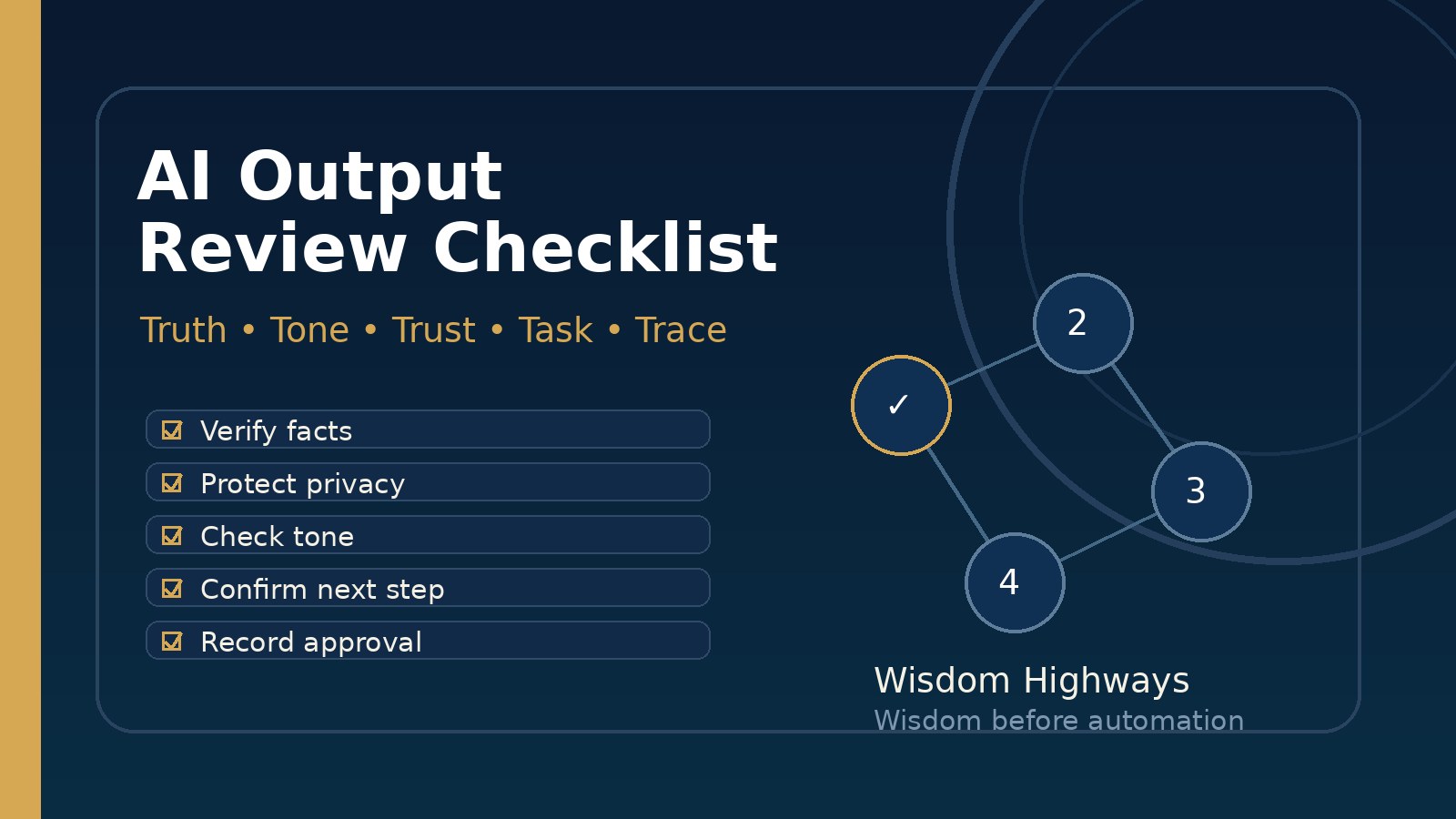
The Wisdom Highways Output Review Model
Use this five-part model when you need a memorable standard:
- Truth: Is it accurate and source-backed?
- Tone: Does it sound human, respectful and aligned with our voice?
- Trust: Does it protect privacy, relationships and reputation?
- Task: Does it make the next step clear?
- Trace: Can we identify who reviewed and approved it?
This model turns AI review from a vague warning into a repeatable leadership habit.
Common mistakes to avoid
- Approving because it sounds polished. Fluency is not the same as truth.
- Using AI for sensitive pastoral care without review. People deserve wisdom, not automated empathy.
- Letting junior staff publish AI output without boundaries. Train the team before expanding use.
- Forgetting regional and cultural context. International audiences need examples and wording that do not assume one country or system.
- Failing to record approval. For important content, keep a simple audit trail of who reviewed what and when.
What to automate after the review habit is in place
Once the checklist is familiar, automation can support the process: routing amber and red drafts for approval, reminding reviewers, storing final versions, logging source links and creating a record of changes. This is where AI and automation become safer together.
But do not automate the responsibility away. The system can move the work. Leaders must still own the judgment.
Internal links for your next step
- Human-in-the-Loop AI: What Leaders Should Review Before Automation Goes Live
- AI Accountability Matrix: Who Owns Decisions When Your Team Uses AI?
- AI Audit Trail: What Leaders Should Record When AI Supports Decisions
- AI Staff Training Plan: What Leaders Should Teach Before the Team Uses AI Tools
- AI Data Privacy Checklist: What Teams Should Never Paste Into ChatGPT
Final word: review is not resistance
Some teams treat review as a sign that leaders do not trust technology. Wisdom Highways sees it differently. Review is how mature organizations use technology without surrendering responsibility.
AI can reduce drafting time. It can help leaders organize ideas, repurpose content and respond faster. But the final message carries your name, your ministry, your company or your cause. That means wisdom must have the last word.
Freshness note: Prepared September 22, 2026. Review after major AI governance, privacy or platform-policy changes.
Keep learning with Wisdom Highways. Follow our WhatsApp Channel for practical AI tips, time-saving ideas, product updates and selected offers.
Follow WH Premium AI Vault on WhatsApp