
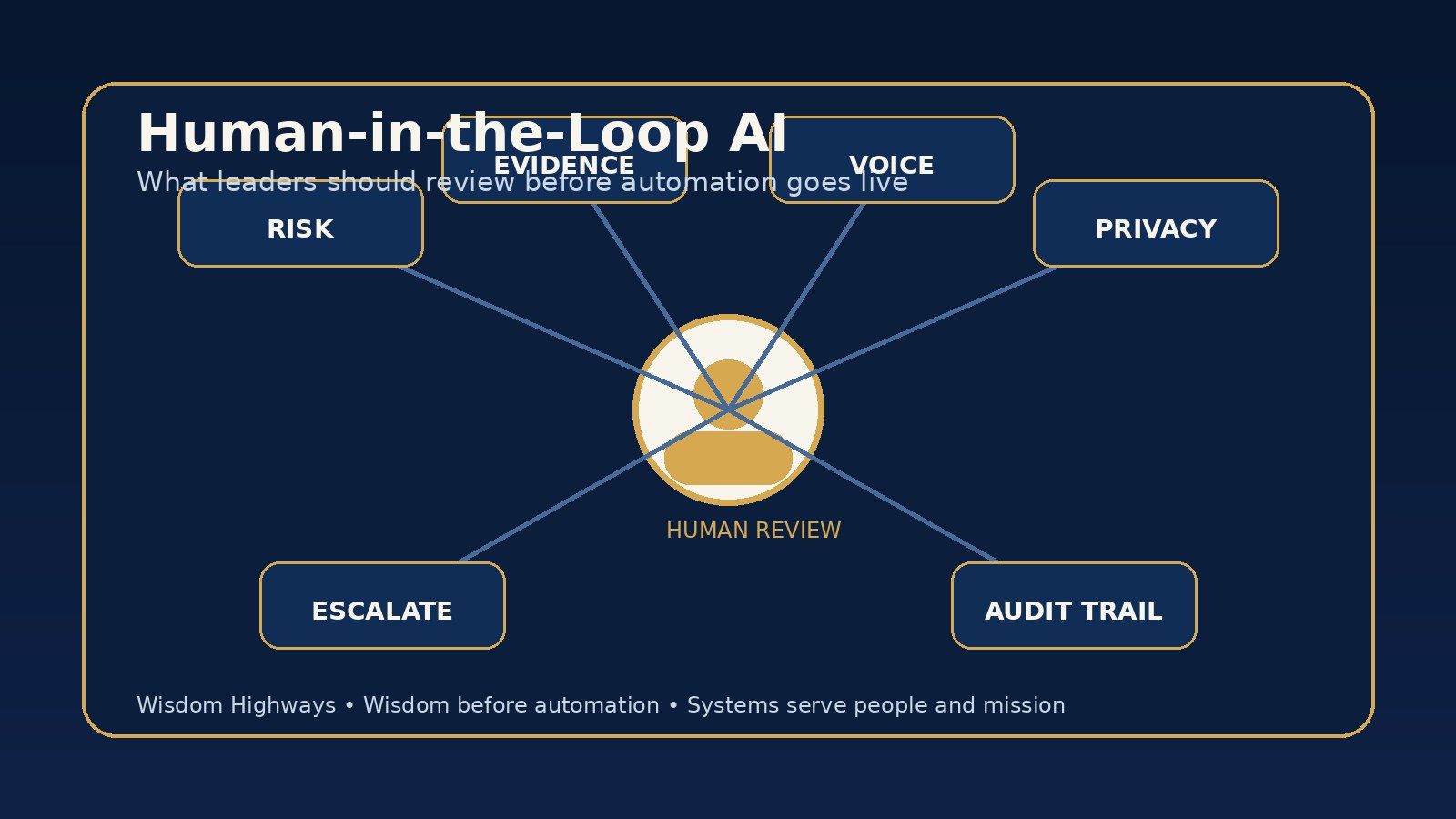
AI can draft, summarize, route and recommend. But it should not quietly become the final authority in work that affects people, trust, money, care or reputation.
Many pastors, nonprofit leaders and small-business owners are now asking a practical question: “Where should a human stay in the loop?” The answer is not simply “everywhere,” because that would remove the efficiency AI can bring. It is also not “nowhere,” because full automation without human accountability can create serious mistakes faster than a manual process ever could.
The wiser question is: Which decisions need human review before AI-assisted work goes live? This article gives Wisdom Highways’ practical review framework for leaders who want to use AI responsibly without slowing every process to a halt.
What does human-in-the-loop AI mean?
Human-in-the-loop AI means a person remains responsible for reviewing, approving, correcting or overriding AI-assisted output at important points in a workflow. The AI may help prepare the work, but a named human still owns the judgment.
For a church, that may mean AI drafts a first-time visitor follow-up email, but a ministry leader checks the tone before it is sent. For a nonprofit, AI may summarize program notes, but a staff member verifies sensitive claims before a funder report is submitted. For a business, AI may categorize support requests, but a person reviews complaints, refunds, legal language or high-value customer issues.
The point is not mistrust of technology. The point is faithful stewardship. Systems can serve mission; they should not silently replace discernment.
Why leaders need this now
Global AI guidance is converging around the same principle: organizations need transparency, accountability, risk management and human oversight. NIST’s AI Risk Management Framework emphasizes governing, mapping, measuring and managing AI risks. The OECD AI Principles call for human-centered values, transparency, robustness and accountability. UNESCO’s Recommendation on the Ethics of AI also stresses human oversight and protection of human rights.
At the workplace level, reports from Microsoft WorkLab, Asana and other productivity research groups continue to show that AI adoption is no longer theoretical. Teams are experimenting rapidly, often before governance is mature. That creates an opportunity for small organizations and ministries: they do not need bureaucracy, but they do need simple review rules before AI becomes embedded in everyday operations.
The Wisdom Highways R.E.V.I.E.W. framework
Use this six-part framework before allowing an AI-supported workflow to operate with minimal supervision.
R — Risk: What could go wrong if the output is wrong?
Start with impact, not excitement. If an AI mistake would merely require a quick edit, the risk may be low. If it could damage trust, expose private information, mislead a donor, offend a church member, create legal confusion or harm a vulnerable person, the risk is higher.
High-risk work needs stronger human review, clearer records and slower rollout. Examples include pastoral-care notes, donor records, finance approvals, safeguarding communication, employee decisions, theological statements, medical/legal/financial advice and public crisis responses.
E — Evidence: Can the claim be verified?
AI can sound confident even when it is incomplete or wrong. Before publishing, sending or acting on AI output, ask: “What source proves this?”
This matters for sermons and teaching notes, grant reports, proposals, case studies, client promises, market statistics, compliance language and public social posts. If the claim cannot be verified, either remove it, soften the wording or send it to a human expert for review.
V — Voice: Does this sound like us?
Organizations do not only communicate facts; they communicate identity. A church has a pastoral tone. A nonprofit has a trust relationship with donors and beneficiaries. A business has a brand promise and customer expectation.
AI can produce a technically correct message that still feels cold, exaggerated or off-brand. Human review should protect voice, empathy, cultural context and spiritual sensitivity. The goal is not just accurate content. It is communication that represents the organization with wisdom.
I — Identity and privacy: Whose data is involved?
If a workflow uses names, contact details, giving history, prayer requests, health details, children’s information, staff records, payment data or confidential client notes, human review and data boundaries become essential.
Leaders should know what data enters the AI tool, where it is stored, who can access it and whether the tool is appropriate for that kind of information. If those answers are unclear, do not automate the workflow yet.
E — Escalation: When must AI stop and hand over?
A wise system knows when not to continue. Define escalation triggers in advance. For example:
- a pastoral message mentions crisis, grief, abuse, self-harm or family breakdown;
- a customer is angry, threatening legal action or requesting a refund outside policy;
- a donor communication involves a sensitive story or major gift;
- a volunteer issue involves safeguarding, children or vulnerable people;
- a financial workflow exceeds an approved amount;
- a public message could affect reputation.
These triggers should route to a person, not an automated sequence.
W — Witness: Is there an audit trail?
Good automation should leave a trace: what happened, when it happened, what the AI produced, who approved it and what was sent or changed. This does not need to be complicated, but it does need to be visible.
For small teams, a simple log, CRM note, approval checkbox or shared workflow history may be enough. Without an audit trail, leaders cannot learn from mistakes or prove responsible oversight.
A practical human-review matrix
| Workflow type | AI may help with | Human must review before |
|---|---|---|
| Church visitor follow-up | Drafting, reminders, tagging | Sensitive pastoral responses or care escalations |
| Nonprofit donor updates | Summaries, first drafts, segmentation | Impact claims, beneficiary stories, major-donor communication |
| Small-business support | FAQ drafts, routing, status summaries | Refund disputes, legal language, angry customers |
| Finance/admin | Data extraction, alerts, report preparation | Approvals, payments, compliance statements |
| Content and teaching | Outlines, repurposing, editing support | Theology, statistics, promises, public claims |
Ministry example: AI-assisted care communication
A church office might use AI to help organize prayer requests, draft non-sensitive follow-up messages and remind ministry leaders when someone needs a call. That can save administrative time and reduce missed follow-up.
But the system should not automatically send advice to someone in crisis, summarize confidential counseling without permission or replace pastoral discernment. The review rule could be simple: AI may prepare; a trained human reviews anything relationally sensitive before it leaves the team.
Business example: AI-assisted customer response
A small business may use AI to draft replies to common enquiries, categorize support requests and prepare weekly customer-issue summaries. This can improve response speed and consistency.
But complaints, refunds, legal threats, safety concerns and high-value clients should escalate to a person. Speed is useful, but trust is more valuable than an instant wrong answer.
Nonprofit example: AI-assisted reporting
A nonprofit can use AI to turn program notes into draft report sections, summarize survey feedback and organize outcomes by funder priority. This is often a strong use case because reporting consumes repeated administrative time.
However, funder-facing claims must be verified against real data. Beneficiary stories need consent and dignity. AI should never invent impact. Human review protects both accuracy and the people represented in the report.
How to decide the level of review
Not every AI workflow needs the same level of control. Use this simple scale:
- Low review: internal summaries, non-sensitive reminders, formatting, duplicate detection and draft outlines.
- Moderate review: public content drafts, customer responses, donor updates, meeting notes and workflow recommendations.
- High review: anything involving vulnerable people, confidential data, theology, finance, employment, legal implications, safeguarding, reputation or irreversible decisions.
If a workflow is high-impact and hard to verify, keep a human firmly in the loop. If it is low-risk, repeatable and easy to check, automation can safely do more.
Seven questions before automation goes live
- Who is the human owner of this workflow?
- What output may AI create without approval?
- What output must be reviewed before sending, publishing or acting?
- What data is the AI allowed to access?
- What escalation triggers send the work to a person immediately?
- Where will approvals, edits and sent outputs be recorded?
- How will we measure whether this workflow saves time without weakening trust?
The Wisdom Highways perspective
Wisdom Highways believes automation should reclaim time for mission, not remove responsibility from leadership. The future does not belong only to organizations with the most tools. It belongs to organizations that combine useful technology with clear judgment, human care and accountable systems.
Human-in-the-loop design is not a technical luxury. It is a leadership discipline. It allows pastors, founders, teams and SMEs to gain speed without surrendering wisdom.
Next step: assess your readiness
If your organization is beginning to use AI, do not ask only, “Which tool should we buy?” Ask, “Where must human judgment remain visible?”
Take the AI & Systems Readiness Assessment to identify where your organization can safely automate, where human review is essential and where your systems need strengthening before AI scales.
Related Wisdom Highways insights
- AI Governance Checklist for Churches and Small Businesses
- AI Implementation Mistakes Leaders Should Avoid Before They Scale
- How Purpose-Driven Organizations Can Use AI Without Losing Their Human Touch
- What Should You Automate First? A Decision Matrix for Leaders
Sources and further reading
- NIST AI Risk Management Framework
- OECD AI Principles
- UNESCO Recommendation on the Ethics of Artificial Intelligence
- Microsoft Work Trend Index / WorkLab
- Asana Anatomy of Work / workplace productivity research
- Stanford HAI AI Index Report
Freshness note: prepared September 2026. Review governance, privacy and AI-policy references regularly because AI regulation, workplace practice and platform capabilities continue to change.