
AI Acceptance Criteria: Define What Good Looks Like Before Your Team Automates
Freshness note: Prepared for publication on 2 October 2026. Review these criteria whenever your AI tools, policies, risk level, ministry context or business workflow changes.
Many AI projects fail quietly before they fail publicly. The tool works. The demo looks good. The first output feels impressive. But nobody has clearly defined what “good enough to use” means. That is why leaders need AI acceptance criteria before they automate important work safely.
Acceptance criteria are not red tape. They are a wisdom-led agreement about what must be true before an AI-assisted output, workflow or tool is trusted. For a pastor, that may include theological care, confidentiality and human review. For a nonprofit leader, it may include donor trust, evidence, equity and stewardship. For an SME owner, it may include customer accuracy, brand tone, privacy, security and measurable time reclaimed.
At Wisdom Highways, our position is simple: wisdom before automation. AI should serve people, mission and trustworthy systems, not merely create faster activity.
What are AI acceptance criteria?
AI acceptance criteria are the clear standards an AI output or workflow must meet before it is approved for use. They answer questions such as: How accurate must this be? Who reviews it? What data is allowed? Which mistakes are unacceptable? What happens when the AI is uncertain? When must a human intervene?
This is different from asking whether an AI tool is interesting. It is also different from asking whether one prompt produced a useful draft. Acceptance criteria define the line between experimentation and operational trust.
The NIST AI Risk Management Framework encourages organizations to map, measure and manage AI risk. The OECD AI Principles emphasize human-centred, transparent, robust and accountable AI. In leadership language: define the standard before speed becomes habit.
Why acceptance criteria matter before automation
Without acceptance criteria, every reviewer uses a different invisible standard. One person cares about grammar. Another cares about accuracy. Another notices privacy. Another assumes the tool is safe because it sounds confident. The team may move fast, but risk is scattered across personal judgment.
Clear criteria help leaders protect trust while still reclaiming time. They make review faster because people know what to check. They also reduce conflict because the question becomes, “Did this meet the standard?” rather than, “Do I personally like this output?”
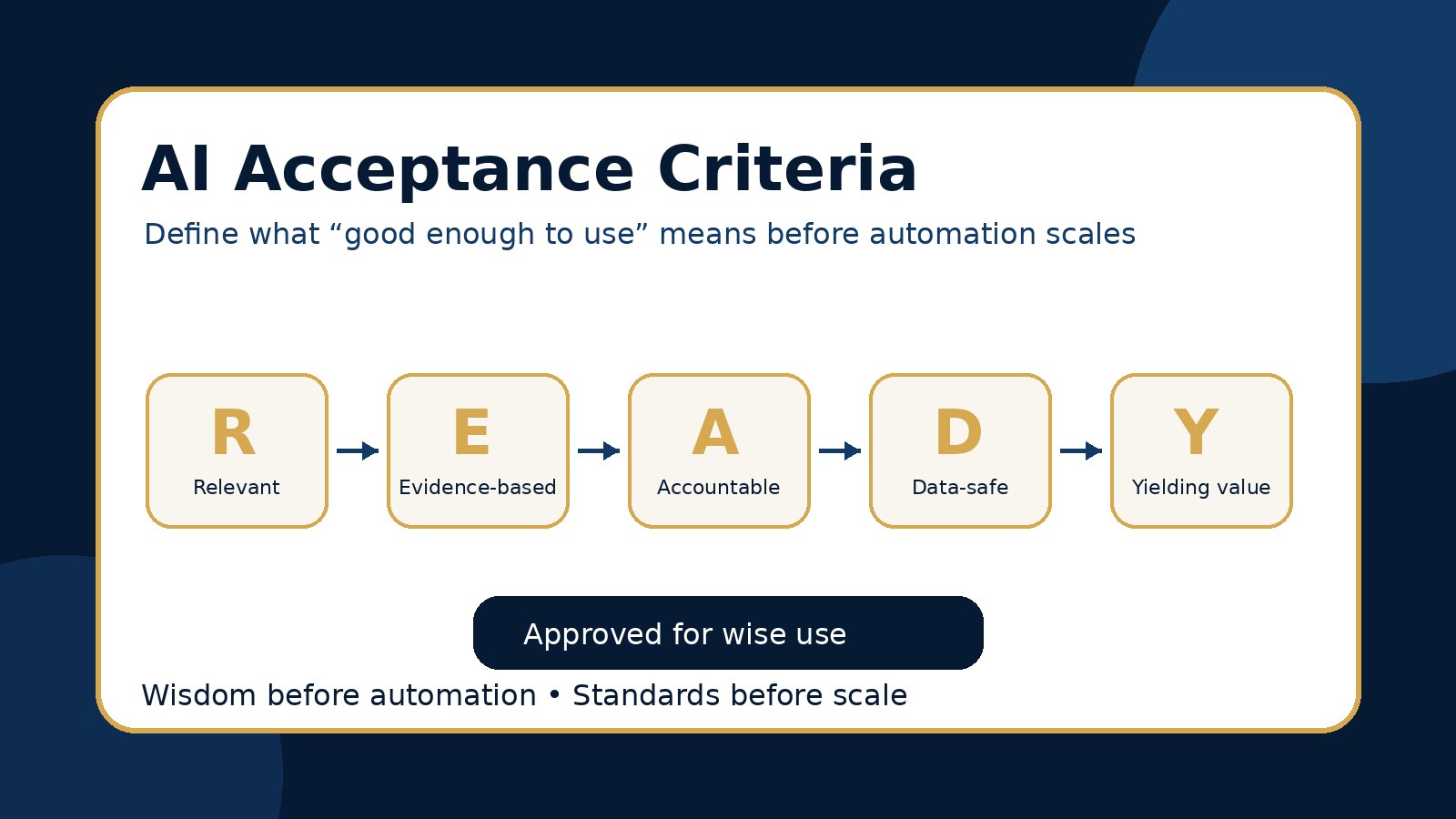
The Wisdom Highways READY standard
Use READY as a practical leadership framework: Relevant, Evidence-based, Accountable, Data-safe and Yielding value.
1. Relevant: does the output fit the real context?
AI often gives a polished answer to an incomplete prompt. Before accepting the result, check whether it fits the audience, geography, ministry or business context, tone, policy, channel and decision being made. A sermon research note, donor email, customer reply and executive briefing may each need a different standard.
2. Evidence-based: are important claims verified?
If an AI output includes a statistic, quote, regulation, technical claim, theological statement, customer promise, medical/legal/financial suggestion or summary of a document, the standard should require verification. The Google people-first content guidance also reinforces a public-content principle: helpful content should serve the reader with trustworthy substance, not just fill a page.
3. Accountable: who owns approval and correction?
Every accepted AI output needs a human owner. Who approves it? Who can stop it? Who updates it? Who answers if someone challenges the result? This connects directly to your human-in-the-loop AI practice and your AI escalation policy.
4. Data-safe: did the process protect sensitive information?
Acceptance criteria should state what data may be used, what must be removed, and what can never be pasted into a tool. The OWASP Top 10 for Large Language Model Applications highlights risks such as sensitive information disclosure and overreliance. For churches, nonprofits and SMEs, that may include member stories, pastoral care details, donor information, HR issues, contracts, customer records or private strategy documents.
5. Yielding value: does this improve the work without weakening trust?
AI adoption should not be measured only by volume. A workflow may produce more drafts while creating more correction, confusion or reputational risk. Acceptance criteria should include value: time reclaimed, quality improved, faster response, better documentation, reduced repetitive work or clearer service. Connect accepted use cases to your AI Benefits Realization Register.
A practical AI acceptance criteria template
| Area | Acceptance question | Minimum standard before use |
|---|---|---|
| Use case | What job is AI helping with? | The workflow is specific, named and appropriate for AI assistance. |
| Risk level | What harm could occur if this is wrong? | The review depth matches the effect on people, money, trust and reputation. |
| Accuracy | Which claims must be checked? | Important claims are verified against reliable sources or internal records. |
| Data boundary | What information may the tool receive? | No restricted or unnecessary sensitive data is exposed. |
| Human review | Who approves the final result? | A named person or role owns approval, correction and escalation. |
| Tone and values | Does this sound like us and serve people well? | The output reflects Wisdom, dignity, clarity, care and mission fit. |
| Evidence trail | Can we explain why this was accepted? | Sources, assumptions and decisions are recorded when impact is meaningful. |
| Value | What improvement are we expecting? | The team defines a measurable benefit, not only a faster process. |
Ministry example: accepting an AI-assisted discipleship email
A ministry team uses AI to draft a follow-up email for new believers. The draft is warm, but acceptance criteria should still ask: Is the theology sound? Is the tone pastoral rather than mechanical? Has any private testimony or counseling detail been exposed? Does a human leader approve it before sending? Does it invite real community rather than replacing care with automation?
The goal is not to reject helpful tools. The goal is to preserve shepherding, doctrine, dignity and trust while reducing repetitive drafting work.
Business example: accepting an AI sales-support workflow
An SME uses AI to draft replies to common customer enquiries. Acceptance criteria may require that product details match the current offer, refund language follows policy, regional claims are cautious, pricing is not invented, and complaints are routed to a person. A fast answer that creates an unsupported promise is not acceptable, even if it sounds professional.
Common mistakes leaders should avoid
- Approving the demo instead of the workflow. A good sample output does not prove operational reliability.
- Using vague standards. “Looks good” is not acceptance criteria.
- Reviewing only the final text. Leaders must also review data input, tool access, escalation, ownership and measurement.
- Skipping high-risk edge cases. Test the unusual, sensitive and emotionally charged scenarios before scale.
- Confusing automation with maturity. More AI activity is not the same as stronger systems.
What good acceptance criteria change inside a team
Good acceptance criteria turn AI from a personal productivity experiment into a responsible system. They help team members know when to use AI, when to slow down, when to ask for human review and when a workflow should not be automated yet. They also make onboarding easier because new staff and volunteers can see the standard instead of guessing from scattered examples.
For leaders, this creates a healthier rhythm. The team can still move quickly, but speed is guided by shared judgment. Public content can be checked against the AI Evaluation Checklist. Sensitive workflows can be reviewed alongside the AI Risk Register Template. Ongoing use can be monitored through an AI Governance Review Cadence. This is how acceptance criteria become a living operating discipline rather than a document that nobody uses.
How to introduce acceptance criteria without slowing the team
Start with one repeated workflow. Do not create a 40-page policy for every small experiment. Choose a practical use case such as social captions, customer replies, meeting summaries, donor updates, research briefs or internal SOP drafts. Define the READY standard, test it on several examples, improve the criteria, and then decide whether the workflow can move from pilot to approved use.
The UK Government Generative AI Framework and the NIST Generative AI Profile both support the same broad principle: AI use needs assurance, oversight and fit-for-purpose review, especially when risk grows.
Final thought: define the standard before the system scales
AI can help leaders reclaim hours, respond faster and reduce repetitive work. But if your team has not defined what acceptable output looks like, automation will multiply both strengths and weaknesses. Wise leaders do not wait for a visible failure before creating standards. They define acceptance before scale.
If your organization is using AI but has not yet defined readiness, risk boundaries, review gates or success standards, start with the next step below.
Related Wisdom Highways resources
- AI Evaluation Checklist
- AI Risk Register Template
- AI Governance Review Cadence
- AI Output Review Checklist
Keep learning with Wisdom Highways. Follow our WhatsApp Channel for practical AI tips, time-saving ideas, product updates and selected offers.
Follow WH Premium AI Vault on WhatsApp