
AI Readiness & Responsible Implementation
AI Post-Implementation Review: What Leaders Should Check 30 Days After Launch
The real test of an AI project is not the launch announcement. It is what leaders discover after real people use the tool in real work for a few weeks. A 30-day AI post-implementation review helps you see whether automation is reclaiming time, protecting trust and serving the mission — or quietly creating new risk.
Updated September 2026. This article is educational and operational, not legal, privacy, cybersecurity, employment or financial advice. Adapt the checklist for your country, sector, staff policies and professional obligations.
Why the 30-day review matters
Many AI and automation projects fail quietly. The workflow technically goes live, the team receives a short training, and leadership moves to the next priority. A month later, the organization may not know whether the system is saving time, improving quality, confusing staff, introducing privacy risk, weakening pastoral care, or simply moving work from one person to another.
A 30-day AI post-implementation review prevents that drift. It gives leaders a structured moment to ask: Did this launch make the work better? Did it protect people? Did it match our values? Are there warning signs we need to correct before scaling?
Wisdom Highways teaches wisdom before automation. Launch is only the beginning. The wise leader measures the fruit of the system before multiplying it.
Search intent: what leaders are trying to solve
Someone searching for an AI post-implementation review is usually past the idea stage. They have piloted or launched a tool and now need a practical way to evaluate results. They may be asking what metrics to track, who should be interviewed, how to handle complaints, how to document lessons and whether the workflow is ready to scale.
This guide is written for pastors, ministry administrators, nonprofit executives, SME owners and operations leaders who need a people-first review process that is serious enough for governance but simple enough for a busy team.
The WH 30-day review frame: time, quality, trust, risk, adoption and mission fit
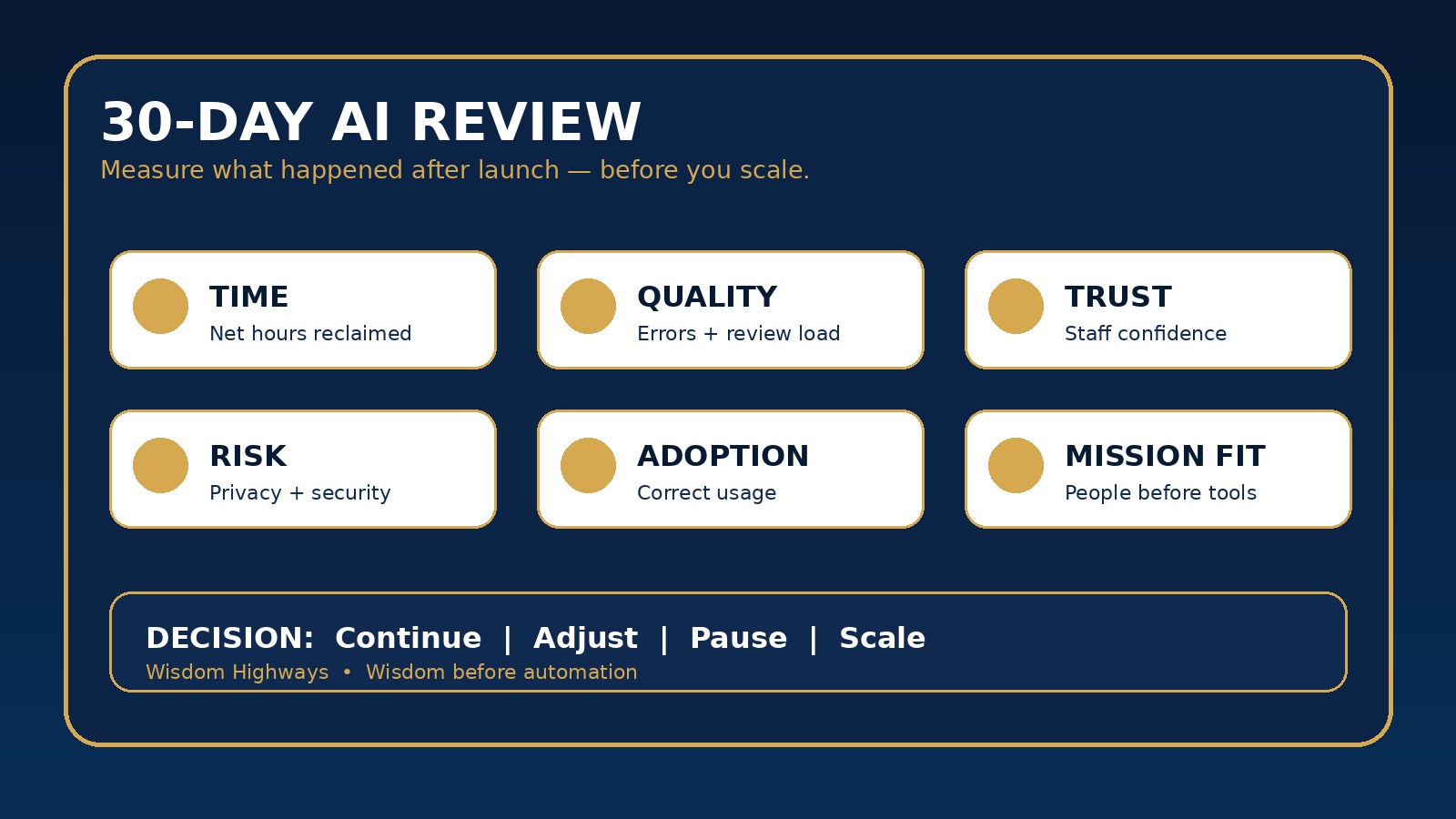
Do not reduce AI success to speed alone. A workflow can be faster and still damage trust, produce unreliable outputs, burden staff with hidden cleanup, or expose sensitive information. Review six dimensions together.
| Review area | Question | Evidence to inspect |
|---|---|---|
| Time | Is the workflow reclaiming meaningful hours? | Before-and-after task timing, handoff delays, repeat work and staff feedback. |
| Quality | Are outputs better, equal or worse? | Error rates, edits required, stakeholder complaints, review notes and sample outputs. |
| Trust | Do people understand and trust the new process? | Staff interviews, user questions, volunteer confidence and leader observations. |
| Risk | Has the launch introduced privacy, security, doctrinal, reputational or operational risk? | Usage logs, incident reports, vendor changes, permissions and sensitive-data handling. |
| Adoption | Are people using it correctly and consistently? | Tool logs, skipped steps, training gaps, exceptions and workarounds. |
| Mission fit | Is the system serving the people and purpose it was meant to serve? | Leadership judgement, pastoral/business outcomes, service quality and values alignment. |
Step 1: compare the promise with the reality
Start with the original reason for the AI project. Was the goal to reduce administrative load, speed up client response, improve content drafting, summarize meetings, route support requests, organize knowledge, or strengthen reporting? Write the promised outcome in plain language, then compare it with observed reality.
For example, a church may have launched AI-assisted weekly announcement drafting to save the communications team time. The 30-day review should not simply ask whether the tool generated words. It should ask whether the announcement process became faster, whether theological and pastoral tone remained strong, whether staff still had to rewrite everything, and whether private member information stayed out of prompts.
A small business may have launched an AI customer-support helper. The review should examine response speed, accuracy, escalation quality, customer trust and whether staff now spend more time correcting confident but wrong drafts.
Step 2: listen to the people doing the work
Dashboards are useful, but they rarely tell the whole story. Ask the people who use the workflow what changed. Keep the questions direct and safe.
- What task is easier than before?
- What task became more confusing?
- Where do you still need human judgement?
- What errors or near misses have you noticed?
- Which step feels unnecessary, risky or unclear?
- What training would make this safer and more useful?
For ministries and nonprofits, include the people closest to service delivery, not only managers. For SMEs, include frontline staff who know customer friction. Leaders often see the polished workflow; staff see the hidden workarounds.
Step 3: inspect the governance trail
The review should connect to your AI usage log, risk register, vendor review, output review checklist and governance cadence. Look for patterns rather than isolated stories.
- Were only approved tools used?
- Were restricted or never-paste data categories protected?
- Were AI outputs reviewed before being sent, published or used in decisions?
- Were incidents, exceptions and overrides recorded?
- Did permissions match the actual roles that needed access?
- Did the vendor change terms, data settings, model behaviour or integrations after launch?
If the governance trail is empty, do not assume everything is safe. It may mean the team never learned what to record.
Step 4: calculate time reclaimed without exaggeration
Time reclamation is central to Wisdom Highways, but it must be measured honestly. Count net time, not imagined time. If an AI tool saves two hours of drafting but creates ninety minutes of correction, the real gain is thirty minutes. If automation speeds reporting but creates weekly troubleshooting, include that cost.
Use a simple review table: task, old time, new time, review/correction time, training/support time, net time reclaimed, and confidence level. Label uncertain estimates as estimates. Do not build public claims or internal decisions on inflated numbers.
The goal is not to prove that AI worked. The goal is to learn where it genuinely helps and where the system still needs wisdom, training or redesign.
Step 5: decide whether to continue, adjust, pause or scale
At the end of the 30-day review, make a clear decision. Avoid vague conclusions such as “looks good” or “needs monitoring.” Use four possible outcomes.
| Decision | When to choose it | Next action |
|---|---|---|
| Continue | The workflow is useful, safe and stable at current scope. | Keep using it and schedule the next governance review. |
| Adjust | The value is real, but training, prompts, permissions or review steps need improvement. | Fix the gaps before expanding usage. |
| Pause | Risk, confusion, quality issues or sensitive-data concerns are significant. | Stop or limit use while leaders investigate and correct the system. |
| Scale | The workflow is delivering value, people trust it and governance is mature enough. | Expand intentionally with training, measurement and accountability. |
Ministry, nonprofit and SME examples
Church or ministry: A church uses AI to create first-draft volunteer scheduling messages. The review finds real time savings, but volunteers are confused by overly formal language. The decision is adjust: keep the workflow, add a tone checklist and require a ministry leader to review messages before sending.
Nonprofit: A nonprofit uses AI to summarize grant research. The review finds useful summaries but inconsistent source checking. The decision is continue with controls: staff may use summaries for scanning, but final grant recommendations must include verified original sources.
SME: A small business uses AI to draft customer replies. The review finds faster response times but three near misses where the draft promised something the company could not deliver. The decision is pause for high-risk categories and adjust training before expanding.
Common mistakes in post-launch AI reviews
- Reviewing only tool usage and not outcomes.
- Counting gross time saved while ignoring correction time.
- Listening only to the project champion.
- Scaling before privacy, security, access and output-review gaps are fixed.
- Treating staff resistance as a people problem when the workflow may be poorly designed.
- Failing to document lessons while the experience is still fresh.
- Assuming that no incident report means no risk exists.
30-day AI post-implementation review checklist
- Restate the original goal in one sentence.
- Collect before-and-after evidence for time, quality and workload.
- Review usage-log entries, incidents, exceptions and output-review notes.
- Interview users, reviewers and affected stakeholders.
- Check whether sensitive information was protected.
- Inspect permissions, vendor settings and integrations.
- Identify training gaps, prompt gaps and policy gaps.
- Calculate net time reclaimed honestly.
- Decide: continue, adjust, pause or scale.
- Assign owners, deadlines and the next review date.
Evidence and governance anchors
The sources below support a lifecycle, human-centred and risk-aware approach to AI after launch. They are governance references, not substitutes for local professional advice.
- NIST AI Risk Management Framework — supports a lifecycle approach to governing, mapping, measuring and managing AI risk.
- NIST AI RMF Playbook — adds practical AI risk-management actions and prompts that should be revisited after launch.
- OECD AI Principles — anchors human-centred, transparent, robust and accountable AI adoption.
- UK ICO AI and data protection guidance — supports ongoing accountability and data-protection review when AI processes personal data.
- NIST Cybersecurity Framework — supports review of identify, protect, detect, respond and recover controls around technology use.
- CISA Secure by Design — reinforces reducing technology risk by design rather than shifting all risk to frontline users.
Related Wisdom Highways resources
Do not scale what you have not reviewed
The safest way to grow with AI is not to move slowly forever. It is to learn quickly and honestly. Review the system after real use. Protect people. Measure net value. Correct gaps. Then scale what is actually wise.
Keep learning with Wisdom Highways. Follow our WhatsApp Channel for practical AI tips, time-saving ideas, product updates and selected offers.
Follow WH Premium AI Vault on WhatsApp