
AI Readiness & Measurement
AI Automation Measurement Plan: Track Time, Quality and Trust After Launch
Launching AI is not the finish line. After the tool goes live, leaders still need to know whether it is reclaiming time, improving quality, protecting trust and serving the mission without creating hidden risk.
Updated September 2026. This guide is educational and operational; adapt it with HR, legal, privacy, pastoral, board, security and regional advisers where required.
After launch, measure what wisdom cares about
Many organizations measure AI too narrowly. They count logins, prompts, documents generated or tasks automated. Those numbers may be useful, but they do not prove that the organization is healthier. A team can use AI every day and still lose trust, create rework, expose sensitive information, confuse approvals or weaken human judgment.
Wisdom Highways teaches wisdom before automation: systems serve mission and people. That means an AI automation measurement plan should track more than speed. It should measure whether time is being reclaimed for the right work, whether outputs are getting better, whether people understand the new workflow, whether risks are visible and whether the mission is being served.
This matters for pastors, nonprofits, SMEs and purpose-driven organizations because they often run lean teams. If AI saves administrative time but creates review chaos, the gain is not real. If a chatbot answers faster but damages care, the organization has automated against its values. Measurement protects leaders from believing the demo after the real work begins.
What an AI automation measurement plan should answer
A measurement plan is a simple operating rhythm for checking whether an AI-assisted workflow is still useful, safe and mission-aligned. It should answer eight leadership questions:
- What workflow did we automate or augment?
- What did we expect to improve?
- How much time is actually being reclaimed?
- Is quality improving, declining or becoming inconsistent?
- Are humans reviewing the right outputs and decisions?
- Are staff, volunteers or customers more confident or more confused?
- What risks, exceptions, complaints or near misses have appeared?
- Should we continue, adjust, restrict, expand or stop?
The plan does not need to be complicated. A one-page scorecard reviewed weekly during a pilot and monthly after stabilization is better than a beautiful dashboard no one uses.
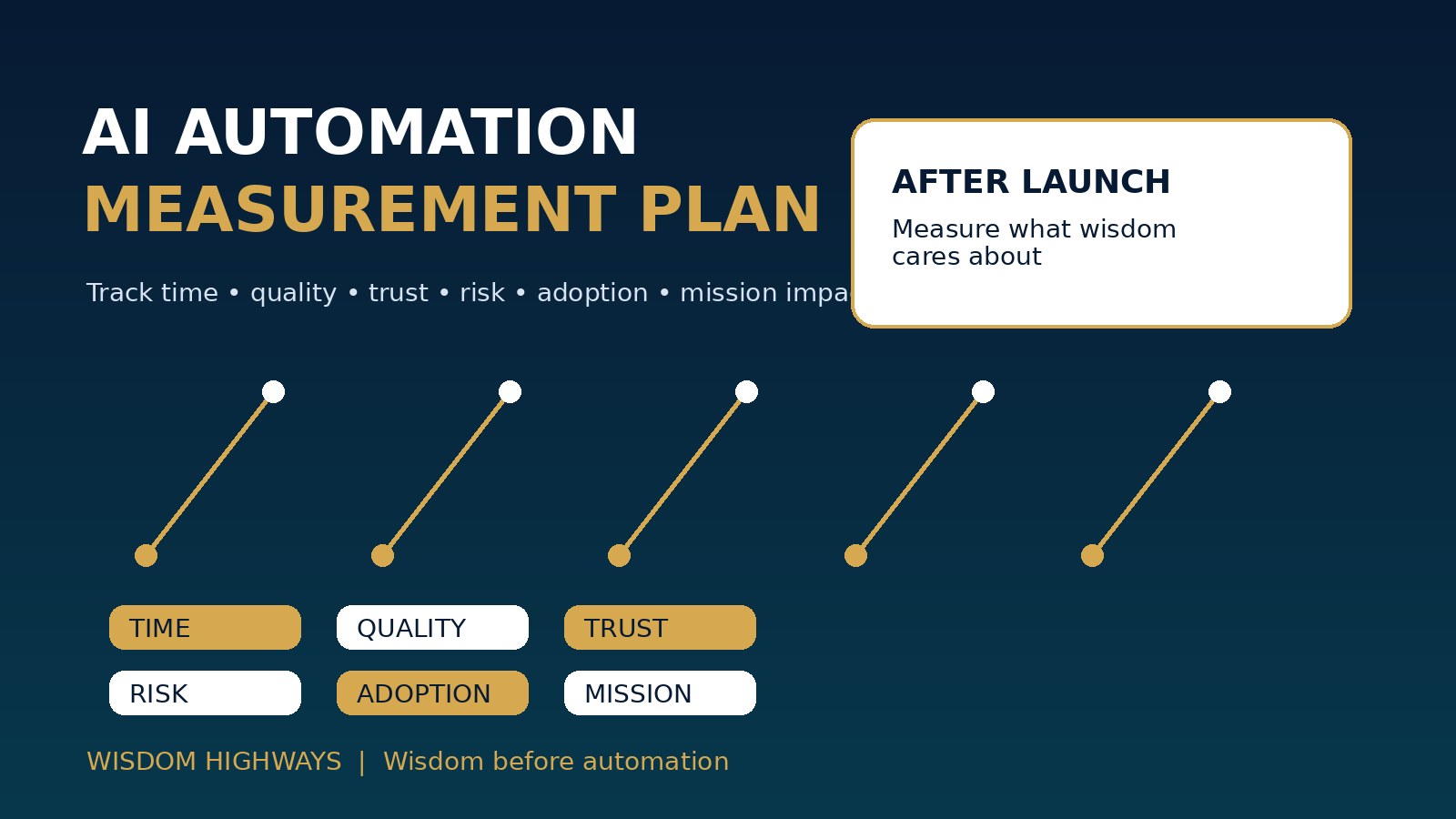
The Wisdom Highways six-part measurement model
1. Time reclaimed: did the right people get time back?
Track time saved, but do not stop there. Ask whose time was reclaimed and where it went. If AI saves an administrator three hours but creates four hours of leadership review, the workflow may need redesign. If it saves a pastor administrative time and gives more space for people, prayer, preparation and leadership, the value is clearer.
Measure before and after: task duration, waiting time, revision time, handoff delays and number of manual steps removed. Then ask whether the reclaimed time is being reinvested into mission-critical work.
2. Quality: are outputs becoming more useful?
Quality can include accuracy, tone, completeness, brand fit, pastoral sensitivity, customer clarity, compliance with policy and usefulness to the next person in the workflow. Create a short review checklist so the team is not relying on feelings alone.
For content, check facts, claims, tone and source alignment. For operations, check completeness, correct fields, clear next actions and fewer preventable errors. For ministry use, check pastoral warmth, confidentiality boundaries and theological sensitivity where relevant.
3. Trust: are people more confident in the system?
Trust is not soft. It determines whether people adopt the workflow honestly or create workarounds. Ask staff whether they understand when to use AI, when not to use it, who reviews outputs and where to report concerns. Ask clients, members or customers indirectly through feedback, complaints, confusion signals and response quality.
If trust declines, pause and listen. The issue may be unclear communication, weak training, fear of replacement, poor output quality or a workflow that hides responsibility.
4. Risk and exceptions: what is going wrong or nearly going wrong?
Every AI-assisted workflow should have a lightweight exception log. Record sensitive-data mistakes, wrong outputs caught during review, unclear ownership, biased or inappropriate suggestions, policy violations, complaints, security concerns and cases where a human overrode the AI output.
NIST’s AI Risk Management Framework is useful here because it points leaders toward ongoing governance and measurement. Risk is not solved by launch approval. It must be watched as real people use real systems.
5. Adoption: are people using the workflow correctly?
Healthy adoption is not the same as high usage. A team may use a tool often but ignore the review step. Another team may use it less often but with stronger discipline and better outcomes. Measure trained users, correct workflow use, review completion, escalation behavior and whether people are asking better questions over time.
6. Mission impact: did automation serve the purpose?
Return to the original reason for automation. Did the church follow up better? Did the nonprofit produce clearer reports? Did the SME respond faster without lowering quality? Did leaders gain visibility? Did people experience better service? Mission impact keeps measurement from becoming a technical exercise.
For pastors and ministry leaders: measure service, not just speed
A church might use AI to draft event descriptions, organize service-planning notes, summarize public teaching resources or prepare volunteer communications. The measurement plan should ask whether these uses free people for care and leadership without making communication feel cold or careless.
Useful ministry measures include fewer missed follow-ups, faster preparation of public communications, clearer volunteer instructions, less administrative overload, stronger human review of sensitive language and no use of general AI tools for confidential pastoral matters unless a protected and approved system exists.
The pastoral question is simple: did technology help us serve people more faithfully, or did it merely make us faster?
For SMEs and nonprofits: measure operating health
A small business or nonprofit might use AI for onboarding checklists, proposal drafts, customer-support replies, donor-report outlines, meeting-action summaries or SOP updates. Measure whether the workflow reduces bottlenecks and improves consistency without hiding mistakes.
Useful business and nonprofit measures include cycle time, revision count, customer or beneficiary clarity, staff confidence, number of escalations, errors caught before delivery, manual steps removed, support tickets, handoff quality and leadership visibility.
If AI makes one task faster but creates unclear records, inconsistent commitments or extra rework downstream, the measurement plan should expose that quickly.
A simple AI automation scorecard
| Measure | Question | Evidence to review |
|---|---|---|
| Time reclaimed | Are we saving meaningful time in the right part of the workflow? | Before/after task time, waiting time, manual steps removed |
| Quality | Are outputs accurate, useful and aligned with voice, policy and context? | Review checklist, error count, revision notes |
| Trust | Do people understand and trust the new workflow? | Staff feedback, concerns, complaints, confidence signals |
| Risk | What mistakes, near misses or policy issues are appearing? | Exception log, audit trail, incident notes |
| Adoption | Are trained people using the workflow correctly? | Training completion, review completion, escalation behavior |
| Mission impact | Is the automation serving the original purpose? | Service outcomes, leadership visibility, stakeholder feedback |
Score each area from 1 to 5 during the pilot. Any score below 3 should trigger a practical fix before expansion.
Thirty-day measurement rhythm after launch
Days 1–7: watch closely
Review every output in the pilot workflow. Record time spent, errors caught, unclear instructions and staff questions. Do not scale yet.
Days 8–14: compare against the baseline
Compare task time, revision count, quality and handoff clarity against the pre-AI workflow. If the baseline was never measured, reconstruct it from recent examples and staff estimates, labeling the estimate clearly.
Days 15–21: listen for trust signals
Ask users what is easier, what is confusing and where they feel uncertain. Look for hidden workarounds or skipped review steps.
Days 22–30: decide with evidence
Use the scorecard to decide whether to continue, adjust, restrict, train again, expand or stop. A wise pause is better than scaling a broken workflow.
Common measurement mistakes
- Counting tool usage as success without checking quality or trust.
- Measuring time saved for one person while ignoring rework for another.
- Failing to record exceptions because no one wants to slow down.
- Expanding before staff understand the review process.
- Using AI for sensitive data without clear privacy and retention boundaries.
- Not connecting automation back to mission, customer value or ministry service.
Evidence and governance anchors
The sources below support the article’s cautious approach to ongoing AI measurement, governance, security, privacy and adoption. They should be treated as anchors for leadership judgment, not as a substitute for professional advice.
- NIST AI Risk Management Framework — its govern, map, measure and manage functions support ongoing measurement, not one-time approval.
- OECD AI Principles — human-centred, transparent, robust and accountable AI use should shape what leaders measure.
- CISA Secure by Design — technology should be designed and operated with safety and security responsibilities in view.
- UK ICO AI and data protection guidance — privacy, accountability and transparency duties should remain visible after deployment.
- Microsoft Work Trend Index — workplace AI adoption changes skills, leadership habits and work patterns that leaders should monitor.
- Prosci change management overview — reinforcement and adoption measurement help change become sustainable.
Related Wisdom Highways resources
Before your next AI expansion
Before expanding an AI workflow, make the measurement visible. Show what time was reclaimed, what quality improved, what trust signals appeared, what risks were caught and what mission outcome was served.
If you cannot show those things yet, the next step may not be more automation. It may be clearer governance, better training, a stronger review process or a simpler workflow.
Keep learning with Wisdom Highways. Follow our WhatsApp Channel for practical AI tips, time-saving ideas, product updates and selected offers.
Follow WH Premium AI Vault on WhatsApp