
AI Readiness & Leadership
AI Change Management Plan: Prepare Your Team Before Automation Changes the Work
Many AI projects fail quietly before the technology fails. The team was not prepared. Roles were unclear. Trust was thin. People heard “efficiency” and feared replacement. Leaders moved from excitement to implementation without guiding the human change underneath.
Updated September 2026. This guide is educational and operational; adapt it with HR, legal, privacy, pastoral, board and regional advisers where required.
AI adoption is a people-change issue before it is a tool issue
A church, nonprofit or small business can buy an AI tool in one afternoon. Changing the way people work takes longer. Staff may need to learn new habits, review AI outputs, protect sensitive data, redesign approvals, document processes, and decide which tasks should remain human-led.
This is why Wisdom Highways treats AI change management as part of AI readiness. The question is not only, “Can this tool automate the task?” The deeper question is, “Can our people, processes, governance and mission absorb this change wisely?”
Without a change plan, leaders risk turning useful AI into anxiety, confusion or shadow AI. With a clear plan, automation can reclaim time, reduce avoidable friction, strengthen service and free people for higher-value work.
Wisdom Highways’ distinctive lens is simple: wisdom before automation; systems serve mission and people. That means the adoption plan must honour trust, dignity, stewardship and clear accountability. AI should never become a shortcut around leadership. It should become a well-governed support system that helps leaders and teams do the right work with more clarity.
What an AI change management plan should cover
An AI change management plan is a practical roadmap for helping people move from current ways of working to wiser AI-assisted ways of working. It should explain why the change matters, what will and will not change, who owns decisions, how people will be trained, how risks will be handled and how success will be measured.
The plan should be simple enough for non-technical leaders and specific enough for implementation. A useful plan answers nine questions:
- What problem are we solving, and why does it matter now?
- Which tasks or workflows will AI support?
- Which decisions remain human-owned?
- What data, conversations or documents are off limits?
- Who is sponsoring, leading and supporting the change?
- How will staff, volunteers or team members be trained?
- How will concerns be heard and addressed?
- What signs will show adoption is healthy?
- When will we pause, adjust or stop?
The Wisdom Highways five-part AI change model
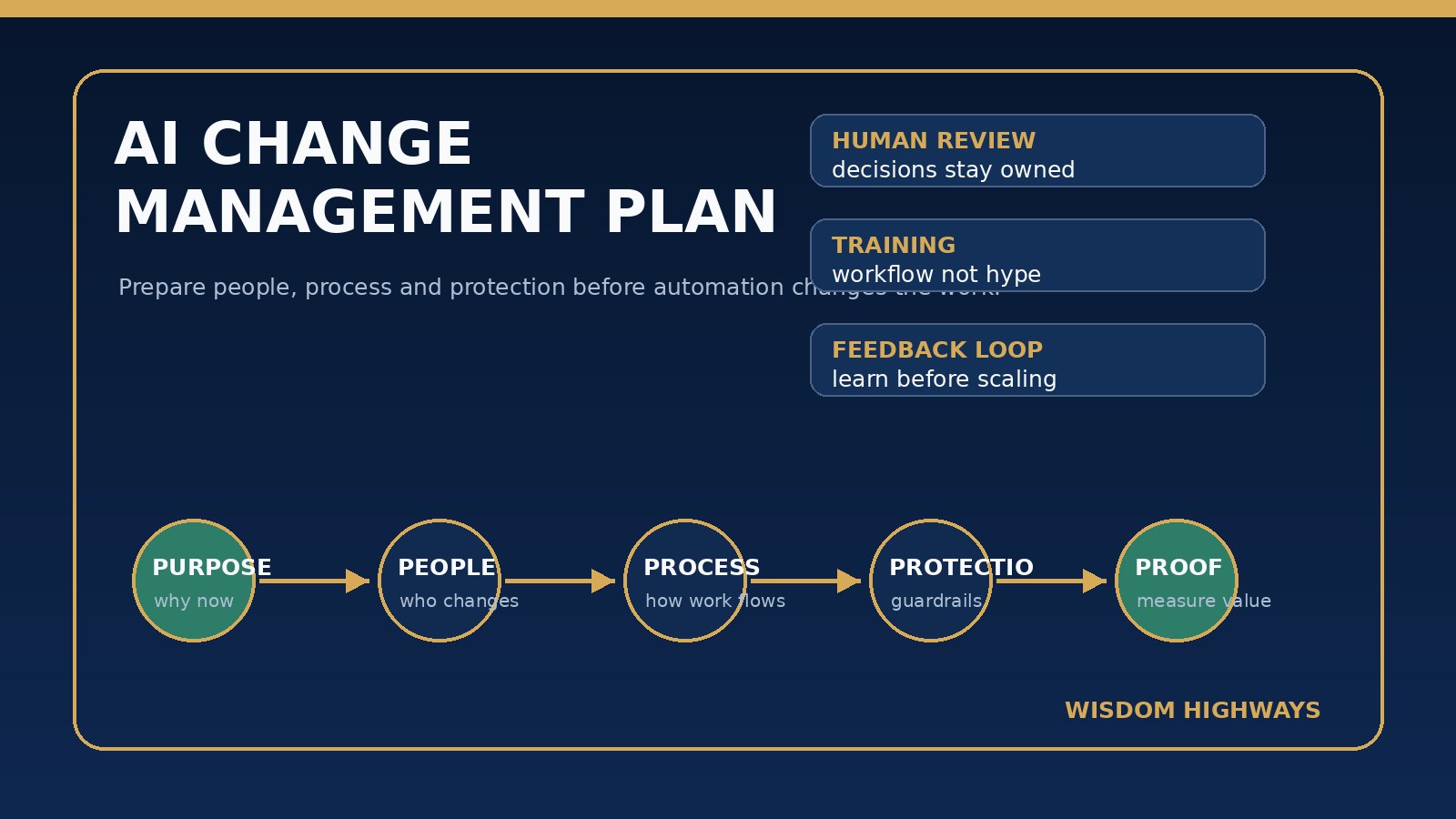
Use this five-part model before launching AI into a live team workflow: Purpose, People, Process, Protection and Proof.
1. Purpose: define the mission reason
Do not introduce AI merely because it is fashionable. Connect the change to a mission outcome: faster member care follow-up, less administrative overload, cleaner donor communication, better customer support, faster reporting, fewer repetitive errors, or more time for pastoral and strategic work.
If the purpose is vague, the team will invent its own story. Some will assume job replacement. Others will treat AI as a toy. A clear purpose reduces fear and focuses adoption.
2. People: map who is affected
AI rarely affects only one role. A tool that drafts emails may affect communications, leadership approvals, privacy, customer service and brand voice. A meeting-summary tool may affect consent, records, pastoral care and board governance. A workflow automation may affect the person who used to hold the process together from memory.
Map the people before you map the software: users, approvers, reviewers, data owners, clients, members, volunteers and leaders.
3. Process: redesign the workflow, not just the prompt
AI works best when placed inside a clear process. Decide what happens before AI, during AI and after AI. For example: a staff member gathers approved source material, AI drafts a first version, a human checks accuracy and tone, sensitive claims are verified, and the final output is logged or sent through the normal approval path.
4. Protection: set boundaries before speed spreads
Use clear rules for confidential information, pastoral care, HR, finance, children’s ministry, donor data, customer records, legal-sensitive issues and high-impact decisions. NIST, OECD and ISO-style governance principles all point toward structured oversight, transparency, accountability and risk management. Leaders do not need to become technical experts, but they do need visible guardrails.
5. Proof: measure adoption and value
Do not measure AI only by tool usage. Measure whether it improves the work without damaging trust. Look for time reclaimed, fewer avoidable revisions, faster response times, better documentation, fewer errors, stronger staff confidence, clearer approvals and fewer risky workarounds.
For pastors and ministry leaders: protect trust while reclaiming time
Ministry teams often feel pressure from administration: messages, rotas, service planning, follow-up, sermon-resource organization, volunteer coordination, reports and event preparation. AI can help reduce repetitive load, but churches must treat people’s stories, prayer needs and pastoral situations with special care.
A ministry-safe AI change plan might begin with low-risk administrative workflows: volunteer scheduling drafts, public event descriptions, internal checklists, service planning templates, or FAQ responses based on approved public information. It should avoid general AI use for confidential pastoral counselling notes, safeguarding matters, children’s ministry incidents, confessions, vulnerable-person concerns or private prayer requests unless a protected, approved and accountable system exists.
The pastoral message is important: “We are using technology to serve people more faithfully, not to replace care, discernment or presence.” That sentence can lower anxiety because it names the boundary.
For SMEs and nonprofits: avoid automation that breaks trust
Small organizations can move quickly, which is an advantage. But speed can also spread confusion. If one person starts using AI for proposals, another for customer replies, another for HR notes and another for finance summaries, the organization may create four different risk models without realizing it.
Start with one workflow where the benefit is visible and the risk is manageable: client onboarding checklists, internal SOP drafts, customer-support response drafts, meeting-action summaries, donor-report outlines or weekly operations summaries. Name the human reviewer, define the source material, set a quality checklist and collect feedback before expanding.
This approach respects both innovation and stewardship. It allows leaders to learn from a real workflow without exposing the whole organization at once.
A 30-day AI change management plan
Days 1–5: choose the right workflow
Select one workflow that is repetitive, time-consuming and not highly sensitive. Write the current pain in plain language. Example: “Our team spends too much time rewriting event descriptions from scratch,” or “Client onboarding information is scattered and slows down delivery.”
Days 6–10: define the boundaries
Decide what AI may use, what it may not use, who reviews outputs, when escalation is required and what must be documented. If the workflow touches personal data, HR, finance, pastoral care or legal-sensitive material, slow down and seek the right advice.
Days 11–17: train a small pilot group
Train people on the workflow, not just the tool. Show examples of good prompts, weak outputs, required reviews, tone corrections, privacy boundaries and when to say, “This needs a human decision.”
Days 18–24: run the pilot with human review
Use real tasks, but keep review close. Capture time saved, errors caught, unclear instructions, staff concerns and unexpected benefits. Do not scale yet.
Days 25–30: review, improve and decide
Ask three questions: Did this reclaim meaningful time? Did quality or trust improve? Are the risks understood and governed? Then decide whether to continue, adjust, expand or stop.
The AI change readiness checklist
- Mission fit: The change serves a clear ministry, customer, operational or leadership purpose.
- Workflow clarity: The current process is documented enough that AI will not automate confusion.
- Human ownership: A named leader owns decisions, quality and escalation.
- Data boundary: The team knows what information is allowed, restricted or off limits.
- Communication plan: People understand why the change is happening and what it means for them.
- Training plan: Users are trained on responsible use, review standards and practical examples.
- Review gate: AI outputs are checked before they affect people, money, public commitments or sensitive care.
- Feedback loop: Staff can report confusion, risk, poor outputs or better ideas.
- Measurement: Leaders track time reclaimed, quality, confidence, adoption and risk signals.
- Pause rule: The organization knows when to slow down, correct or stop.
Common mistakes to avoid
- Announcing AI without explaining the human reason. People need context, not slogans.
- Training only on prompts. Prompt skill matters, but workflow judgment matters more.
- Skipping middle managers or ministry administrators. They often carry the real process knowledge.
- Measuring speed while ignoring trust. Faster work is not better if accuracy, care or confidentiality decline.
- Scaling before the pilot teaches you. Small pilots reveal hidden process problems safely.
- Forgetting reinforcement. New habits fade unless leaders review, coach and improve the system.
Before AI changes the work, assess your readiness
If your organization is exploring AI, automation or agents, do not begin with the tool alone. Begin with readiness: leadership clarity, workflow health, data boundaries, staff training and human oversight.
Related Wisdom Highways resources
- AI Approval Workflow: A Simple Sign-Off Process Before Your Team Launches New Tools
- AI Staff Training Plan: What Leaders Should Teach Before the Team Uses AI Tools
- AI Governance Review Cadence: How Often Leaders Should Recheck AI Tools After Launch
- Shadow AI Governance Checklist: How Leaders Can Reduce Hidden Tool Risk
- AI Automation Roadmap: A 30-Day Plan for Purpose-Driven Leaders
- AI Automation ROI: A Time Reclamation Scorecard for Leaders
Sources and further reading
- NIST AI Risk Management Framework: govern, map, measure and manage functions support structured AI risk and adoption decisions.
- OECD AI Principles: human-centred values, transparency, robustness, security and accountability are useful anchors for people-first AI change.
- CISA Secure by Design: security and safety should be built into technology and operating practice rather than bolted on after launch.
- UK ICO AI and data protection guidance: AI adoption should include privacy, accountability, transparency and data-protection responsibilities.
- Microsoft Work Trend Index: current workplace AI discussion emphasizes adoption, leadership, skills and changing work patterns.
- Prosci change management overview: organizational change succeeds through intentional preparation, communication, sponsorship, training and reinforcement.
Keep learning with Wisdom Highways. Follow our WhatsApp Channel for practical AI tips, time-saving ideas, product updates and selected offers.
Follow WH Premium AI Vault on WhatsApp