
AI Readiness & Incident Response
AI Incident Response Plan: What to Do When Sensitive Data Is Pasted Into AI
An AI mistake does not have to become an organizational crisis. The difference is whether leaders know how to pause, contain, assess, communicate and prevent the next incident.
Updated September 2026. This article is educational and operational, not legal, cybersecurity, privacy, insurance or employment advice. Adapt it with qualified advisers for your country, sector and risk level.
Why leaders need an AI incident response plan now
Many organizations are teaching people how to use AI, but far fewer are teaching them what to do when AI use goes wrong. A staff member may paste donor details into a public chatbot. A volunteer may upload a spreadsheet containing customer information. A manager may summarize a sensitive staff matter in an unapproved tool. A ministry leader may ask an AI assistant to rewrite pastoral-care notes that should never have left a protected system.
The first few minutes after discovery matter. If people panic, hide the mistake, keep experimenting, or share screenshots in the wrong channel, the risk grows. If they have a simple response plan, the organization can contain the situation, protect people, preserve trust and learn quickly.
Wisdom Highways teaches wisdom before automation. Incident response is wisdom under pressure: not blame first, not technology first, but truth, responsibility, care for people and practical recovery.
Search intent: what people really need from this topic
Someone searching for an AI incident response plan usually wants a practical answer, not a long legal manual. They need to know: what counts as an incident, who should be told, what must be recorded, how to contact the vendor, whether the data can be deleted, whether regulators or affected people may need to be notified, and how to stop the same mistake from happening again.
This guide gives pastors, nonprofit executives, SME owners and operations leaders a plain-language starting framework. It should sit beside your data classification rule, AI policy, tool inventory, access-control practice and privacy obligations.
First define what counts as an AI incident
An AI incident is not only a dramatic breach. For a church, nonprofit or SME, it may be any AI-related event that creates meaningful risk to people, confidentiality, mission, operations, finances or reputation.
- Restricted or never-paste data entered into an unapproved AI tool.
- Personal, pastoral, donor, customer, child, staff or beneficiary information uploaded without permission.
- Credentials, tokens, API keys, contracts or financial files pasted into an AI system.
- AI-generated content sent externally before human review and later found to be false, harmful or confidential.
- A team member using a personal AI account for organizational work in a way that exposes sensitive information.
- A vendor or connected AI workflow behaving unexpectedly with organizational data.
The aim is not to punish honest reporting. The aim is to make risk visible early enough to respond wisely.
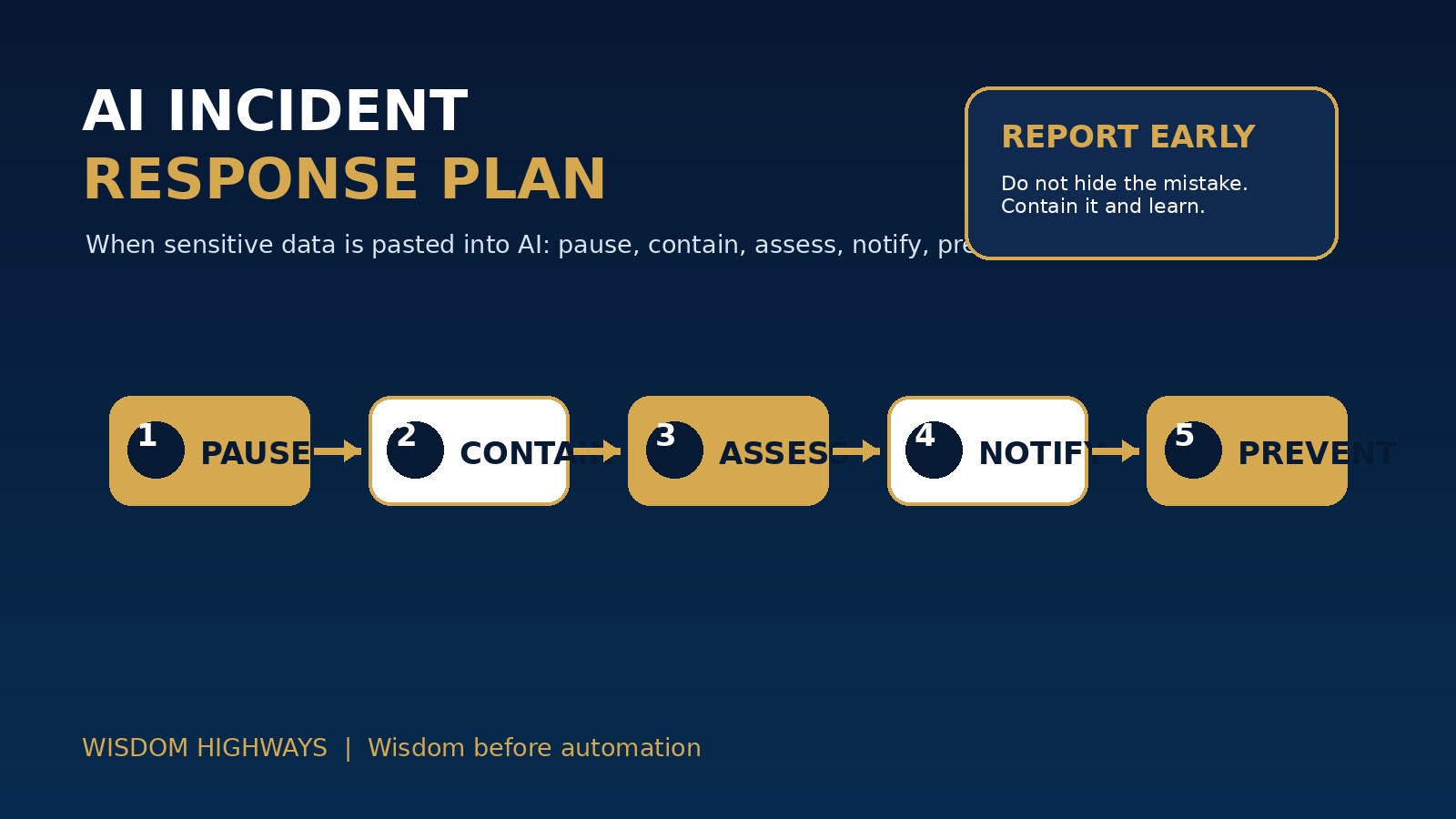
The WH five-step AI incident response workflow
1. Pause the workflow
Stop further prompting, uploading, forwarding or publishing connected to the incident. Do not keep testing with the same sensitive data. If an automation is involved, pause the workflow or disconnect the integration until the risk is understood.
2. Contain access
Identify the tool, account, workspace, file, prompt, output, plugin, integration and people involved. If possible, remove shared links, revoke tokens, rotate exposed credentials, restrict access, and preserve evidence without spreading sensitive content further.
3. Assess the data and the tool
Classify what was exposed. Was it public, internal, restricted or never-paste information? Did it contain personal data, pastoral-care details, financial records, beneficiary stories, contract terms, passwords or customer information? Then assess the tool: was it approved, enterprise-managed, covered by a contract, configured not to train on inputs, or simply a personal consumer account?
4. Notify the right people
Escalate according to seriousness: the accountable leader, privacy/security adviser, legal adviser, IT/admin owner, ministry or department head, and vendor contact where appropriate. Depending on jurisdiction and impact, formal notification to regulators, affected individuals, insurers or partners may be required. Do not make that decision casually.
5. Learn and prevent recurrence
After containment and advice, update the policy, training, access controls, approved-tool list, data classification examples and exception log. A mature organization does not merely ask, “Who made the mistake?” It asks, “What system made this mistake easy?”
What to record without making the problem worse
Good records help leaders respond, but careless records can spread the sensitive information further. Create an incident note that captures the facts without unnecessarily copying the exposed data.
| Record | Why it matters |
|---|---|
| Date, time and discoverer | Establishes timeline and responsibility. |
| Tool, account and workflow | Shows where the information went and who may control it. |
| Data category | Connects the incident to public, internal, restricted or never-paste classification. |
| People or groups affected | Supports notification and care decisions. |
| Immediate containment steps | Shows what was done to reduce harm. |
| Advisers contacted | Preserves accountability for privacy, legal, security or pastoral decisions. |
| Prevention action | Turns the incident into organizational learning. |
Examples for churches, nonprofits and SMEs
Church or ministry: A youth worker pastes a private pastoral-care note into an AI tool to make it “more professional.” The leader pauses use, records the incident without repeating the details, checks whether any child or vulnerable-person information was included, restricts access, seeks safeguarding/privacy advice and trains the team with a never-paste example.
Nonprofit: A fundraiser uploads a donor spreadsheet to generate email segments. The organization checks what fields were included, whether the tool was approved, whether deletion or vendor support is available, whether notification is required, and then updates the donor-data rule and tool permissions.
SME: A manager pastes a customer complaint and contract extract into a public chatbot. The business identifies the account, removes any shared output, checks confidentiality and privacy obligations, informs the accountable owner and adjusts training so staff use anonymized examples.
Seven-day implementation plan
- Day 1: Name the incident owner and backup owner.
- Day 2: Define what counts as an AI incident for your organization.
- Day 3: Create a one-page reporting form that does not require copying sensitive data.
- Day 4: Map escalation contacts: leadership, IT/admin, legal/privacy, safeguarding, vendor and communications.
- Day 5: Add containment steps for credentials, shared files, prompts, outputs and automations.
- Day 6: Train with three realistic scenarios.
- Day 7: Connect incident response to your AI policy, data classification model and exception log.
Common mistakes to avoid
- Blaming first, which teaches people to hide incidents.
- Continuing to test the same prompt with the same sensitive information.
- Posting screenshots of sensitive data in group chats while asking for help.
- Assuming the vendor can delete or ignore data without checking terms and support options.
- Waiting for a perfect policy before giving staff an emergency reporting path.
- Failing to record the incident because no obvious harm appeared immediately.
- Treating AI incidents as only technical issues when they may also be pastoral, reputational, legal or relational.
Leadership checklist before the next AI mistake
- Do staff and volunteers know where to report an AI mistake?
- Can they report quickly without fear of humiliation?
- Do we know which AI tools are approved and who administers them?
- Do we know how to pause connected automations?
- Have we defined restricted and never-paste data?
- Do we have professional advisers for privacy, legal and security questions?
- Do we review incidents monthly to strengthen systems?
Evidence and governance anchors
The sources below support the article’s cautious approach to preparation, incident handling, privacy, AI risk governance and sensitive-information control. They are references for leadership discipline, not replacements for local professional advice.
- NIST AI Risk Management Framework — supports continuous mapping, measuring, managing and governing of AI risks.
- CISA Incident Response Playbook — provides a practical incident-response orientation for containment and coordination.
- UK ICO personal data breach guidance — supports careful assessment and reporting discipline for personal data incidents.
- NIST Cybersecurity Framework — reinforces identify, protect, detect, respond and recover disciplines for incident preparation.
- OWASP Top 10 for LLM Applications — highlights sensitive information disclosure and other LLM-specific risks.
- OECD AI Principles — anchors accountable, robust and human-centred AI use.
Related Wisdom Highways resources
Before the next accidental paste
An AI incident response plan does not need to be complicated to be useful. It needs to be remembered under pressure: pause, contain, assess, notify and prevent recurrence. That simple rhythm can protect people, restore trust and turn a mistake into maturity.
Keep learning with Wisdom Highways. Follow our WhatsApp Channel for practical AI tips, time-saving ideas, product updates and selected offers.
Follow WH Premium AI Vault on WhatsApp