
The most expensive AI tool is not always the one with the highest monthly fee. Sometimes it is the one your team buys before anyone has defined the need, the data risk, the owner, the workflow or the stopping point.
Many churches, nonprofits and SMEs are now under pressure to “get an AI tool.” A staff member recommends a chatbot. A ministry team wants a content assistant. A business unit wants an automation platform. A vendor promises productivity. The demo looks impressive. The price looks manageable. The hidden question is bigger: Should this organization buy this tool now, for this purpose, under these rules?
This AI procurement checklist helps leaders make that decision with wisdom before contracts, subscriptions, integrations and staff habits create risk that is harder to unwind later.
What AI procurement means in plain language
AI procurement is the leadership process of deciding whether to buy, approve or renew an AI-enabled tool. It includes more than price comparison. Wise procurement asks whether the tool fits the mission, solves a real workflow problem, handles data safely, can be governed by the team and will actually serve people better than the current process.
The UK Government’s AI procurement guidance emphasizes clarity of need, risk, accountability and supplier responsibilities. NIST’s AI Risk Management Framework points leaders toward governing, mapping, measuring and managing AI risk across the lifecycle. OECD’s AI principles highlight human-centred, robust, secure and accountable AI. For smaller organizations, the lesson is practical: do not buy AI as a shortcut around leadership judgment.
Why leaders need a procurement checklist now
AI purchasing decisions are no longer limited to the IT department. Communications teams, operations managers, pastors, assistants, sales teams, finance teams and volunteers can all discover AI tools and request approval. Without a simple procurement discipline, organizations can quickly end up with duplicated subscriptions, scattered data, unclear access, weak oversight and tools nobody remembers approving.
This is especially important for purpose-driven organizations. A church may handle pastoral care information. A nonprofit may hold donor and beneficiary details. A small business may manage customer data, contracts, pricing, staff information and intellectual property. An AI tool can be helpful, but it can also create privacy, reputation, cost and trust questions if it is purchased too casually.
Wisdom Highways’ position is simple: wisdom before automation. Procurement is one of the places where that wisdom becomes operational.
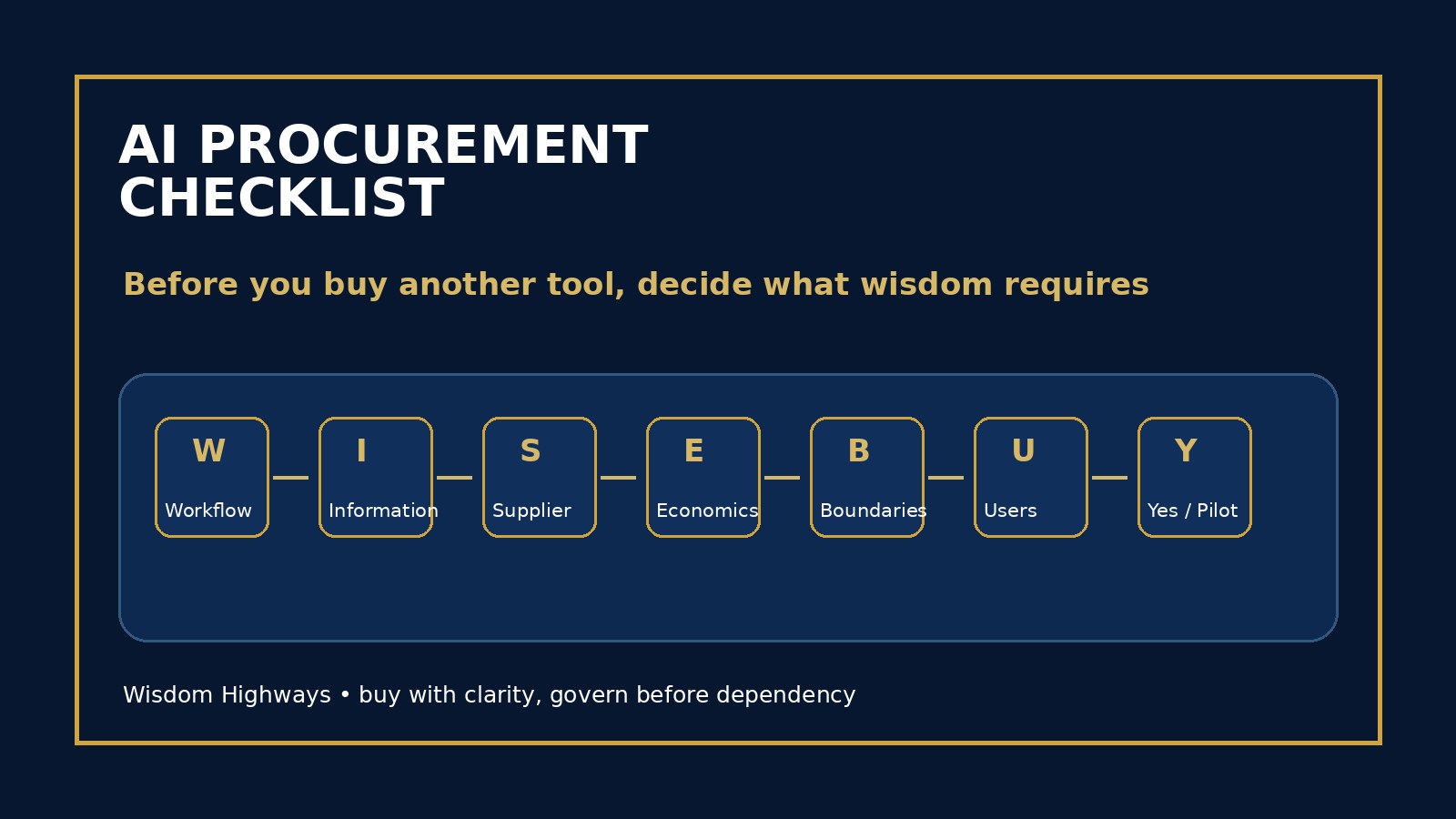
The WISE BUY checklist
Use the WISE BUY framework before approving a new AI tool, renewing a subscription or connecting a vendor to organizational data.
W — Workflow need
Start with the work, not the tool. What specific workflow will improve? Is the pain repetitive administration, slow follow-up, poor handoff, inconsistent content review, manual reporting, weak knowledge retrieval or delayed customer response?
- What problem are we solving?
- Who feels the pain today?
- What would improve if this worked?
- What process should be fixed before software is added?
If the team cannot define the workflow clearly, pause. Use an AI workflow audit or an AI automation roadmap before buying another platform.
I — Information and data exposure
Ask what information the tool will see, store, learn from, process, export or send to other systems. ICO guidance on AI and data protection reminds organizations that personal data use creates accountability responsibilities. Even when an organization is not legally sophisticated, leaders should know what data a tool will touch.
- Will staff paste personal, pastoral, donor, customer, employee or financial data?
- Does the vendor use inputs for training by default?
- Where is data stored and who can access it?
- Can data be deleted, exported or restricted?
- Does this use case belong in a safer tool or should it be forbidden?
Before approval, compare the use case with your AI data privacy checklist and AI data classification rules.
S — Supplier and security fit
A vendor is not only selling features. It may become part of your operational trust chain. Review security, reliability, support, terms, data practices, integrations, account controls and exit options. CISA’s Secure by Design principle is useful here: avoid depending on tools whose preventable weaknesses are visible before launch.
This does not mean every small organization must run an enterprise procurement process. It means leaders should ask a proportional set of questions before connecting AI to sensitive work. Use a vendor due diligence checklist for the details.
E — Economics and exit
The subscription price is only one part of cost. Consider setup time, staff training, review time, integration effort, cleanup work, replacement of existing tools, support burden and the cost of leaving later. A cheap tool can become expensive if it spreads across the team without ownership. A more expensive tool can be wise if it replaces several manual processes safely and measurably.
- What existing tool or manual process will this replace?
- Who will own setup, training and review?
- How will we measure time reclaimed, quality improved or risk reduced?
- What happens if we cancel?
- Can we export our data and continue the work elsewhere?
B — Boundaries and human oversight
Decide what the tool may do and what it must not do. Can it draft but not send? Summarize but not decide? Recommend but not approve? Route but not delete? If the AI touches pastoral care, donor communication, HR, finance, safeguarding, legal-adjacent content or customer commitments, human oversight should be explicit.
The UK Government’s generative AI framework highlights accountability, assurance and human oversight. For a church, nonprofit or SME, that can become a simple approval rule: the higher the human consequence, the stronger the human review.
U — Users, access and training
Procurement fails when leaders buy a tool but do not decide who should use it, how they should use it or when they should stop. Before rollout, define user groups, access levels, training needs, prompt standards, review expectations and support channels.
Connect the purchase to your AI access control checklist, staff training plan and prompt library governance. Buying a tool without training the team is not readiness.
Y — Yes, no or pilot decision
The best procurement decision is not always “yes.” Sometimes the right answer is no, not yet, pilot first, use an existing tool, improve the process manually, or approve only for a limited use case. A pilot can protect the organization from overcommitting before it has evidence.
Use an AI approval workflow and pilot checklist so the decision is recorded and reviewable.
Examples for churches, nonprofits and SMEs
Church communications: A church wants to buy an AI writing tool for announcements, follow-up messages and sermon-support content. The procurement decision should check tone, theological sensitivity, data boundaries, who approves messages and whether pastoral-care situations are excluded from unsupervised AI use.
Nonprofit operations: A charity wants an AI tool to summarize programme notes and draft donor updates. Leaders should check beneficiary dignity, consent, anonymization, data retention, donor-claim accuracy and whether outputs need review before public use.
SME growth systems: A business wants an AI assistant for customer support and proposal preparation. Procurement should test scope accuracy, pricing control, escalation rules, CRM access, export options and whether the tool creates promises the business cannot fulfil.
A 30-minute procurement review meeting
- Name the workflow. Define the specific job the tool will improve.
- Map the data. Identify what information the tool will touch.
- Review the vendor. Check security, terms, support, integrations and exit options.
- Estimate total cost. Include training, review, integration and cleanup effort.
- Set boundaries. Decide what the AI may draft, suggest, send, change or never touch.
- Choose owners. Assign approval, administration and monitoring responsibility.
- Decide next step. Approve, reject, pilot, delay or use an existing system.
When not to buy the tool
Do not buy when the use case is vague, the vendor cannot explain data practices, the team lacks an owner, sensitive data would be exposed without controls, the tool duplicates existing software, there is no exit plan, or the organization is using AI to avoid a leadership conversation that should happen first.
Also pause if the purchase would quietly shift spiritual, medical, legal, financial, employment or safeguarding responsibility to a tool. AI can support preparation and administration, but leaders remain accountable for high-stakes human decisions.
Procurement records to keep
- The approved use case and business or ministry reason.
- Data categories the tool may and may not process.
- Vendor review notes and important terms.
- Owner, approver and administrator names.
- Access rules and training requirements.
- Pilot results, risks and decision date.
- Review date, renewal date and exit plan.
These records support your AI tool inventory, risk register and monitoring plan after the tool goes live.
Wisdom Highways perspective
Procurement is not bureaucracy for its own sake. It is stewardship before dependency. Wise leaders do not only ask, “Can this AI tool save time?” They ask, “Will this tool serve our mission, protect people, strengthen trust and remain governable when the demo is over?”
If the answer is yes, buy with clarity. If the answer is no, wait with confidence. If the answer is uncertain, pilot before scaling. Systems should serve mission and people, not pull leaders into avoidable complexity.
Related Wisdom Highways resources
- AI Vendor Due Diligence Checklist
- AI Tool Inventory Template
- AI Approval Workflow
- AI Data Privacy Checklist
Sources and further reading
- UK Government Guidelines for AI Procurement — AI procurement should consider need, data, accountability, transparency, risk and supplier responsibilities before purchase.
- NIST AI Risk Management Framework — AI risk should be governed, mapped, measured and managed across the system lifecycle.
- OECD AI Principles — AI should be human-centred, transparent, robust, secure, safe and accountable.
- ICO AI and Data Protection Guidance — AI adoption can create data protection duties around personal data, transparency, security and accountability.
- CISA Secure by Design — Security and resilience should be considered before technology becomes operationally depended upon.
- UK Government Generative AI Framework — Generative AI use requires accountability, assurance, monitoring and human oversight.
- Google Helpful Content Guidance — Public content should be useful, original and people-first rather than created only for search engines.
Freshness note: Prepared and source-checked in October 2026. Review before reuse if procurement, data protection, AI governance or vendor terms materially change.
Keep learning with Wisdom Highways. Follow our WhatsApp Channel for practical AI tips, time-saving ideas, product updates and selected offers.
Follow WH Premium AI Vault on WhatsApp