
AI Governance · Leadership Ownership · Human Accountability
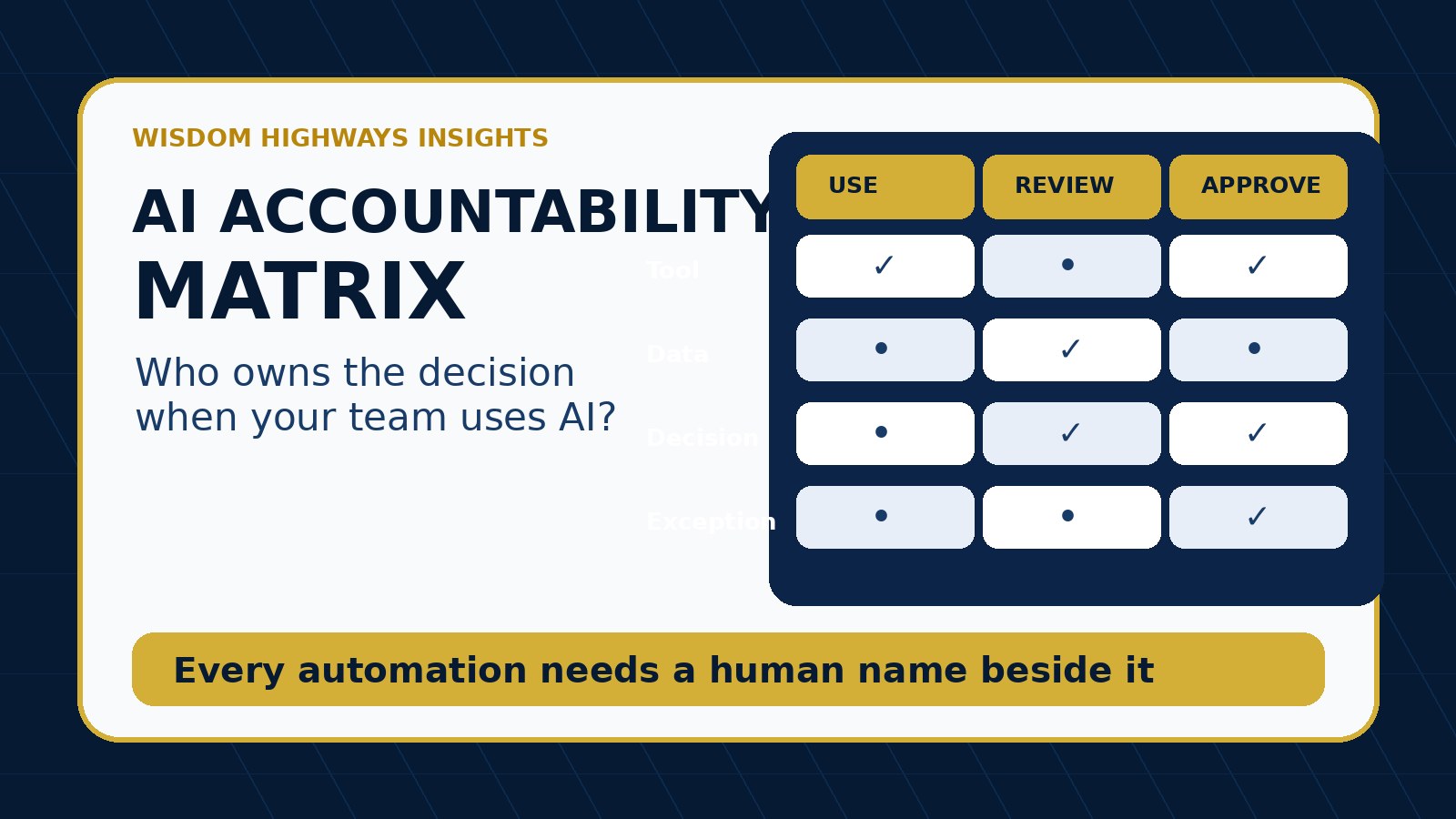
AI Accountability Matrix: Who Owns Decisions When Your Team Uses AI?
Freshness note: prepared September 21, 2026 for pastors, nonprofit leaders, SME owners and purpose-driven executives adopting AI tools while protecting trust, mission and human judgment.
AI creates a leadership problem before it creates a technology problem: people often use the tool, but nobody is clearly named as the owner of the decision. A staff member asks ChatGPT to draft a donor email. A ministry volunteer uses an AI image tool for a youth poster. A sales assistant lets an AI workflow prioritize leads. A manager approves a vendor integration because it saves time. If something is inaccurate, insensitive, biased, private, unsafe or off-brand, who is accountable?
Many churches, nonprofits and small businesses do not need a complicated AI department. They do need a simple accountability map. Without one, AI adoption becomes a fog of good intentions: users assume managers approved it, managers assume users checked it, leaders assume vendors are responsible, and everyone assumes someone else will catch the risk.
An AI accountability matrix solves that problem. It clarifies who may request AI use, who approves it, who reviews output, who owns the final decision, who handles exceptions, and who reports lessons back into the system. The goal is not bureaucracy. The goal is wise stewardship: every AI-assisted workflow should have a human owner before it has a technical shortcut.
What is an AI accountability matrix?
An AI accountability matrix is a plain-language table that assigns responsibility for AI-related decisions across a workflow. It answers practical questions such as:
- Who is allowed to use this AI tool or automation?
- Who approves new uses before launch?
- Who checks output before it reaches clients, members, donors, staff or the public?
- Who owns the final decision if AI influences a recommendation?
- Who responds when something goes wrong?
- Who updates policy, training and permissions after lessons are learned?
Many leaders already know the RACI model: Responsible, Accountable, Consulted and Informed. An AI accountability matrix uses the same spirit, but it adds AI-specific roles such as tool owner, data steward, human reviewer, escalation owner and final decision owner. For small organizations, this can be a one-page table. For larger teams, it can become part of the AI policy, approval workflow and risk register.
Why AI accountability matters now
AI tools make it easy for work to move faster than ownership. A draft can be generated in seconds. A campaign can be personalized automatically. A summary can influence a pastoral, HR, donor or client decision. An AI agent may eventually take actions across email, calendars, CRMs, websites or documents. Speed is useful, but speed without ownership creates hidden risk.
The NIST AI Risk Management Framework frames AI risk management around governing, mapping, measuring and managing systems over time. Accountability belongs inside that governance rhythm, not after an incident. The OECD AI Principles emphasize human-centred values, transparency, robustness, security and accountability. UNESCO’s Recommendation on the Ethics of Artificial Intelligence also stresses human oversight and responsibility. These are global signals: responsible AI is not only about what the tool can do; it is about who remains answerable for its use.
In Wisdom Highways language, accountability is how wisdom stays in front of automation. If a person cannot name the owner of an AI-assisted decision, the organization is probably not ready to scale that workflow.
The seven ownership roles every leader should define
A practical AI accountability matrix does not have to start with legal language. Start with seven human roles.
| Role | Question it answers | Small-organization example |
|---|---|---|
| Executive sponsor | Who sets the boundary for why this AI use exists? | Pastor, founder, executive director or business owner |
| Workflow owner | Who owns the process being changed? | Operations lead, ministry administrator, department head or sales manager |
| Tool owner | Who manages the tool, settings, access and vendor relationship? | Admin, IT support, systems lead or designated manager |
| Data steward | Who decides what information may or may not be used? | Leader responsible for pastoral, donor, client, HR, finance or member data |
| Human reviewer | Who checks AI output before it affects people? | Editor, pastor, manager, team lead or qualified subject-matter reviewer |
| Final decision owner | Who is accountable for the decision after AI assists? | The human leader who approves the action, message or recommendation |
| Escalation owner | Who responds to incidents, near misses or exceptions? | Designated governance lead or senior responsible leader |
In a church of twenty staff, one person may hold several roles. In a nonprofit or SME, the founder may be sponsor while an operations manager owns workflows. The point is not to create titles. The point is to remove ambiguity.
A simple AI accountability matrix template
Use this lightweight template before approving any recurring AI workflow:
- Workflow name: the process being supported, such as donor-email drafting, sermon-research summarization, customer-support triage, meeting-note summaries or social-caption drafting.
- Purpose: why the AI use exists and what human problem it solves.
- Audience affected: members, clients, donors, beneficiaries, staff, volunteers, children, vendors, applicants or the public.
- Data allowed: what information can be used safely.
- Data prohibited: sensitive, pastoral, financial, HR, health, legal, children’s, client-confidential or donor-confidential information that must not be entered.
- Approved tools: the specific platform, integration or automation allowed for the workflow.
- Responsible user: who performs the task.
- Human reviewer: who checks accuracy, tone, privacy, theology, brand, bias and suitability.
- Final decision owner: who approves the action or publication.
- Escalation path: who handles exceptions, near misses and incidents.
- Review cadence: when the workflow is rechecked for performance, risk and continued fit.
This template connects naturally to the AI approval workflow, AI access-control checklist, AI exception log and AI risk register. Together, they turn AI governance from a document into a living leadership system.
Where unclear accountability creates the most risk
Unclear AI ownership is most dangerous where decisions affect trust, privacy, spiritual care, money, reputation or vulnerable people. Leaders should pay special attention to these areas:
- External communication: emails, social posts, proposals, donor appeals, pastoral announcements, public statements and customer responses.
- People decisions: hiring, performance notes, volunteer suitability, pastoral-care triage, member follow-up and beneficiary support.
- Financial or donor workflows: fundraising messages, payment reminders, segmentation, grant narratives and finance summaries.
- Client or member data: transcripts, intake forms, counselling notes, CRM records, private prayer requests, contracts and confidential documents.
- Automated actions: workflows that send messages, update records, trigger tasks, score leads, summarize meetings or make recommendations without review.
- AI agents and integrations: tools with permission to act across multiple systems, not merely draft text.
The OWASP Top 10 for Large Language Model Applications highlights risks such as sensitive information disclosure, insecure output handling, excessive agency and supply-chain concerns. Those risks are not solved only by technical controls. They also require clear human responsibility.
Church example: pastoral communication needs named ownership
A church wants to use AI to help draft weekly pastoral-care follow-up messages. The purpose is compassionate consistency, not replacing shepherding. The accountability matrix says the ministry administrator may generate first drafts from non-sensitive notes only. The associate pastor reviews every message for pastoral tone and theological suitability. The senior pastor owns the final communication standard. Sensitive counselling details, children’s information and confidential prayer requests are prohibited from the tool. Any concern goes into the exception log.
This approach protects human care. AI may assist with wording, but pastoral judgment remains with people called to serve people.
Nonprofit example: beneficiary stories require consent and review
A nonprofit uses AI to draft impact-story outlines from approved interview notes. The communications lead owns the workflow. The programme manager confirms that consent boundaries are respected. A human editor checks whether details could identify a beneficiary unintentionally. The executive director approves high-sensitivity stories before publication. The matrix also names what must never be pasted into a public AI tool: identifying details, trauma history, private addresses, children’s information and unapproved photographs.
Here, accountability protects dignity. The story may be stronger because AI helps organize it, but the responsibility for truth, consent and care stays human.
SME example: sales automation needs final decision ownership
A small business uses an AI-assisted CRM workflow to score enquiries and draft follow-up emails. The sales manager owns the workflow. The operations lead owns the tool and permissions. Sales reps may use AI drafts, but they must review claims before sending. The business owner remains accountable for pricing promises, guarantees and brand standards. If the AI suggests a discount, claim or delivery timeline outside policy, it must be escalated before it reaches the client.
This prevents a common automation mistake: letting speed create promises the organization did not actually approve.
Five mistakes to avoid
- Making the tool the owner. Software can assist a process, but it cannot carry moral, pastoral, legal or brand accountability.
- Assuming the user is always accountable. Users need boundaries, training and review. Leaders still own the system they authorize.
- Approving AI use without naming the data steward. Most serious mistakes begin when people are unclear about what information may enter a tool.
- Reviewing only public content. Internal summaries, recommendations, scores and automations can also shape decisions.
- Ignoring vendor and integration ownership. Someone must monitor settings, permissions, data terms, access changes and model behaviour changes.
The Wisdom Highways accountability test
Before scaling any AI workflow, ask six questions:
- Can we explain the purpose of this AI use in one sentence?
- Can we name the human owner of the workflow?
- Can we name the human owner of the final decision?
- Do we know what data is allowed and prohibited?
- Do we know who reviews output before it affects people?
- Do we know what happens if something feels wrong?
If the answer to any question is unclear, pause before scaling. The issue may not be that AI is inappropriate. The issue may be that ownership is not yet mature enough for the use case.
How to implement the matrix this week
Leaders can begin without waiting for a perfect AI programme:
- Choose three active AI uses. Start where staff are already using AI, not where you imagine the future might go.
- Identify the affected people. Ask who could be helped or harmed by the output.
- Name the seven ownership roles. One person can hold multiple roles, but every role should be intentional.
- Write allowed and prohibited data rules. Keep them visible and simple.
- Add human review requirements. The more sensitive the workflow, the stronger the review.
- Connect exceptions to a log. If someone bypasses the process or finds a gap, record the lesson.
- Review after thirty days. Ask whether the workflow saved time, protected trust and stayed aligned with mission.
This is Time Reclamation with wisdom. The aim is not only to save minutes. The aim is to save leaders from preventable confusion, rework, embarrassment and trust damage.
When to keep AI out of the decision
An accountability matrix should also give leaders permission to say no. Some decisions require such deep human judgment, confidentiality, spiritual discernment, legal sensitivity or relational context that AI should not be used at all, or should be limited to administrative support around the decision. Pastoral counselling, safeguarding, disciplinary processes, high-stakes employment decisions, sensitive financial hardship cases and vulnerable-person support deserve special caution.
Responsible AI is not measured by how many workflows use AI. It is measured by whether technology serves the mission, protects people and strengthens wise leadership.
The Wisdom Highways perspective: every automation needs a human name beside it
Automation becomes safer when responsibility is visible. A named owner slows down confusion, not progress. It tells the team, “We know why this exists, who it serves, what it may touch, who checks it and who answers for it.”
That is how purpose-driven organizations can adopt AI without losing their human touch. AI can support communication, administration, analysis, operations and follow-up. But the final responsibility for truth, care, judgment and mission still belongs to people.
Related Wisdom Highways insights
- AI Approval Workflow: A Simple Sign-Off Process Before Your Team Launches New Tools
- AI Access Control Checklist: Who Should Be Allowed to Use Which Tools?
- AI Exception Log: How Leaders Should Track Overrides, Near Misses and Risk Decisions
- AI Risk Register Template: Track What Could Go Wrong Before You Automate
- Human-in-the-Loop AI: What Leaders Should Review Before Automation Goes Live
- How Purpose-Driven Organizations Can Use AI Without Losing Their Human Touch
Sources and further reading
- NIST AI Risk Management Framework — governance, mapping, measuring and managing AI risks.
- OECD AI Principles — global principles for trustworthy and human-centred AI.
- UNESCO Recommendation on the Ethics of Artificial Intelligence — international ethics guidance including human oversight and responsibility.
- European Commission AI regulatory framework overview — risk-based regulatory direction emphasizing governance and human oversight.
- Microsoft Responsible AI — practical responsible-AI principles from a major AI platform provider.
- OWASP Top 10 for Large Language Model Applications — LLM risk categories that benefit from clear ownership and escalation.
Keep learning with Wisdom Highways. Follow our WhatsApp Channel for practical AI tips, time-saving ideas, product updates and selected offers.
Follow WH Premium AI Vault on WhatsApp