
AI Readiness • Pilot Design • Human Governance
AI Pilot Program Checklist: How to Test AI Safely Before Scaling
The safest way to scale AI is not to start with a grand transformation programme. It is to run a wise, limited pilot that tells the truth.
Many churches, nonprofits and small businesses are now past the question, “Should we look at AI?” Their teams are already experimenting. A leader has tried ChatGPT. A staff member is using an AI note-taker. Someone has connected a form to an automation tool. A vendor is promising a faster customer-support workflow. The pressure to move is real.
But speed without structure can create a new kind of waste: tools that nobody governs, automations that create confusion, AI outputs that sound confident but are wrong, privacy questions nobody answered, and subscriptions that do not actually reclaim meaningful time.
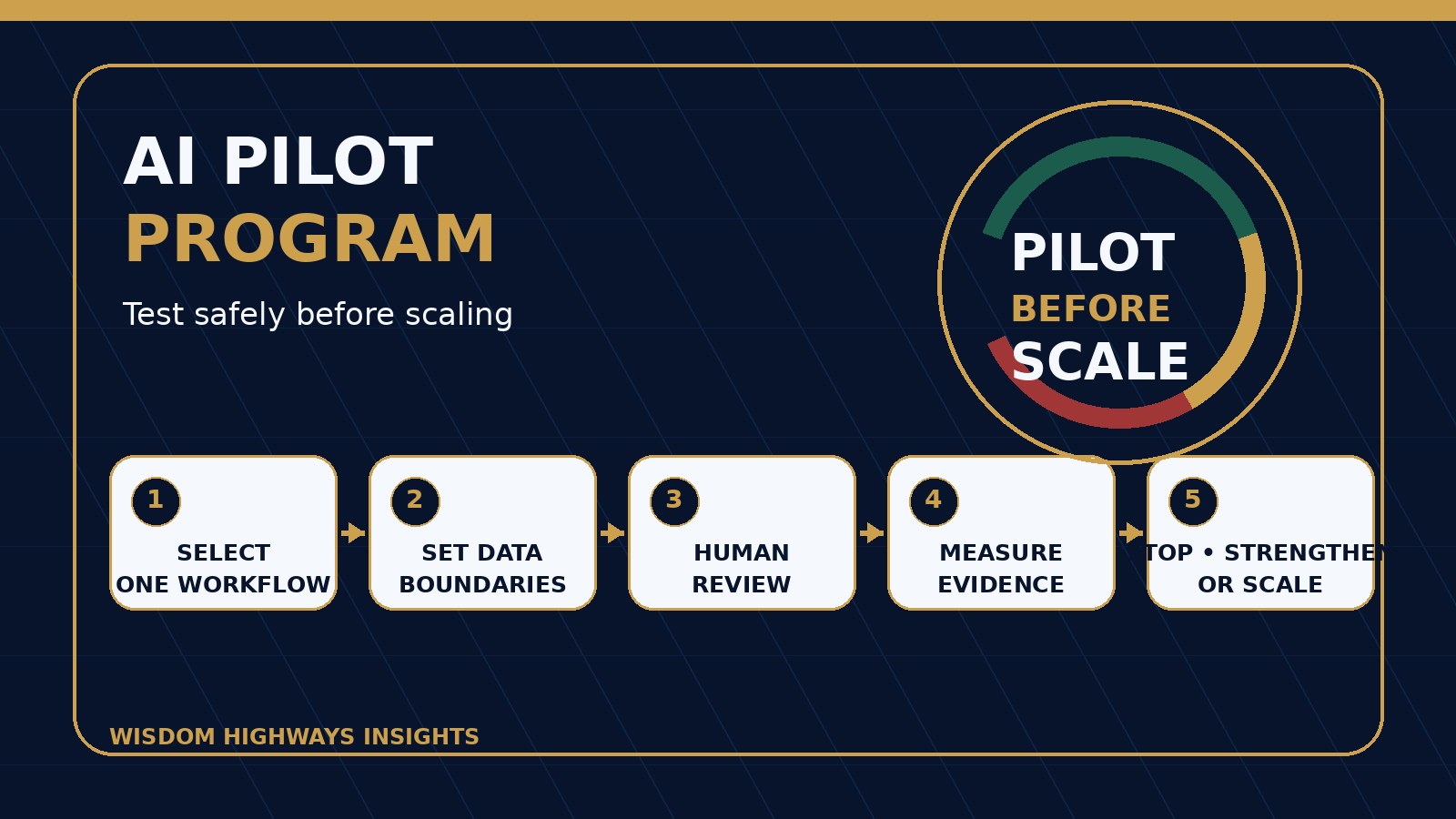
This AI pilot program checklist is designed for non-technical leaders who want practical progress without gambling with trust. It will help you choose one workflow, test it safely, measure what matters, and decide whether to stop, strengthen or scale.
Before you launch a pilot, check your readiness. Take the AI & Systems Readiness Assessment to identify whether your workflow, data, team ownership and governance are ready for a responsible AI test.
Why an AI pilot is a leadership discipline, not a technology experiment
An AI pilot should not be a playground where every tool is tried at once. It should be a controlled learning process. The leader is not only asking, “Does the tool work?” The wiser question is:
Can this AI-assisted workflow improve time, quality or follow-through without weakening truth, trust, privacy, accountability or human care?
That question aligns with the direction of reputable global guidance. The NIST AI Risk Management Framework encourages organizations to govern, map, measure and manage AI risks in context. The OECD AI Principles emphasize human-centered values, transparency, robustness, safety and accountability. The UK Information Commissioner’s Office AI guidance keeps attention on data protection, fairness and accountability when AI uses personal information. The Stanford HAI AI Index tracks how rapidly AI capability, adoption and policy attention continue to develop globally.
The interpretation for Wisdom Highways is simple: leaders do not need to fear AI, but they do need to govern it. A pilot gives you a smaller, safer place to practice that governance before the workflow touches more people.
The Wisdom Highways pilot principle
At Wisdom Highways, the standard is not “automate because you can.” The standard is:
Wisdom leads the pilot. People govern the process. Technology serves the mission. Evidence decides what scales.
If a pilot cannot be explained in plain language, owned by a responsible person, tested with safe data, reviewed by humans and measured honestly, it is not ready to scale.
Step 1: Choose one workflow, not one fashionable tool
The first mistake is starting with the tool. “We should use this AI platform” is weaker than “we need to improve this repeated workflow.” A pilot should begin with a real operational pain point.
Good pilot candidates are usually workflows that are repeated, time-consuming, relatively low risk and easy to review. Examples include:
- turning meeting notes into action items;
- drafting first responses to common enquiries;
- summarizing public resources or internal knowledge articles;
- organizing event registrations and reminders;
- repurposing approved sermons, webinars or trainings into draft content;
- classifying customer-support messages before a human responds;
- preparing a weekly leadership dashboard from known data sources.
A poor first pilot is one where the consequences of error are serious: pastoral counseling, safeguarding, HR discipline, legal advice, medical advice, financial commitments, doctrinal statements, crisis communication, pricing promises, donor confidentiality or automated public posting.
Step 2: Write the pilot brief in one page
Before anyone connects a tool, write a short pilot brief. This protects focus and reduces scope creep.
Your one-page pilot brief should answer:
- Workflow: What repeated process are we improving?
- Audience: Who is affected—staff, volunteers, members, customers, donors, beneficiaries or leaders?
- Problem: What is slow, manual, inconsistent, expensive or easily forgotten?
- AI role: Will AI draft, summarize, classify, search, recommend, route or trigger a next step?
- Human role: Who reviews, approves, corrects and owns the final action?
- Data boundary: What information may be used, and what must never be entered?
- Success measure: What would prove the pilot helped?
- Stop condition: What would make us pause or cancel the pilot?
If you cannot answer these questions, the organization may not have an AI problem yet. It may have a process-clarity problem.
Step 3: Set the data boundary before testing
AI pilots often fail quietly because people use convenient data before anyone sets the rules. For churches, nonprofits and SMEs, this can create reputational and privacy risk even when no harm was intended.
Create three lanes:
- Green data: public website content, public FAQs, approved templates, non-sensitive sample text, anonymized test examples and information already approved for broad use.
- Yellow data: internal documents, team notes, lightly sensitive operational data or customer/member examples that may be used only with permission, minimization and review.
- Red data: pastoral counseling notes, safeguarding information, confidential donor details, private health information, legal matters, HR issues, financial account data, passwords, private client files and anything the organization has not authorized for AI use.
This is where a pilot becomes a trust-building exercise. The goal is not to scare the team. The goal is to make safe experimentation possible.
Step 4: Keep the first version human-in-the-loop
For a first pilot, AI should normally prepare or assist; it should not act with final authority. Let AI draft the response, summarize the meeting, suggest the category, prepare the checklist or recommend the next step. Then a human reviews before anything is sent, published, promised, deleted, escalated or recorded as final.
This matters because AI systems can be useful and still be wrong. They can miss local context, misunderstand tone, invent a detail, overstate confidence or produce language that does not fit your values. Human review is not a lack of innovation. It is responsible leadership.
Use the related Wisdom Highways guide on human-in-the-loop AI review as a companion when defining approval points.
Step 5: Test with real workflow shape but safe examples
A vendor demo is not a pilot. A casual trial by one enthusiastic staff member is not a pilot either. A real pilot uses examples that reflect the organization’s actual work while protecting people and sensitive data.
For example:
- A church can test visitor follow-up using fictional but realistic visitor records, approved welcome language and clear human review before any message is sent.
- A nonprofit can test grant-report summarization with public programme descriptions and anonymized outcomes rather than identifiable beneficiary stories.
- A small business can test enquiry classification using past message patterns rewritten without personal details or confidential commercial information.
Test normal cases and edge cases. Include vague messages, emotional messages, incomplete information, tone-sensitive scenarios and requests that should be escalated to a human.
Step 6: Measure time, quality, trust and review burden
Many AI pilots measure only whether a tool is impressive. That is not enough. Measure whether the workflow improves without creating new hidden work.
Track four kinds of evidence:
- Time: Did the task take less time from start to approved finish?
- Quality: Were outputs clearer, more consistent, more complete or easier to act on?
- Trust: Did the workflow protect tone, privacy, accuracy, accountability and human care?
- Review burden: Did humans spend less time approving the work, or did they have to fix so much that the pilot created more work?
This is especially important for Time Reclamation. Saving five minutes on drafting is not progress if a leader then spends twenty minutes correcting errors, calming confusion or rebuilding trust.
Step 7: Decide with a Stop / Strengthen / Scale review
At the end of the pilot, do not drift into permanent use just because people became familiar with the tool. Hold a short review and make a deliberate decision.
The review should include both leaders and the people who actually used the workflow. Ask what became easier, what became confusing, what had to be corrected, what users trusted, what they did not trust, and where the process still depended on one person’s hidden knowledge. This conversation often reveals the real implementation work: cleaner templates, clearer ownership, better intake forms, stronger approval rules or a narrower first use case.
For a church, this review may include ministry leaders, administrators and the person responsible for pastoral sensitivity. For a nonprofit, it may include programme, fundraising, operations and data-protection voices. For an SME, it may include sales, delivery, customer support and the person who owns the customer promise. The pilot should not be judged only by the tool champion. It should be judged by the workflow owner and by the people whose trust the workflow affects.
- Stop: The pilot created accuracy, privacy, trust, cost or workflow problems that outweigh the benefit.
- Strengthen: The pilot has promise, but needs better templates, data boundaries, training, approval points or vendor answers.
- Scale: The pilot produced useful evidence, protected trust, has a named owner, and can expand in a controlled way.
Scaling should still be gradual. Move from one workflow to one adjacent workflow; from one team to a second team; from drafting to limited automation only after evidence and governance mature.
Three sample AI pilots for Wisdom Highways audiences
For pastors and church teams: visitor follow-up support
Pilot goal: reduce dropped follow-up after Sunday services or events. AI may help draft a warm first message from approved church language, summarize visitor preferences and remind a human leader of next steps. Human review remains required before sensitive replies or pastoral care. Red data includes counseling details, safeguarding matters and private prayer disclosures.
For nonprofits: programme update summarization
Pilot goal: turn staff updates into a consistent internal leadership brief. AI may summarize non-sensitive weekly notes into “what happened, what matters, what is blocked, what decision is needed.” Human leaders verify facts and remove anything not approved for wider circulation.
For small businesses: enquiry triage and first-draft response
Pilot goal: reduce response delays for common enquiries. AI may categorize messages, suggest a next step and draft a reply from approved FAQ language. Humans approve pricing, scope, complaints, refunds, legal issues and high-value opportunities.
The AI pilot checklist
Use this checklist before approving a pilot:
- We selected one workflow, not a vague tool experiment.
- The workflow is repeated, valuable and low enough risk for a first pilot.
- We named a human owner.
- We wrote the AI role and the human approval role.
- We defined green, yellow and red data.
- We know which decisions AI may not make.
- We tested with realistic but safe examples.
- We measured time, quality, trust and review burden.
- We checked vendor/data/privacy basics before using real information.
- We held a Stop / Strengthen / Scale review before expansion.
Common mistakes to avoid
- Piloting too many tools at once. This produces confusion instead of learning.
- Using sensitive data too early. Start with approved or anonymized examples.
- Skipping human review because the output sounds polished. Confidence is not accuracy.
- Letting the pilot become permanent without a decision. Familiarity is not governance.
- Measuring only speed. A faster bad workflow is still a bad workflow.
- Ignoring shadow AI signals. If people are already using tools informally, use the pilot to bring innovation into the light rather than merely punish it.
How this connects to your wider AI readiness
A good pilot reveals more than tool performance. It reveals whether your organization has clear processes, usable templates, responsible data habits, trusted human owners, realistic measures and a culture that can learn without chaos.
Use this article alongside the AI vendor due diligence checklist, the shadow AI governance checklist, the AI policy template, the AI workflow audit, and the automation decision matrix.
Wisdom Highways’ position is clear: do not scale AI confusion. Pilot wisely, measure honestly, protect people and let technology serve the mission.
Ready to choose the right first AI pilot?
If you are unsure which workflow should be tested first, begin with a readiness diagnosis. Take the AI & Systems Readiness Assessment to identify your strongest first opportunity, the risks to govern and the next practical step for your church, nonprofit or business.
Freshness note
This article was prepared in September 2026. AI tools, data settings, vendor terms and regulatory expectations continue to change. Recheck vendor documentation, privacy settings and internal governance before launching or expanding any AI pilot.
Keep learning with Wisdom Highways. Follow our WhatsApp Channel for practical AI tips, time-saving ideas, product updates and selected offers.
Follow WH Premium AI Vault on WhatsApp