
Freshness note: prepared 24 October 2026. Revisit this guide when the workflow, tool, data, people affected or level of consequence changes.
A busy leader sees a process taking too long and asks a sensible question: Can AI help us with this?
Sometimes it can. AI can prepare a first draft, organise information, summarise routine material or route a predictable request. But before choosing a tool, a wiser question comes first:
Should this work be automated at all—and, if it is, what must remain meaningfully human?
That distinction protects mission and trust. A church can acknowledge a visitor form automatically; it should not let a bot handle a pastoral crisis. A nonprofit can sort routine volunteer enquiries; it should not allow an automated score to quietly determine who receives help. An SME can draft answers to common questions; it should not let an unreviewed system make promises about refunds, employment or a contract.
At Wisdom Highways, we believe wisdom comes before automation. Systems should reclaim time for mission, relationships and sound decisions—not make responsibility disappear behind a fast output.
Assistance is not authority
AI does not have to be either everywhere or forbidden. The useful leadership move is to set its role deliberately.
- AI may assist when it prepares, organises, drafts, classifies or suggests and a person can check the result.
- A human should approve when an output affects another person, carries a promise, uses sensitive information or could materially change a decision.
- A human should lead when the work calls for care, moral judgement, spiritual discernment, confidential context, accountability or the ability to explain and repair a decision.
This is consistent with the lifecycle approach in the NIST AI Risk Management Framework and with the human-centred values and accountability principles set out by the OECD. Those sources are not a ready-made policy for every organisation. They do, however, support a proportionate approach: a fast answer is not automatically a wise answer.
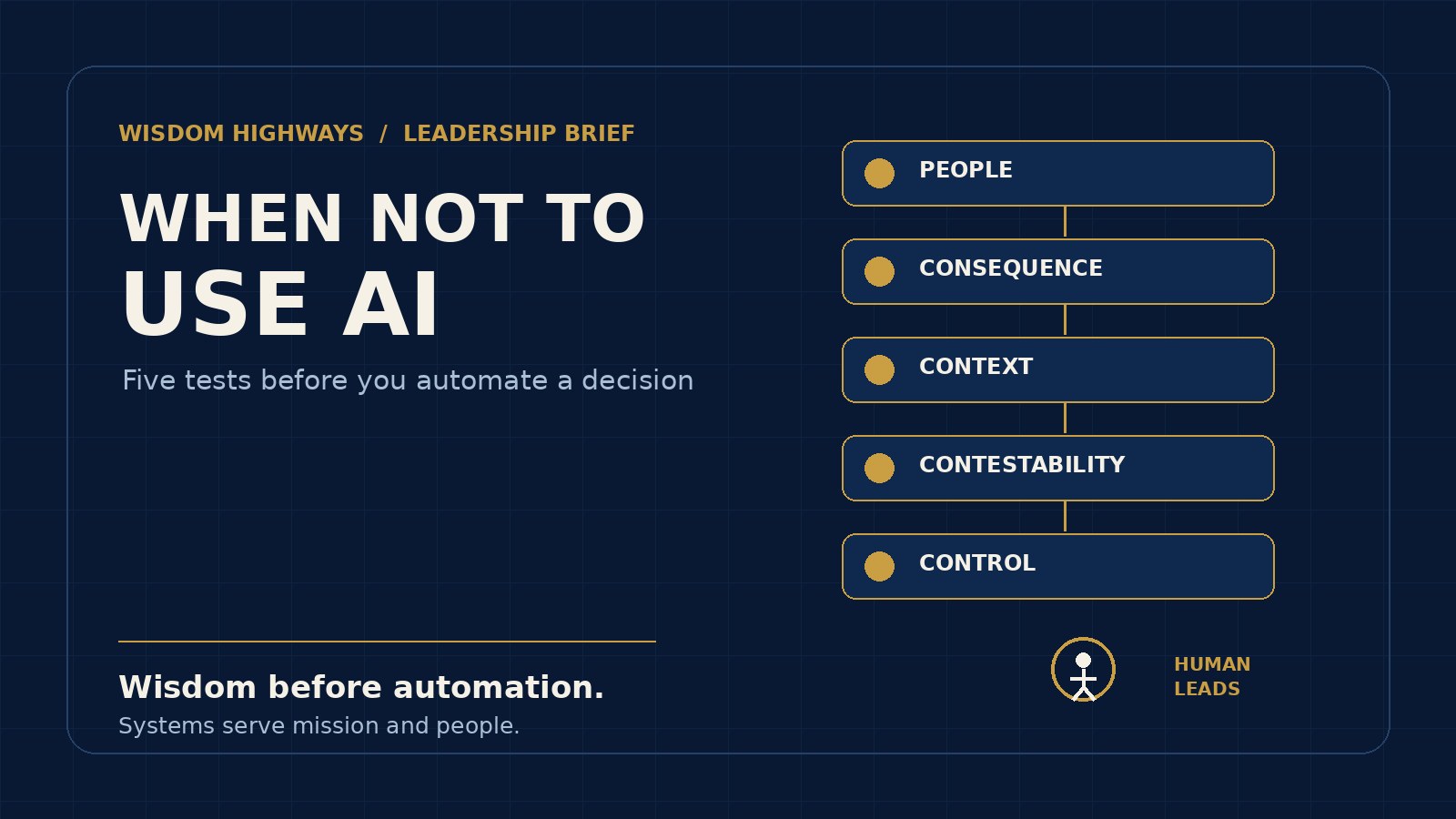
The WH P-C-C-C-C test
Before AI is allowed to act, run five questions: People, Consequence, Context, Contestability and Control. If a workflow fails even one, do not treat it as hands-off automation. Reduce AI’s role, add a meaningful review point or keep the work human-led.
1. People: would this affect someone’s dignity, care or trust?
Start with the person on the other side. Is the work connected to grief, pastoral care, discipline, safeguarding, employment, financial distress, a complaint or a vulnerable person’s request for help?
When the answer is yes, speed should not be the main goal. An AI tool may help an administrator find a policy or prepare a neutral first draft. It should not impersonate empathy, decide whether someone is credible or close a sensitive conversation without a responsible person involved.
Church example: automate an acknowledgement that a prayer request was received, while routing crisis, abuse, self-harm, safeguarding, conflict and confidential pastoral care to a trained human route.
SME example: classify “where is my order?” enquiries, while routing disputed payments, serious complaints and discrimination concerns to a named person.
Ask: If the person later learns AI handled this, would they feel respected and able to reach a real person?
2. Consequence: what happens if the output is wrong?
A typo in an internal summary can be corrected. A wrong message to a donor, applicant, customer or church member can damage trust. A wrong recommendation about staff, finance or safeguarding can cause more lasting harm.
Ask what the realistic downside is if the system is wrong, incomplete or confidently misleading—and whether the impact can be reversed quickly and fairly. The higher the consequence and the harder the reversal, the stronger the human control should be.
A practical rule is: low consequence may be automated; meaningful consequence needs a reviewer; serious or hard-to-reverse consequence needs human authority. This is not fear of technology. It is proportionate leadership.
3. Context: does the system have enough of the real story?
AI can recognise patterns in what it receives. It may not know the history, relationship, unwritten agreement, cultural nuance or recent change that gives a situation meaning.
A late payment might be carelessness, bereavement, an invoicing error or a customer dispute. A volunteer’s silence could mean disengagement, illness, travel or a missed message. A short note may contain irony, grief or a request for discretion that a system cannot reliably interpret.
Ask: What would a wise human use here that will not reliably be in the prompt, form or record? If the answer is “a lot,” let the system assist an informed person rather than decide. Do not solve a context problem by feeding a tool more personal data than the workflow genuinely needs. Use the principles in our AI Data Classification for Leaders guide before sharing information.
4. Contestability: can a person understand, question and correct the result?
A trustworthy process does not trap someone inside a decision they cannot understand or challenge. If AI influences a response, recommendation or ranking, name the person who owns the outcome, the point where a human can intervene and the route for correcting an error.
This does not mean every low-risk draft needs a public explanation. It means consequential workflows should not be designed so that nobody can answer, “Who can review this, and what happens if it is wrong?” The UNESCO Recommendation on the Ethics of AI likewise places human oversight and accountability at the centre of its global guidance.
For practical decision boundaries, see the AI Decision Rights Matrix. For workflows already in use, retain a proportionate record using the AI Audit Trail guide.
5. Control: can you stop, change and govern the workflow?
A workflow is not under control merely because it works today. Leaders should be able to explain who approved it, what data it receives, which tool and integrations it uses, what it may send or decide and how to pause it when something changes.
Before launch, confirm that you can turn the workflow off without losing essential service; identify its owner and approver; remove access when people or vendors leave; review exceptions; update instructions safely; and record significant incidents. The NIST AI RMF Playbook is a useful source of lifecycle-oriented implementation ideas; it is not a substitute for legal, safeguarding or professional advice.
A practical decision table
| If the work is… | Appropriate AI role | Human boundary |
|---|---|---|
| Routine, low-impact and easy to reverse | Automate predictable steps; monitor exceptions | Name an owner and provide a stop switch |
| Repetitive but customer- or member-facing | Draft, classify or route | A person approves promises, unusual cases and sensitive replies |
| Based on incomplete or changing context | Summarise relevant information | A responsible person interprets and decides |
| Sensitive, personal or pastoral | Assist only with approved, minimal information where appropriate | A trusted human leads the interaction and decision |
| High-impact, hard to reverse or difficult to explain | Do not delegate the decision | Human authority, documentation and review are required |
Three mistakes that make “human oversight” meaningless
Automating the visible task, not the real decision. Sending an appointment reminder can be automated. Deciding how to respond when someone repeatedly misses appointments may require history, care and judgement.
Using a reviewer as a rubber stamp. Human oversight is not meaningful if the reviewer has no time, context or authority to challenge the output. Give reviewers criteria, permission to stop the process and a route for exceptions. Our guide to human-in-the-loop AI helps teams make that role concrete.
Enabling a vendor feature because it is convenient. Technical availability is not proof of mission fit. Before connecting a tool to people, data or a core workflow, run a proportionate AI vendor risk review.
A 20-minute pre-automation conversation
Before the next AI experiment, bring together the person who owns the work and the person accountable for its outcome. Ask:
- What problem are we actually trying to solve?
- Which step is repetitive, and which step requires judgement?
- Who could be harmed, excluded or misled if this goes wrong?
- What context is missing from the data the tool will see?
- Who can stop the workflow and correct an exception?
- What will we measure besides speed—quality, trust, complaints, missed cases or rework?
If the answers are unclear, that is not failure. It is a signal to slow down, map the process and choose a smaller, safer starting point. The European Commission’s overview of the EU AI regulatory framework is useful context for organisations serving European markets, but the legal obligations that apply depend on the role, location and use case. Seek qualified advice where that question is material.
Wisdom before automation
The best AI strategy is not the one with the most tools. It is the one that makes wise human work more possible.
Let systems handle the routine steps they can handle responsibly. Let people retain the work that requires judgement, compassion, accountability and trust. That is how a church protects pastoral care, a nonprofit protects dignity and a business protects the relationships on which its reputation depends.
Before you automate the next workflow, assess the readiness of the people, process, data and governance around it. Take the AI & Systems Readiness Assessment to identify where AI can create useful capacity—and where human leadership should remain firmly in charge.
For practical leadership prompts and future resources, you can also join the Wisdom Highways WhatsApp channel.
Related resources
- How to Know If Your Organization Is Ready for AI Automation
- AI Board Oversight: 12 Questions Before Approving AI
- AI Decision Rights Matrix
Keep learning with Wisdom Highways. Follow our WhatsApp Channel for practical AI tips, time-saving ideas, product updates and selected offers.
Follow WH Premium AI Vault on WhatsApp