
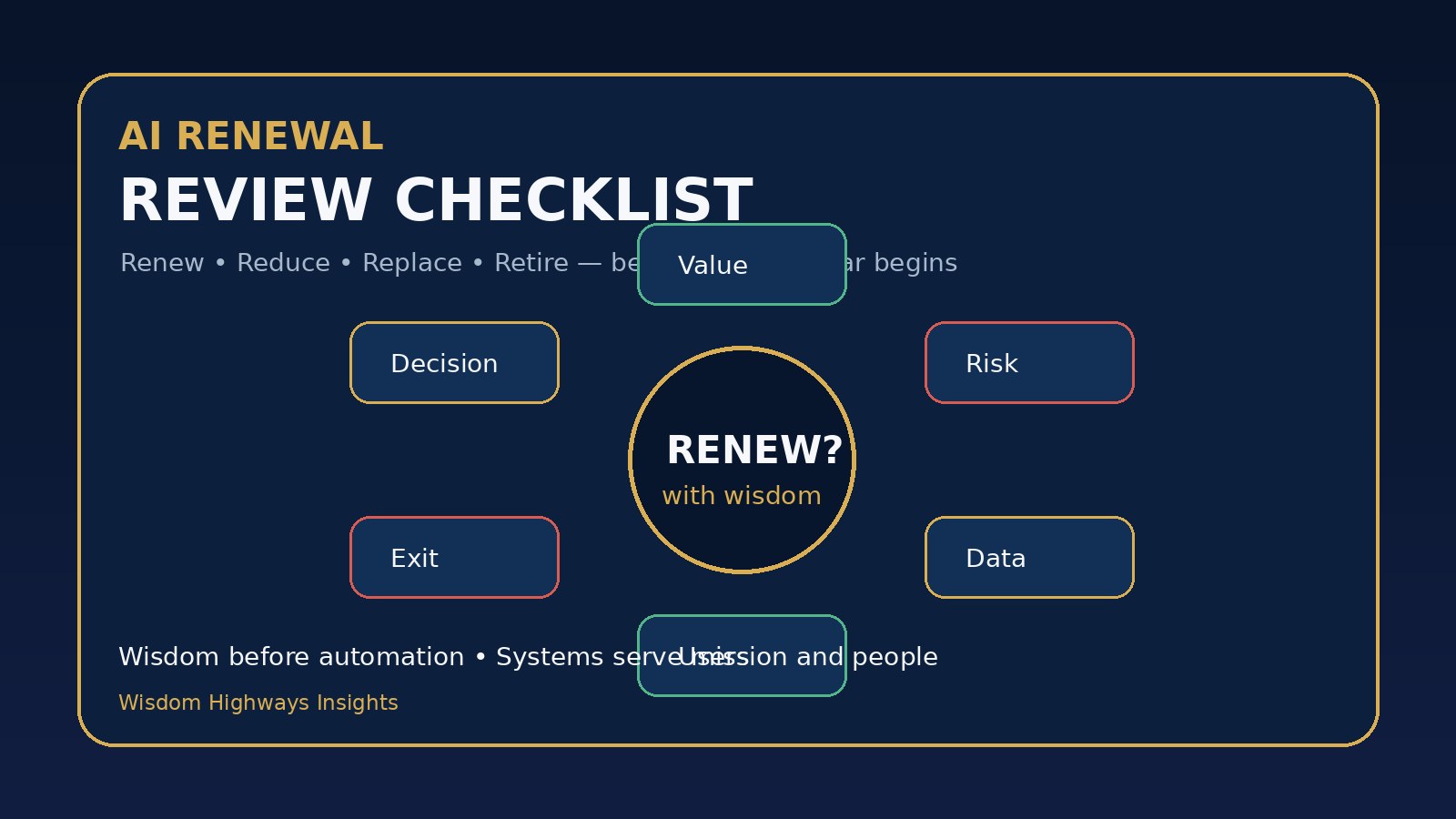
An AI tool should not renew itself just because the card on file still works. Before a church, nonprofit or growing business pays for another month or another annual contract, leaders should pause and ask: has this tool earned the right to remain in our system?
Many organizations are now entering a new stage of AI adoption. The first wave was experimentation: try the chatbot, test the automation, approve the subscription, connect the workflow. The next wave is stewardship: review what is working, what is risky, what is unused, what is duplicated and what should be retired before it becomes permanent clutter.
This AI renewal review checklist helps pastors, ministry administrators, nonprofit leaders and SME owners decide whether to renew, reduce, replace or retire AI tools before the next payment cycle begins.
Why AI renewal deserves leadership attention
Renewal is not only a finance decision. It is a governance decision. A tool that was safe enough for a small pilot may not be safe enough for wider use. A tool that saved time in one workflow may create cost, confusion or data exposure elsewhere. A subscription that looked inexpensive at launch may become expensive when training, review, integrations and support are included.
NIST’s AI Risk Management Framework points leaders toward governing, mapping, measuring and managing AI risk across the lifecycle. OECD’s AI principles emphasize human-centred, robust, secure and accountable AI. The practical lesson for smaller organizations is simple: do not review AI only before launch. Review it again before renewal.
Wisdom Highways frames this as wisdom before automation. If a tool is becoming part of the way your team thinks, communicates, decides or serves people, it deserves a renewal conversation with evidence, not assumption.
Start with your AI tool inventory
A renewal review begins with a truthful list. Which AI tools are approved? Which are still being tested? Which were bought by a department, volunteer, staff member or founder and never added to the main record? Which tools are embedded inside software you already use?
If the organization cannot name its AI tools, owners, users, data access and renewal dates, the first task is not renewal. The first task is an AI tool inventory. Renewal without inventory is how shadow AI quietly becomes operational dependency.
The RENEW checklist
Use the RENEW framework at least 30 days before a paid AI tool renews. For higher-risk tools, use it quarterly or after major workflow changes.
R — Results and value
Ask what value the tool actually produced. Do not rely only on enthusiasm or vendor promises. Look for evidence: time reclaimed, quality improved, bottlenecks reduced, errors prevented, service speed increased, administrative load lowered or decision visibility improved.
- What workflow did the tool improve?
- Who used it regularly, and who stopped using it?
- What changed for staff, volunteers, customers, donors, members or leaders?
- Did the tool create measurable Time Reclamation or only a feeling of modernity?
- Can the value be seen in your AI benefits realization register?
If the tool has no clear owner, no repeated use and no visible value, renewal should not be automatic.
E — Exposure and risk
Review what the tool now touches. Since the original approval, users may have added data, connected integrations, changed prompts, invited more people, enabled automation or used the tool for work that was never intended. A renewal review should identify whether the risk profile has changed.
- Does the tool process personal, pastoral, donor, customer, employee or financial data?
- Have integrations expanded to email, CRM, calendars, forms, files or payment systems?
- Has the vendor changed terms, data practices, model behavior or security features?
- Have there been incidents, near misses, complaints, hallucinations or embarrassing outputs?
- Does your AI monitoring plan show new concerns?
ICO guidance on AI and data protection reminds organizations that personal data use brings accountability duties. CISA’s Secure by Design principle is also relevant: do not deepen dependency on a tool whose preventable weaknesses are already visible.
N — Need and fit
The right tool last year may not be the right tool now. Your team may have changed. The workflow may have improved. Another approved platform may now include the same feature. The original problem may be gone, or it may have been misdiagnosed.
- Is this still the best tool for the workflow?
- Does it duplicate another subscription?
- Has the team outgrown it or barely adopted it?
- Would a better process solve the issue without another tool?
- Should this be compared with your AI procurement checklist again before renewal?
Renewal should prove continuing fit. It should not reward inertia.
E — Economics and ownership
Review total cost, not only the invoice. Include seat licenses, usage fees, training, supervision, prompt maintenance, cleanup work, integration support, review time and the cost of errors. Also ask whether one clear owner remains accountable.
- What did the tool cost in cash and staff time?
- Are all paid seats still needed?
- Who owns administration, access, policy compliance and vendor contact?
- What would happen if that person left?
- Is the renewal monthly, annual, auto-renewing or contract-bound?
A tool with no owner should not quietly renew. Ownership is part of readiness.
W — Way forward
End the review with a decision, not a discussion that disappears. The decision may be renew, reduce, replace, renegotiate, re-pilot, restrict, pause or retire. Record the reason, owner, review date and any required changes.
- Renew when value is proven, risk is governed and ownership is clear.
- Reduce when fewer seats, features or use cases are enough.
- Replace when the tool no longer fits or a safer approved option exists.
- Restrict when the tool is useful but should not touch sensitive workflows.
- Retire when value is weak, risk is high or ownership has disappeared.
If retirement is the answer, use an AI decommissioning plan so data, users, integrations, records and alternatives are handled carefully.
Examples of renewal decisions
Church communications: A church uses an AI writing assistant for announcements, devotional drafts and volunteer follow-up. The tool saves time, but people have begun pasting pastoral care details into it. The wise decision may be renew with restrictions, training and a clearer data rule, not simply renew as-is.
Nonprofit reporting: A nonprofit uses AI to summarize programme notes and draft donor updates. The review shows real time savings, but the team needs stronger anonymization, output review and claims checking before renewal. The decision may be renew after corrective actions.
SME customer support: A business bought an AI support assistant but still handles most enquiries manually because the knowledge base is weak. The renewal decision may be pause or reduce until knowledge base governance is improved.
A 45-minute AI renewal meeting agenda
- Confirm the tool record. Owner, users, renewal date, cost, vendor and approved use case.
- Review value evidence. Time reclaimed, quality gains, user adoption and operational impact.
- Review risk evidence. Data exposure, incidents, integrations, access and vendor changes.
- Check fit. Does the original need still exist? Is there duplication?
- Decide the way forward. Renew, reduce, replace, restrict, re-pilot or retire.
- Record actions. Assign owners, deadlines, training, policy updates and the next review date.
Red flags before renewal
- No one can explain the approved use case.
- The tool has users but no owner.
- Staff use it for sensitive work without clear boundaries.
- The tool has not been reviewed since launch.
- The vendor changed terms or features and no one assessed the impact.
- The tool duplicates another platform.
- The team cannot export data or explain what happens if the subscription ends.
- Leaders are renewing because cancellation feels inconvenient, not because value is proven.
Wisdom Highways perspective
AI renewal is a test of stewardship. It reveals whether the organization is leading the technology or simply being carried forward by subscriptions, habits and convenience. The question is not, “Can we afford another year?” The better question is, “Should this tool continue to serve our mission, our people and our standards?”
Some tools should be renewed with confidence. Some should be reduced. Some should be replaced. Some should be retired with gratitude because they served a season and are no longer right for the work. Wise leaders do not only start well with AI. They review well.
Related Wisdom Highways resources
- AI Procurement Checklist
- AI Tool Inventory Template
- AI Benefits Realization Register
- AI Decommissioning Plan
Sources and further reading
- NIST AI Risk Management Framework — AI risk should be governed, mapped, measured and managed across the lifecycle.
- OECD AI Principles — AI systems should remain human-centred, robust, safe, secure, transparent and accountable.
- UK Government Guidelines for AI Procurement — procurement should include clear needs, risk, accountability and supplier responsibilities.
- UK Government Generative AI Framework — generative AI use requires accountability, assurance, monitoring and human oversight.
- ICO AI and Data Protection Guidance — AI involving personal data requires accountability, fairness, transparency, security and review.
- CISA Secure by Design — technology decisions should reduce preventable security and resilience failures before dependency deepens.
- Google Helpful Content Guidance — public content should be useful, original and people-first.
Freshness note: Prepared and source-checked in October 2026. Review before reuse if AI procurement, data protection, vendor-review or governance guidance materially changes.
Keep learning with Wisdom Highways. Follow our WhatsApp Channel for practical AI tips, time-saving ideas, product updates and selected offers.
Follow WH Premium AI Vault on WhatsApp