Freshness note: Published October 2026. This article should be reviewed as AI tools, governance standards and ministry/business workflows change.
Many leaders do not have an AI problem first. They have a source-of-truth problem. One team member uses a prompt from last month. Another follows an old policy in a shared folder. A volunteer copies sensitive information into a tool because the data rule was buried in a meeting note. A manager approves an automation without knowing who owns the workflow, the review cadence or the stop rule.
The result is not only confusion. It is risk drift. AI begins to move faster than the organization’s memory. People may still be sincere, but they are no longer working from the same map.
An AI source of truth map is a simple leadership document that connects the rules, prompts, data boundaries, owners, workflows and review rhythms your team should trust. It does not need to be complicated. It needs to be clear enough that a pastor, administrator, operations manager, volunteer coordinator or small-business team lead can answer one question quickly: “Where do we look before we act?”
What is an AI source of truth map?
An AI source of truth map is a practical index of the approved documents and decision points that govern how your organization uses AI. It tells the team where to find the current policy, approved prompts, data rules, tool inventory, owners, exception process and review schedule.
Think of it as the table of contents for responsible AI use. It is not the policy itself. It is the map that prevents the policy, prompt library, data classification rules and workflow decisions from living in separate places with separate owners.
Why this matters for churches, nonprofits and small businesses
Large enterprises may have legal, security and compliance departments to chase scattered documents. Most purpose-driven organizations do not. A church office may have a part-time administrator, ministry leaders, volunteers and external vendors. A nonprofit may rely on grant staff and remote contractors. A small business may move quickly because the owner, assistant and marketing lead are all solving urgent problems.
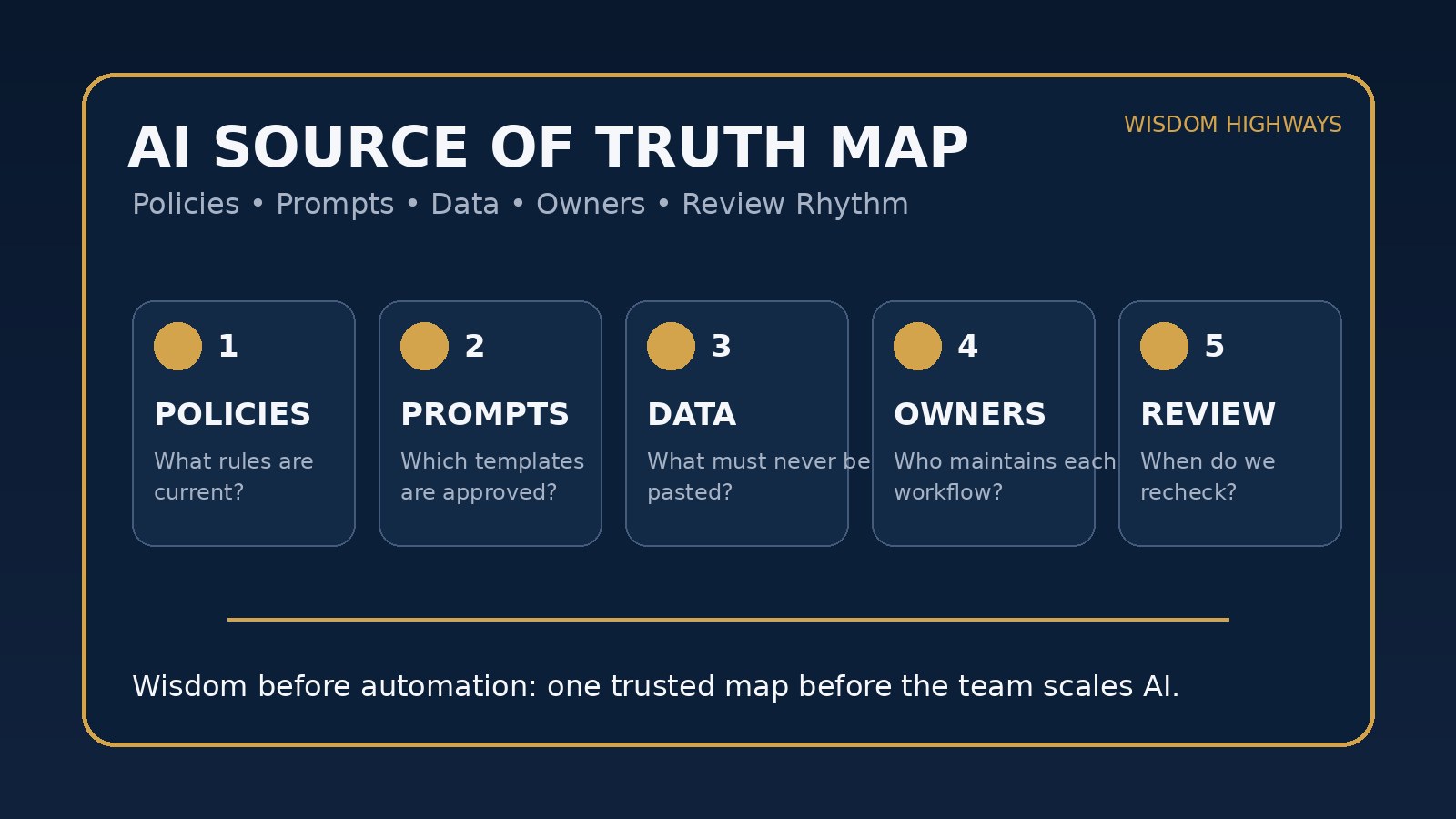
In that environment, AI confusion usually comes from five gaps:
- Policy gap: people do not know which AI rules are current.
- Prompt gap: teams reuse unreviewed prompts for sensitive work.
- Data gap: staff are unsure what can be pasted, summarized or uploaded.
- Ownership gap: no one knows who maintains the tool, workflow or automation.
- Review gap: documents exist, but nobody knows when they must be rechecked.
The Wisdom Highways perspective is simple: wisdom before automation. A faster system is not a better system if it multiplies outdated instructions. AI should serve mission, people and stewardship. That requires a shared map.
The MAPS framework for your AI source of truth
Use the MAPS framework to build a source-of-truth map your team can maintain:
M — Mission-critical rules
List the approved policies and boundaries that must guide AI use. Include your AI policy, data privacy rules, approval workflow, incident response plan and any ministry, donor, client or customer confidentiality expectations. The goal is not to create bureaucracy. The goal is to make the right rule easy to find before someone makes a risky decision.
A — Approved assets
Record the approved AI tools, prompts, templates, automation workflows and knowledge-base pages your team should use. If your team has an approved sermon-summary prompt, customer-email prompt, board-report template or donor-communication workflow, the map should point to the current version. This protects quality and reduces quiet improvisation.
P — People and ownership
Name the accountable owner for each major document, tool and workflow. The owner does not have to do every task personally, but someone must be responsible for accuracy, access, review and escalation. If everything is “shared,” eventually nothing is owned.
S — Schedule for review
Add the review rhythm. Some items may need monthly review, such as access lists or active automations. Others may need quarterly or annual review, such as policies, vendor records or training materials. The map should make stale instructions visible before they become operational habits.
What to include in the map
Start with a simple table. Do not wait for a perfect governance platform. A well-maintained spreadsheet or internal page is better than a beautiful system no one updates.
| Map item | What it answers | Owner | Review rhythm |
|---|---|---|---|
| AI policy | What is allowed, restricted or prohibited? | Senior leader / operations owner | Quarterly or after major tool changes |
| Tool inventory | Which AI tools are approved or under review? | Operations / IT / admin lead | Monthly |
| Data classification | What can be shared, restricted or never pasted? | Data/privacy owner | Quarterly |
| Prompt library | Which prompts are approved for repeat use? | Workflow owner | Monthly for active prompts |
| Approval workflow | Who signs off before launch or scale? | Department or ministry lead | After each pilot |
| Incident response | What happens when something goes wrong? | Executive/operations owner | After every incident or twice yearly |
A practical example
Imagine a church wants to use AI to summarize ministry reports and draft volunteer communications. Without a source-of-truth map, leaders may approve the idea in a meeting, store prompts in one person’s account, keep data rules in another document and forget to update volunteers when the process changes.
With a source-of-truth map, the team can see: the approved tool, the approved prompt, the “never paste” data categories, the person who reviews the draft before it goes out, the fallback process when the tool is unavailable and the next review date. The system becomes easier to trust because the people around it are clear.
The same pattern works for a small business using AI to prepare proposals or a nonprofit using AI to organize grant notes. The question is not “Can AI help?” The question is “Can the team find the right boundary, owner and review step before using it?”
Common mistakes to avoid
- Making the map too complex. If only one technical person understands it, the map will not guide daily decisions.
- Linking to stale documents. A source-of-truth map with old links creates false confidence.
- Listing tools without owners. Inventory without accountability still allows drift.
- Approving prompts without data rules. A good prompt can still be unsafe when used with the wrong information.
- Forgetting volunteers and vendors. The people outside payroll often need the clearest instructions.
- Treating review as optional. AI tools change; your map must have a rhythm for rechecking reality.
How to build the first version in one hour
- List the AI-related documents you already have. Include policies, prompts, training notes, tool lists and approval steps.
- Mark each item as current, uncertain or outdated. Do not pretend old documents are approved if no one has reviewed them.
- Name an owner for each item. If there is no owner, assign a temporary steward before the next leadership meeting.
- Add the next review date. A weak date is better than no date; it creates a trigger for accountability.
- Connect the map to daily workflow. Put the link where staff actually work: onboarding notes, team dashboard, project template or operations manual.
- Test it with one real scenario. Ask, “If someone wanted to use AI for this task today, could they find the tool, prompt, data rule, owner and review step?”
Evidence and governance grounding
This article does not claim that every organization needs enterprise-grade AI management software. It does reflect a broader global pattern: responsible AI and cybersecurity guidance increasingly emphasizes governance, mapping, inventories, accountability, risk management and review. NIST’s AI Risk Management Framework points leaders toward governing, mapping, measuring and managing AI risk. NIST’s Cybersecurity Framework 2.0 and the CIS Controls reinforce the importance of knowing assets, roles and protective practices. OWASP’s LLM guidance highlights risks that become harder to manage when tools, data flows and responsibilities are unclear.
For churches, nonprofits and small businesses, the practical translation is not “copy a corporate compliance manual.” It is: create a clear, living map so people can act wisely before speed becomes confusion.
Related Wisdom Highways resources
- AI Tool Inventory Template
- AI Data Classification for Leaders
- AI Prompt Library Governance
- AI Ownership Register
- AI Governance Review Cadence
Before you scale AI, check your readiness
If your organization is using AI but your policies, prompts, data rules and owners are scattered, do not treat that as failure. Treat it as a signal. You may not need more tools yet. You may need a wiser operating system around the tools you already have.
Keep learning with Wisdom Highways. Follow our WhatsApp Channel for practical AI tips, time-saving ideas, product updates and selected offers.
Follow WH Premium AI Vault on WhatsApp