
AI Readiness · Governance · Leadership Systems
AI Governance Review Cadence: How Often Leaders Should Recheck AI Tools After Launch
Approving an AI tool is not the finish line. For pastors, nonprofit leaders and small-business owners, the more important question is what happens after the tool is already inside daily work.
AI systems change. Staff habits change. Vendors update features. A safe use case can become risky when the data, audience, workflow or decision changes. That is why Wisdom Highways recommends a simple AI governance review cadence: a rhythm of small, human-led checks that keeps automation aligned with mission, trust and people.
Why AI needs a review rhythm after launch
Many organizations treat AI approval like a one-time purchase decision: choose a tool, train the team, write a short policy and move on. That is understandable, but it is not enough.
AI governance is not only about stopping bad tools. It is about making sure approved tools continue to serve the right purpose, use the right data, produce work that humans can trust, and fit the organization’s values as real-world use grows.
For Wisdom Highways, the goal is not bureaucracy. The goal is wise continuity: enough structure to prevent drift, without creating meetings that steal back the time AI was meant to reclaim.
The Wisdom Highways 30-60-90-quarterly cadence
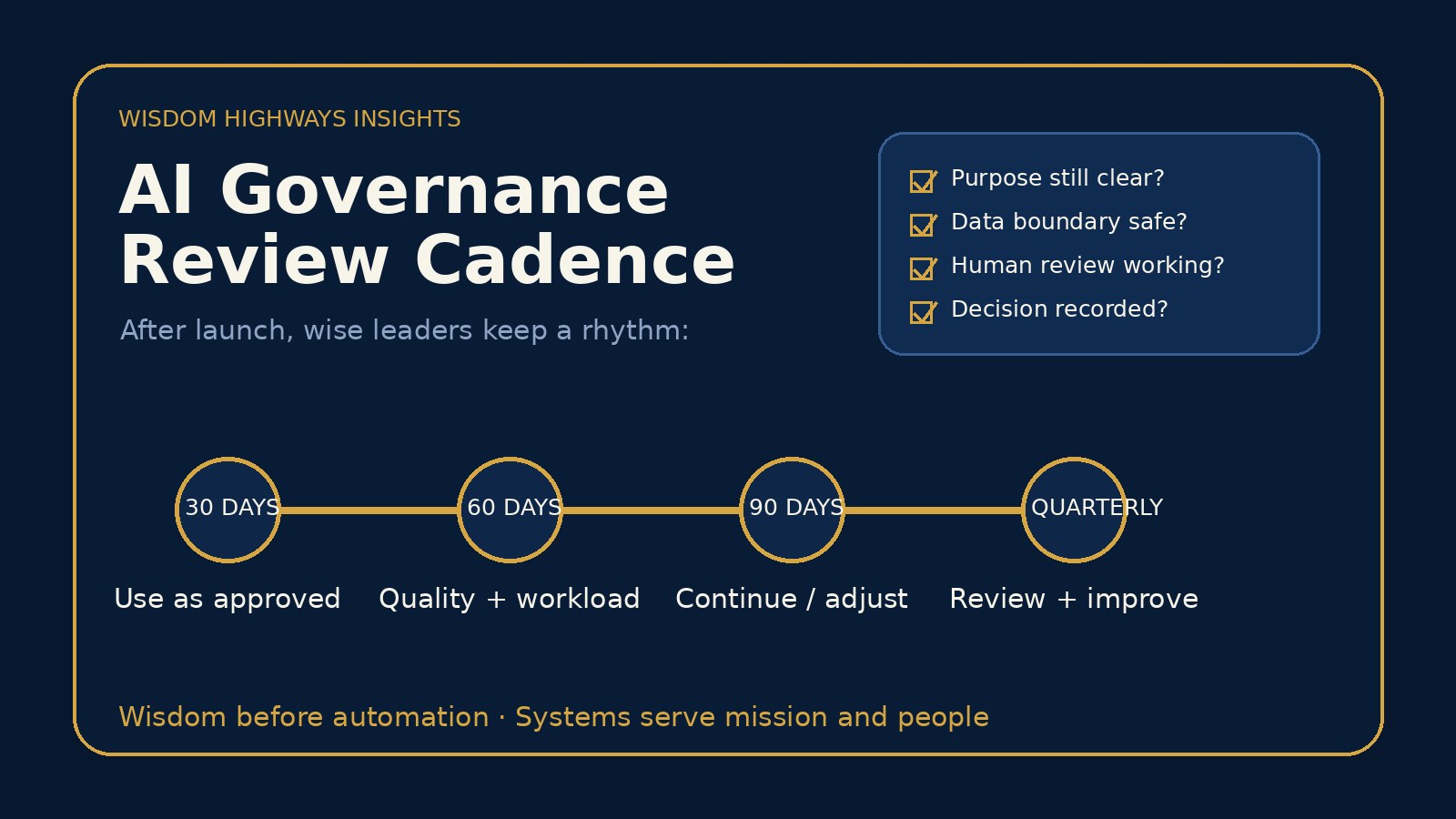
A practical cadence does not need to be complex. Start with this rhythm for every meaningful AI workflow:
1. First 30 days: confirm the tool is being used as approved
In the first month, check whether the team is using the AI tool for the original purpose. Ask: Are staff following the data boundary? Are humans reviewing outputs? Are there early complaints, mistakes or workarounds?
2. Day 60: review output quality and human workload
By the second month, patterns are visible. Review samples of AI-assisted work. Look for repeated errors, tone problems, missed context, privacy concerns or hidden rework. Time Reclamation is only real if the saved time is not being spent fixing preventable mistakes later.
3. Day 90: decide whether to continue, adjust, pause or scale
At 90 days, leaders should make a clear decision. Continue if the tool is useful and governed. Adjust if the workflow needs better prompts, training or approval steps. Pause if the risk is rising. Scale only when the evidence supports it.
4. Quarterly thereafter: keep the system aligned
After the first 90 days, most low-to-medium-risk workflows can move to a quarterly review. High-risk workflows may need monthly review. Very low-risk workflows, such as internal brainstorming with no sensitive data and no public output, may only need a lighter check unless something changes.
What leaders should review each time
Every AI review should answer seven questions in plain language:
- Purpose: Is this AI tool still being used for the approved purpose?
- People: Who is affected by the outputs — members, donors, customers, staff, students, suppliers or the public?
- Data: What information is being entered, uploaded or connected? Has any personal, pastoral, donor, customer, financial or confidential data boundary changed?
- Human review: Who checks outputs before they affect people or decisions?
- Quality: What mistakes, hallucinations, tone issues, bias risks or rework have appeared?
- Vendor/tool change: Has the provider changed features, terms, model behavior, integrations or retention settings?
- Decision: Continue, adjust, pause, escalate, retire or scale?
The review should end with an owner, a decision and a date for the next check. Without those three items, the meeting may feel productive but governance remains weak.
Examples for churches, nonprofits and SMEs
Church or ministry example
A church uses AI to draft weekly announcements, volunteer reminders and first-pass sermon-series communication. A 30-day review may find that the tone is helpful, but one staff member started using the tool to summarize sensitive pastoral-care notes. The right response is not to ban AI everywhere. It is to reinforce the data boundary, update the prompt guide, and keep pastoral/confidential material outside public AI tools unless a properly governed system exists.
Nonprofit example
A nonprofit uses AI to help draft donor updates and grant-report narratives. A quarterly review may show that AI saves writing time but occasionally overstates impact. The governance fix is to require human verification against approved program data before any funder-facing statement is sent.
Small business example
An SME uses an AI chatbot to answer customer questions. A review may reveal that the bot handles basic questions well but gives outdated refund information after a policy change. The leader should update the knowledge base, test common scenarios and assign a monthly owner for accuracy checks.
One-page AI governance review checklist
Use this checklist at each review:
- Tool/workflow name:
- Owner:
- Approved use case:
- Current actual use:
- Data entered or connected:
- People affected:
- Human review step:
- Known incidents, complaints or corrections:
- Output-quality sample reviewed:
- Vendor or feature changes since last review:
- Policy or training updates needed:
- Decision: continue / adjust / pause / retire / scale:
- Next review date:
This is intentionally simple. A small organization does not need enterprise paperwork before it can practice wisdom. It needs a repeatable rhythm that leaders can actually keep.
How often should different AI workflows be reviewed?
| Workflow risk | Examples | Suggested cadence |
|---|---|---|
| Low | Internal brainstorming, meeting agenda drafts, non-sensitive content outlines | 90-day initial review, then semiannual or when use changes |
| Medium | Marketing drafts, donor communications, customer support drafts, volunteer messages | 30-60-90, then quarterly |
| High | Pastoral care notes, financial decisions, employment-related screening, legal/medical/regulated advice, public automated replies | Monthly or before use; often requires specialist/legal/data-protection review |
When in doubt, review more often at the beginning and reduce frequency only after the tool has proven stable, useful and governed.
Common mistakes to avoid
- Reviewing only the tool, not the workflow. The risk often appears in how people use the tool, not in the product name.
- Counting time saved but ignoring trust cost. One inaccurate donor, customer or member communication can consume more time than the AI saved.
- Scaling before evidence. A pilot that works for one team may fail when copied into a different department, ministry or market.
- Letting vendors define your governance. Vendor documentation helps, but your mission, audience, data and accountability still belong to your leadership.
- Failing to retire tools. Governance includes the courage to stop using a tool that no longer serves people well.
Wisdom Highways perspective: review is stewardship, not fear
Leaders do not need to fear every new AI capability. But they should also not outsource discernment to software. Technology can accelerate work, but wisdom decides what kind of work deserves acceleration.
A review cadence protects the best parts of automation: saved time, clearer systems, better responsiveness and less repetitive work. It also protects the deeper things: trust, reputation, pastoral care, customer confidence, staff judgment and mission integrity.
If your organization is already using AI but has no review rhythm, start with one workflow this week. Name the owner. Review the data boundary. Check five outputs. Record a decision. Set the next review date. That small discipline can prevent larger problems later.
Need help knowing whether your systems are ready?
Take the Wisdom Highways AI & Systems Readiness Assessment. It helps leaders identify where AI, automation and workflow decisions need stronger foundations before scaling.
Related Wisdom Highways insights
Evidence and source notes
This article adapts general governance principles into a practical review cadence for small and purpose-driven organizations. Useful references include:
- NIST AI Risk Management Framework — govern, map, measure and manage framing for AI risk.
- NIST Generative AI Profile — generative AI risks and ongoing risk management considerations.
- OECD AI Principles — human-centered values, transparency, robustness, security and accountability.
- UK ICO guidance on AI and data protection — data-protection duties where AI uses personal information.
Freshness note: AI tools, vendor terms and regulations continue to change. Review this guidance alongside your local legal, data-protection and sector requirements before applying it to high-risk workflows.
A simple review meeting agenda leaders can actually keep
If the review rhythm feels heavy, reduce the meeting to four movements: look back, look closely, decide, and assign. First, look back at what the AI tool was approved to do. Second, look closely at a small sample of real outputs and the data people used to produce them. Third, decide whether the workflow should continue as-is, continue with safeguards, pause for repair, or be retired. Fourth, assign one owner and one date. That is enough to move governance from theory into leadership practice.
This is also where wisdom before automation becomes practical. The leader is not asking, “Can the tool do more?” The leader is asking, “Should this tool keep serving this mission, these people and this season?” That question protects churches from careless communication, nonprofits from overstated impact claims, and businesses from customer trust damage.
It also protects Time Reclamation. AI should reduce avoidable work, not quietly create new cycles of checking, correcting, apologizing and rebuilding confidence. If the review shows that a workflow saves ten minutes but creates uncertainty for three people downstream, the system has not truly reclaimed time. It has only moved the burden.
Finally, the review should reconnect the tool to mission. A purpose-driven organization should never let technology become a detached experiment. AI is useful when it helps people serve better, communicate more clearly, make wiser decisions and steward limited capacity. Systems serve mission and people; mission and people should never be forced to serve the system.
Keep learning with Wisdom Highways. Follow our WhatsApp Channel for practical AI tips, time-saving ideas, product updates and selected offers.
Follow WH Premium AI Vault on WhatsApp