
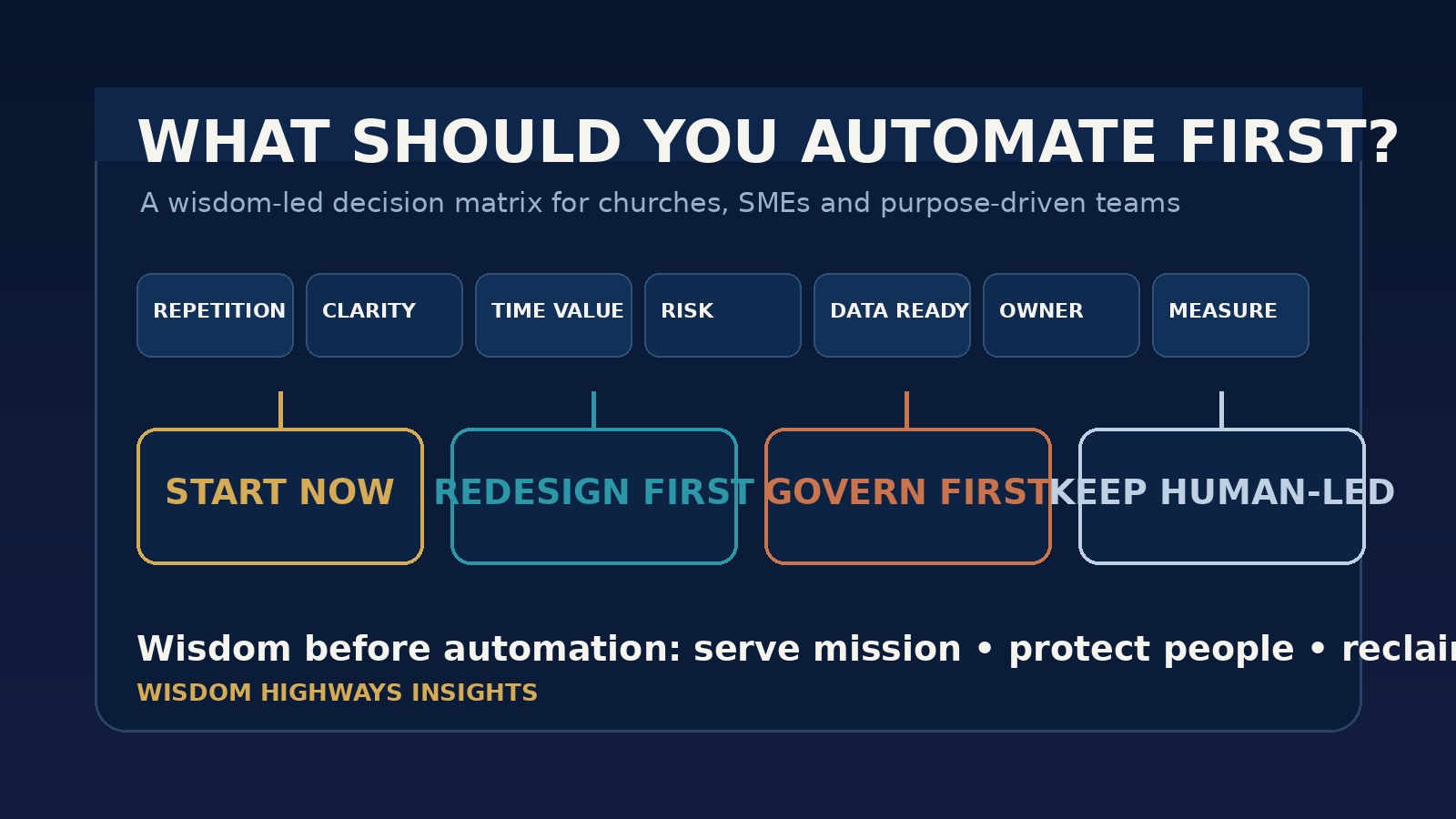
Most leaders do not need more automation ideas. They need a wise way to choose the first one. When every tool promises speed, the real leadership question becomes: which workflow should we automate now, which should we redesign first, and which should remain intentionally human?
A church administrator may want help with visitor follow-up, volunteer reminders and sermon-clip repurposing. A small-business owner may want automated lead responses, invoice chasing and content scheduling. A nonprofit director may want cleaner donor communication and board reporting. Each idea may be useful, but the wrong first project can waste time, create confusion or damage trust.
Why “what should we automate first?” is a leadership decision
Automation is often treated as a technical question: Which software? Which AI tool? Which integration? But the better starting point is stewardship. Leaders are deciding where human attention should be reclaimed and where responsibility must remain visible. That matters for pastors, ministry teams, SMEs and purpose-driven organizations because the goal is not to look modern; the goal is to serve people better with less operational drag.
Current global AI guidance supports this cautious but practical approach. The NIST AI Risk Management Framework encourages organizations to map context, measure risk and manage AI use. The OECD AI Principles emphasize human-centred values, transparency and accountability. The Microsoft Work Trend Index 2025 reflects the continuing pressure on knowledge workers to manage growing digital work with AI support. The UK ICO guidance on AI and data protection is a reminder that data boundaries must be considered before teams upload sensitive information into tools.
The practical takeaway is simple: start with work that is frequent, rule-based, low-to-moderate risk, measurable and already understood. Delay work that is sensitive, doctrinally nuanced, emotionally complex, legally exposed or poorly defined.
The Wisdom Highways first-automation decision matrix
Use this matrix before choosing your next automation pilot. Score each candidate workflow from 1 to 5 in the seven areas below. A strong first project usually scores high on value and clarity, but low on sensitivity and complexity. The purpose is not mathematical perfection; it is leadership clarity.
1. Repetition: how often does the task happen?
High-repetition work is usually a better starting point than rare work. Weekly visitor follow-up, appointment reminders, intake sorting, content repurposing and invoice reminders often justify automation because the time savings compound. A once-a-quarter report may still matter, but it may not be the best first win unless it is especially painful or visible.
2. Clarity: is the process already understood?
Automation exposes messy processes. If nobody can describe the current steps, exceptions and desired outcome, the first job is process clarification, not software. A clear workflow has a defined trigger, input, action, owner, approval rule and completion point.
3. Time value: how much human attention can be reclaimed?
Look beyond minutes saved. Ask whose attention is being freed and what mission-serving work they can return to. Reclaiming three hours from a senior pastor, founder or revenue owner may matter more than saving ten minutes in a task nobody notices. Wisdom Highways often frames this as Time Reclamation: technology should return meaningful human capacity, not merely create a busier digital machine.
4. Risk and sensitivity: what could go wrong?
Some tasks are repetitive but still sensitive. Pastoral care, conflict communication, counseling, hiring decisions, financial advice, children’s ministry information, confidential client records and public theological positioning require strong human ownership. AI may assist with structure or reminders, but it should not become the unseen decision-maker.
5. Data readiness: is the required information clean and permissible to use?
Many automation failures are really data failures. If contact records are duplicated, consent status is unclear, notes are scattered or sensitive information has no boundary, the pilot may need a data-cleanup step first. Before AI touches the workflow, decide what data may be used, what must be anonymized, and what should never be entered into unapproved tools.
6. Human ownership: who approves, monitors and improves it?
Every automated workflow needs a named owner. This is especially important for small teams where one person may wear many hats. If an automated welcome sequence sends the wrong message, who pauses it? If AI drafts a donor email, who approves it? If a lead follow-up system fails, who notices? Ownership keeps automation accountable.
7. Measurement: can success be observed within 30 days?
A good first pilot should produce visible learning quickly. Useful measures include hours reclaimed, response time, fewer missed follow-ups, fewer manual handoffs, better consistency, reduced errors or clearer reporting. If no one can name the success measure, the project is not ready.
A simple scoring guide
- Start now: high repetition, clear process, clear owner, measurable value, low sensitivity and manageable data.
- Redesign first: valuable task, but the process is unclear, data is messy or ownership is missing.
- Govern first: promising task, but it involves sensitive personal, pastoral, client, financial, child-related or public-facing information.
- Keep human-led: work requiring discernment, relationship repair, spiritual counsel, final leadership judgment or high-trust decisions.
This guide prevents two common mistakes: automating the loudest pain before understanding it, and delaying every improvement because the organization is waiting for a perfect AI strategy. The wise path is disciplined momentum.
Examples for churches and ministry teams
Good first candidates
- Visitor follow-up reminders after Sunday services, with human review before personal messages go out.
- Volunteer scheduling prompts and confirmation reminders.
- Sermon or teaching repurposing into draft outlines, clips, summaries and social captions for human editing.
- Event registration confirmations, preparation emails and post-event feedback collection.
- Internal FAQ support for staff or volunteers using approved documents.
Handle with stronger governance
- Pastoral counseling responses or emotionally sensitive care communication.
- Children, youth or vulnerable-person information.
- Doctrine-sensitive teaching summaries that have not been reviewed by a trusted leader.
- Public statements during conflict, crisis or grief.
- Financial giving conversations where trust and confidentiality are central.
The ministry question is not, “Can AI help?” It often can. The better question is, “Where can AI reduce administrative weight without weakening shepherding, discernment or trust?”
Examples for SMEs, nonprofits and purpose-driven organizations
Good first candidates
- New-lead acknowledgment and routing so prospects are not left waiting.
- CRM cleanup prompts, duplicate detection and task creation.
- Proposal or quote follow-up reminders with human-approved language.
- Meeting-note summaries, action-item extraction and owner assignment.
- Content repurposing from webinars, workshops, podcasts or long-form articles.
Handle with stronger governance
- Legal, medical, tax, financial or compliance-sensitive advice.
- Hiring, firing or performance decisions.
- Customer complaints requiring empathy and judgment.
- Use of confidential client data in non-approved AI tools.
- Automated public replies where tone can affect reputation.
For SMEs, the strongest first automation is often near revenue, response time or delivery consistency — but only when the message and handoff are human-owned. Speed without trust is not growth.
The 30-minute leader workshop
If you need a fast starting point, gather the people closest to the work and run this short exercise.
- List: write down ten repetitive tasks that drain time or cause missed opportunities.
- Score: rate each task from 1 to 5 for repetition, clarity, time value, risk, data readiness, ownership and measurability.
- Sort: place each task into Start Now, Redesign First, Govern First or Keep Human-Led.
- Select: choose one pilot that can be tested safely within 30 days.
- Define: name the owner, success measure, approval rule and rollback plan before building anything.
This workshop is intentionally simple. It gives leadership a shared language before tools enter the conversation. In many organizations, that shared language is the difference between scattered AI experiments and a real automation roadmap.
Common mistakes to avoid
- Automating a broken process: if the current workflow is confusing, automation will usually make the confusion faster.
- Choosing the fanciest tool first: tool selection should follow workflow clarity, not replace it.
- Ignoring data boundaries: convenience is not a substitute for confidentiality, consent or stewardship.
- Removing humans from trust moments: some moments should be assisted by systems but owned by people.
- Failing to measure: if the team cannot see whether the pilot worked, it will be hard to improve or justify scaling.
How this connects to your AI automation roadmap
Your first automation should not be an isolated trick. It should become evidence for your broader roadmap. If the pilot works, document what changed: which trigger was reliable, which data was needed, which approval step mattered, which messages required human editing, and what time or errors were reduced. Then use those lessons to choose the next workflow.
If you already read How to Build an AI Automation Roadmap, this decision matrix fits into the first stage: choosing a wise starting point. If your team has not yet defined boundaries, pair this article with the AI Governance Checklist for Churches and Small Businesses. If you are unsure whether the organization is ready, review How to Know If Your Organization Is Ready for AI Automation.
A wise first project beats a dramatic first project
The best first automation may not be the most impressive. It may be the small workflow that stops leads from being forgotten, helps volunteers receive timely reminders, turns one teaching resource into five useful formats, or gives a leader back two focused hours every week. That kind of improvement builds confidence because people can feel the difference.
Wisdom before automation means asking: Does this serve the mission? Does it protect people? Does it reclaim meaningful time? Does a human still own the outcome? When the answer is yes, automation becomes more than efficiency. It becomes stewardship.
Related resources
- 7 Repetitive Business Tasks You Should Stop Doing Manually
- 15 Tasks Pastors and Church Teams Can Automate Today
- AI vs Automation: What’s the Difference, and Which One Do You Need?
- Take the AI & Systems Readiness Assessment
Sources and further reading
- NIST AI Risk Management Framework
- OECD AI Principles
- Microsoft Work Trend Index 2025
- UK ICO AI and data protection guidance
Freshness note: Prepared September 2026. Review after major AI regulation, data-protection or platform-policy changes, and update examples as Wisdom Highways publishes new case-informed frameworks.