
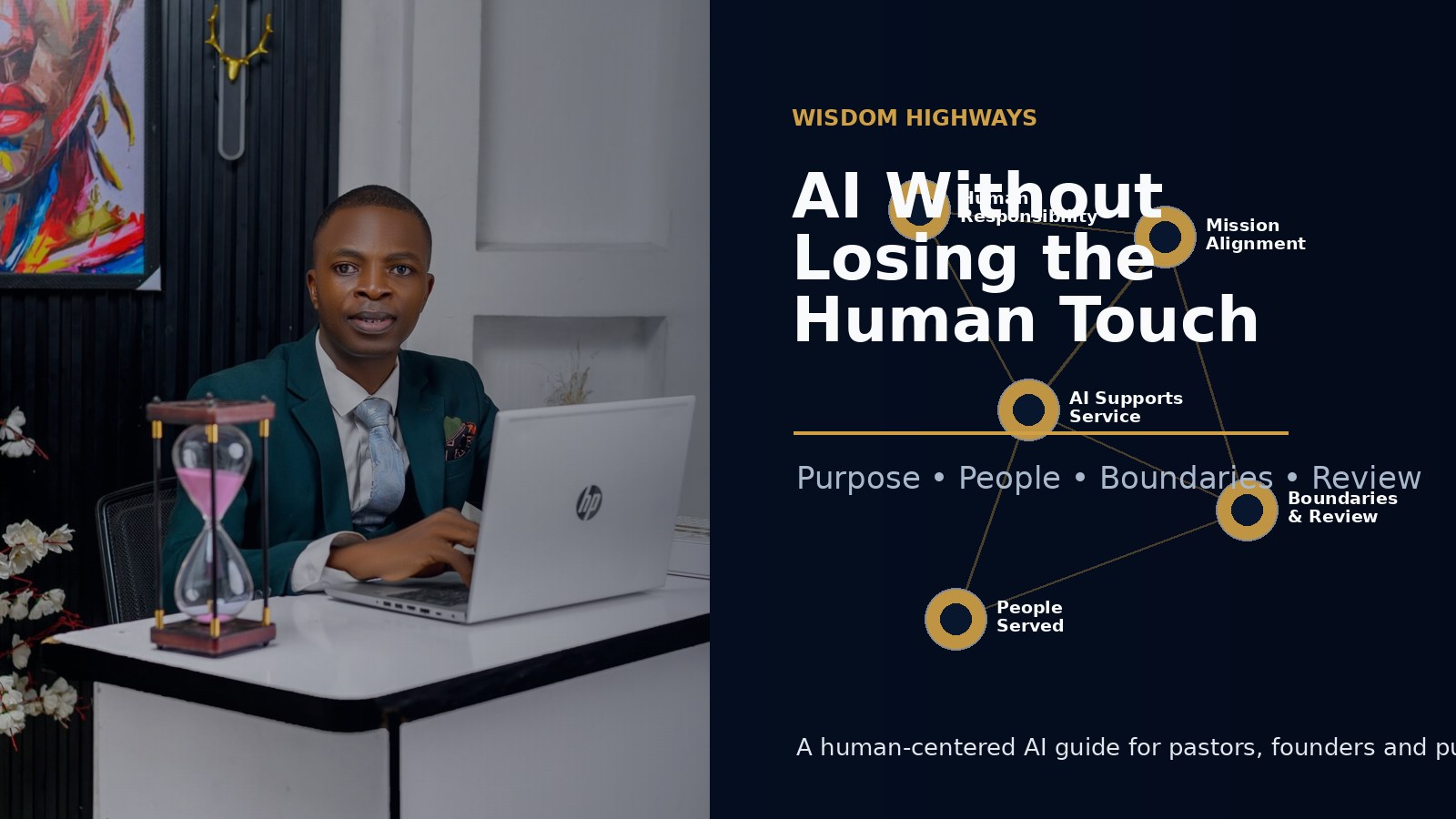
Wisdom Highways Leadership & AI
Purpose-driven organizations do not lose their human touch because they use AI. They lose it when they let speed replace care, automation replace discernment, and tools make decisions that leaders have not governed wisely.
For pastors, ministry teams, founders, nonprofits and values-led SMEs, this is the real question: Can AI help us serve people more consistently without becoming cold, mechanical or careless?
The answer is yes — but only if wisdom leads the implementation. AI should remove unnecessary friction from the work, not remove the people from the mission.
Search intent answered: can AI be human-centered?
Many leaders are not asking for a technical lecture. They are asking whether AI can fit an organization built on trust, care, service and moral responsibility. They want to know:
- which tasks AI can support without damaging relationships;
- which decisions should remain human-led;
- how to protect privacy, dignity, tone and reputation;
- how to introduce AI without frightening staff, members, volunteers or customers;
- how to measure whether AI is actually improving service.
This guide gives a practical framework for using AI in a way that supports people, protects values and strengthens mission.
What “human touch” really means
Human touch is not just a warm tone in an email. It is the presence of human judgment where people’s lives, trust and dignity are involved.
For a church, human touch may mean pastoral sensitivity, prayerful discernment, confidentiality and care when someone is grieving, struggling or asking for help. For a business or nonprofit, it may mean honesty, accountability, fairness, empathy and the ability to understand nuance beyond a form submission.
AI can help an organization respond faster. Wisdom decides where a person must remain present.
What global guidance says: AI needs human governance
Current international AI guidance consistently points in the same direction: AI systems need accountability, transparency, risk management and human oversight. The NIST AI Risk Management Framework frames trustworthy AI around managing risks such as validity, safety, security, accountability, transparency, explainability, privacy and fairness. The OECD AI Principles emphasize human-centered values, transparency, robustness, accountability and inclusive growth. UNESCO’s Recommendation on the Ethics of Artificial Intelligence also stresses human rights, dignity, oversight and social impact. Privacy-focused guidance such as the UK Information Commissioner’s Office AI guidance reinforces the need to consider personal data, accountability and risk before deploying AI in people-facing workflows.
Faith-aligned leaders should hear something important in that global conversation: technology is powerful, but it is not morally neutral in practice. The question is not only “Can this be automated?” The wiser question is “What kind of organization will this automation help us become?”
Where AI can strengthen care instead of weakening it
Used wisely, AI can increase consistency and reduce hidden delays. It can help teams notice what used to fall through the cracks.
1. Faster first response
AI can help classify inquiries, draft a first response and route the matter to the right person. A church visitor, donor, client or volunteer should not wait for days because the team is buried in admin. But sensitive replies should still be reviewed by a human.
2. Better follow-up
Many organizations do not lack compassion; they lack a reliable follow-up system. AI-supported workflows can remind leaders who needs a call, which forms are incomplete, which newcomers need orientation and which client commitments are overdue.
3. Clearer internal knowledge
AI can help turn scattered documents, meeting notes, FAQs, policies and ministry information into a searchable knowledge base. This protects institutional memory and makes service more consistent across teams and locations.
4. More time for relationship work
The best use of AI is not to replace meaningful human service. It is to reclaim time from repetitive tasks so leaders can spend more energy on judgment, discipleship, care, strategy, creativity and leadership.
What should remain human-led
Purpose-driven organizations should not automate everything simply because the tool allows it. Keep human leadership in areas where dignity, discernment and responsibility are central.
- Pastoral care and counselling: AI may help organize notes or draft general resources, but it should not become the shepherd, counsellor or spiritual authority.
- Conflict and discipline: Complaints, correction, HR matters and relational conflict require human wisdom and accountability.
- Legal, financial, medical and safeguarding decisions: AI output can be wrong or incomplete. These areas need qualified human review.
- Personal data and confidentiality: Leaders must decide what data should never enter an AI tool and who is allowed to access it.
- Public claims and promises: AI can draft, but a responsible leader must verify before anything is published.
The rule is simple: AI can prepare, summarize, organize and suggest. Human leaders must govern, verify and carry responsibility.
A Wisdom Highways framework: the H.U.M.A.N. test
Before using AI in a people-facing process, run the workflow through the H.U.M.A.N. test.
H — Human responsibility
Who owns the final decision? If nobody is clearly responsible, the workflow is not ready for AI.
U — Useful burden removed
What real burden does this remove? If the use case only adds novelty, complexity or noise, it is not a priority.
M — Mission alignment
Does this support the organization’s purpose, values and service promise? If it makes the organization faster but less faithful to its purpose, pause.
A — Appropriate boundaries
What data, tools, language, actions and decisions are off-limits? Boundaries should be written before deployment, not after a mistake.
N — Noticeable improvement
How will the team know the system helped? Measure response time, completion rate, error reduction, staff workload, client/member experience and human-review quality.
Ministry example: visitor follow-up without losing pastoral care
A church may receive visitor cards, prayer requests, event sign-ups and volunteer questions every week. AI can help organize those inputs, identify the correct next step and draft a warm follow-up message. The workflow might label each item as “new visitor,” “volunteer interest,” “event question” or “pastoral care concern.”
But the system should be designed with boundaries. A general welcome note may be approved quickly. A prayer request involving grief, illness, abuse, family conflict or crisis should be routed to a human leader. The technology supports consistency; it does not carry pastoral authority.
SME example: client onboarding without becoming impersonal
A purpose-driven business may use AI to summarize a discovery call, prepare an onboarding checklist, draft a welcome email and remind the team of promised deliverables. This can make the client experience smoother and reduce missed steps.
But the founder or account lead should still review the client’s priorities, clarify expectations and personalize the relationship. Automation should make the company more attentive, not more distant.
Common mistakes to avoid
- Starting with the most sensitive workflow. Begin with narrow, reviewable tasks before touching care, complaints or confidential decisions.
- Confusing tone with trust. A warm AI-written message is not enough. Trust requires accuracy, confidentiality and responsible follow-up.
- Letting tools define the process. Map the workflow first, then choose the technology.
- Using unapproved source material. AI should draw from verified policies, service descriptions, ministry information and approved knowledge.
- No review point. Every people-facing AI workflow needs a clear human approval or escalation path.
Implementation checklist for leaders
- Choose one repeated workflow where delays or dropped balls hurt people.
- Write the current process from first input to final follow-up.
- Identify which steps are administrative, which are judgment-based and which are sensitive.
- Define the AI role: draft, summarize, classify, remind, route or report.
- Set boundaries for data, tone, actions and escalation.
- Use only approved source material for answers and messaging.
- Test with a small team before expanding.
- Measure whether response time, consistency, quality and human workload improve.
- Review quarterly as tools, risks and organizational needs change.
Wisdom Highways perspective
At Wisdom Highways, we believe automation should serve mission and people. The goal is not to make organizations look technologically advanced. The goal is to help leaders reclaim time, build stronger systems, steward responsibility and serve with greater consistency.
Wisdom before automation means purpose defines the system, people govern the system, and technology serves the system.
If AI helps your team become more responsive, more consistent and more present for what matters most, it is serving the mission. If it makes the organization faster but colder, louder but less trustworthy, or efficient but careless, it needs to be redesigned.
Is your organization ready to use AI without losing the human touch?
Before adding more tools, assess your workflows, human-review points, data boundaries, team readiness and mission alignment.
Key takeaway
Purpose-driven organizations can use AI without losing their human touch when they keep human responsibility clear, choose useful burdens to remove, align every workflow with mission, set appropriate boundaries and measure whether people are actually being served better.