
Wisdom Highways Authority Insight
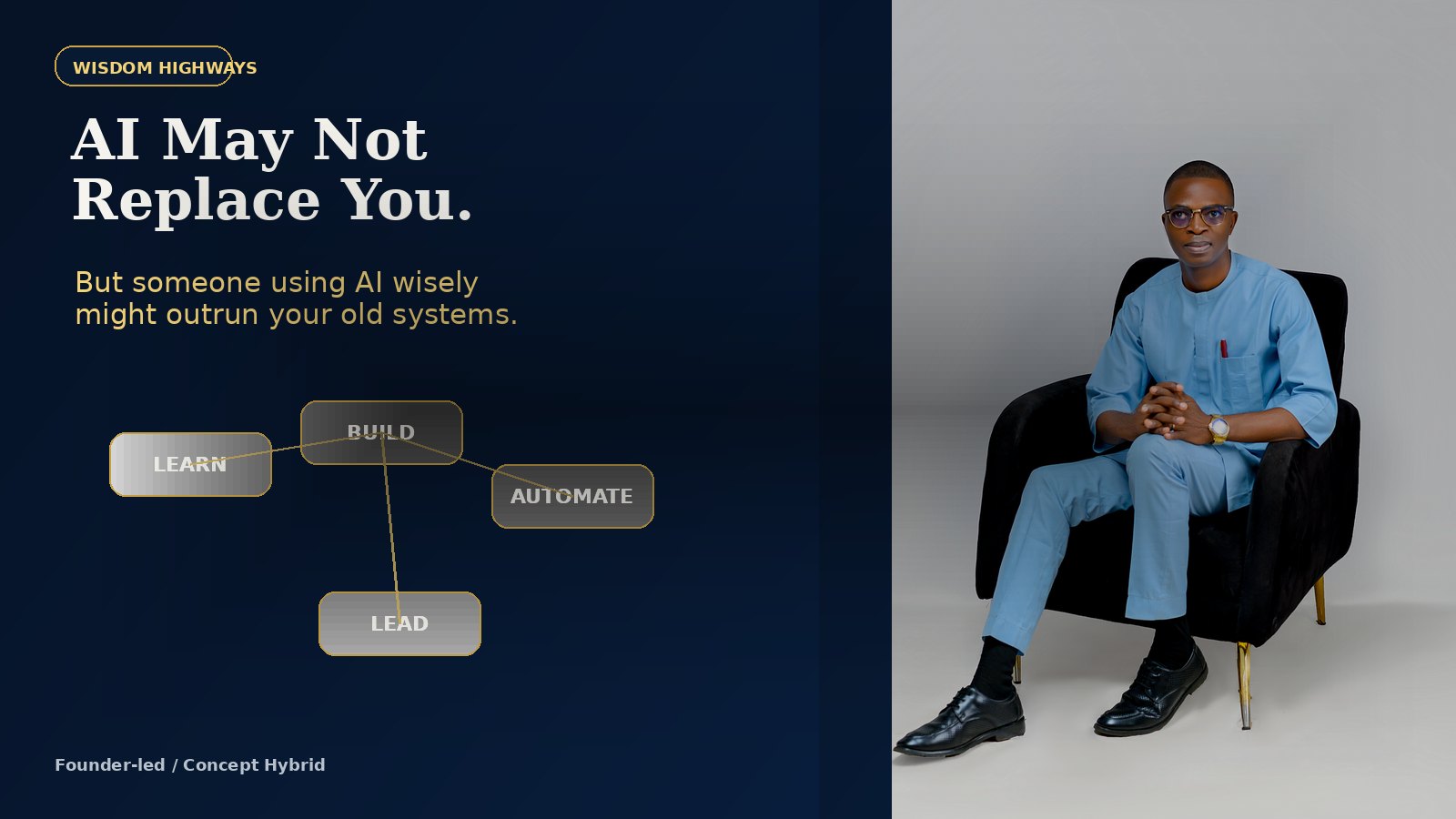
AI may not replace you in one dramatic moment. But someone who learns how to use AI wisely may begin to learn faster, respond better, build clearer systems, serve more people and make decisions with better preparation than a leader who keeps doing everything the old way.
That sentence can sound threatening if we hear it through fear. But it can also become a wise invitation: not to panic, not to chase every new tool, and not to surrender human responsibility — but to become a more prepared leader.
The question is no longer only, “Will AI affect my work?” For pastors, founders, executives and purpose-driven teams, a better question is: what parts of our work are still being carried by manual habits that cannot support the assignment ahead?
The real advantage is not AI. It is wise adaptation.
AI alone is not a strategy. A tool in confused hands can multiply confusion. A tool in wise hands can multiply clarity, capacity and service.
The leaders who benefit most from AI are not always the most technical. Often, they are the ones who can see clearly:
- which work should remain deeply human;
- which repeated work can be supported by systems;
- which decisions need better information;
- which tasks are draining time without adding equal value;
- which opportunities are being missed because the organization is too manually stretched.
In other words, the future does not simply belong to people who “use AI.” It belongs to people who use AI with judgment, values, discipline and purpose.
Why someone using AI may move ahead
The advantage is usually not magic. It comes from compounding improvements across ordinary work.
1. They learn faster
AI can help summarize material, compare options, draft questions, organize research and make unfamiliar topics easier to approach. This does not remove the need for wisdom. It reduces the friction of learning so the leader can focus on discernment, application and accountability.
2. They build systems faster
Many organizations are not struggling because they lack passion. They are struggling because their work lives in scattered messages, repeated explanations, manual follow-ups and disconnected files. AI and automation can help turn repeated work into clearer workflows.
3. They communicate with more consistency
A wise leader should not sound mechanical. But neither should every important message be recreated from scratch. AI can help prepare drafts, check clarity, organize talking points and maintain consistent language across teams — while human leadership preserves tone, truth and care.
4. They respond faster
Speed is not always wisdom. But slow response caused by poor systems can quietly damage trust. A leader with better systems can follow up, organize, communicate and decide with less delay.
5. They multiply what is already strong
A strong sermon, workshop, article, meeting insight or strategic idea can become many useful assets: summaries, checklists, team notes, training material, social posts and implementation steps. AI can help repurpose wisdom without replacing the leader’s original conviction.
What AI should not replace
Wisdom Highways does not teach leaders to surrender responsibility to machines. Some work must remain human-led:
- spiritual discernment;
- pastoral care and sensitive human conversations;
- ethical judgment;
- final decisions that affect people deeply;
- vision, calling, values and direction;
- trust-building leadership.
AI can assist. It should not become the conscience, shepherd, prophet, founder, strategist or final authority of the organization.
Divine wisdom leads. Human leaders govern. Technology serves the mission and the people.
The dangerous position: working hard but refusing to upgrade the system
The greatest risk for many leaders is not laziness. It is faithful effort trapped inside outdated systems.
A pastor can be deeply sincere and still lose hours every week to repeated admin. A founder can be gifted and still miss opportunities because follow-up is manual. A team can be committed and still look disorganized because information is scattered across too many places.
When someone else combines similar passion with better systems, the gap begins to show. They are not necessarily smarter, more anointed, more visionary or more committed. They may simply have learned to stop carrying repeatable work manually.
A practical “AI advantage” audit for leaders
Use these questions to identify where you are vulnerable — not to fear, but to prepare.
Learning
- Do I take too long to understand new topics because research is scattered?
- Do I have a consistent way to turn learning into action?
Communication
- Do I repeatedly explain the same ideas, processes or expectations?
- Could templates, drafts or knowledge bases support clearer communication?
Follow-up
- Are leads, members, clients, volunteers or partners waiting because follow-up depends on memory?
- Do important opportunities fall through gaps?
Decision support
- Do decisions stall because information is not organized?
- Could AI help prepare options, risks and trade-offs before human judgment is applied?
Content and knowledge
- Are sermons, trainings, articles and meetings being used once and forgotten?
- Could your best ideas become reusable teaching and implementation assets?
Five practical areas to upgrade now
1. Repeated communication
Identify the messages, explanations and follow-ups you write again and again. These can often become templates, guided workflows, knowledge bases or assisted drafts.
2. Content repurposing
A sermon, article, training, workshop or strategic message should not disappear after one use. AI can help turn one strong idea into outlines, summaries, captions, checklists and teaching assets — with human review.
3. Lead and enquiry follow-up
If people ask for help and the response process is inconsistent, opportunity is leaking. Better systems can preserve context and support timely follow-up.
4. Internal knowledge
Many organizations repeatedly answer questions that should have become documented knowledge. AI can help organize what the organization already knows so people are not forced to depend on one person’s memory.
5. Decision preparation
AI can help compare options, surface trade-offs and organize information before a decision. But the decision itself still belongs to accountable human leadership.
A better first question than “Which tool should we buy?”
Before choosing software, ask:
Where are we losing time, clarity, follow-up, consistency or opportunity because our current system is too manual?
That question is more useful than chasing trends. It helps you find the places where AI and automation can serve real mission needs.
How to move without panic
- Map your repeated work. List what happens weekly or daily.
- Separate human judgment from mechanical repetition. Do not automate what requires care and discernment.
- Choose one workflow to improve. Start small enough to verify.
- Keep a human review point. Especially for communication, pastoral care, money, legal, personal or reputational matters.
- Measure whether it actually helps. Time saved, response speed, quality, consistency and peace of mind matter.
The Wisdom Highways perspective
The future is not asking leaders to become less human. It is asking leaders to stop confusing manual overload with faithfulness, seriousness or excellence.
Wise leaders will not worship technology. They will govern it. They will not use AI to escape responsibility. They will use better systems to protect time for the work only humans should do.
Is your organization ready to use AI wisely?
Before adopting tools, assess your systems, readiness, risks and opportunities.
Key takeaway
AI may not replace you. But leaders who combine wisdom, human responsibility and better systems will have an advantage over leaders who keep doing everything the old way.
The goal is not fear. The goal is readiness.