
Wisdom Highways AI Explainer
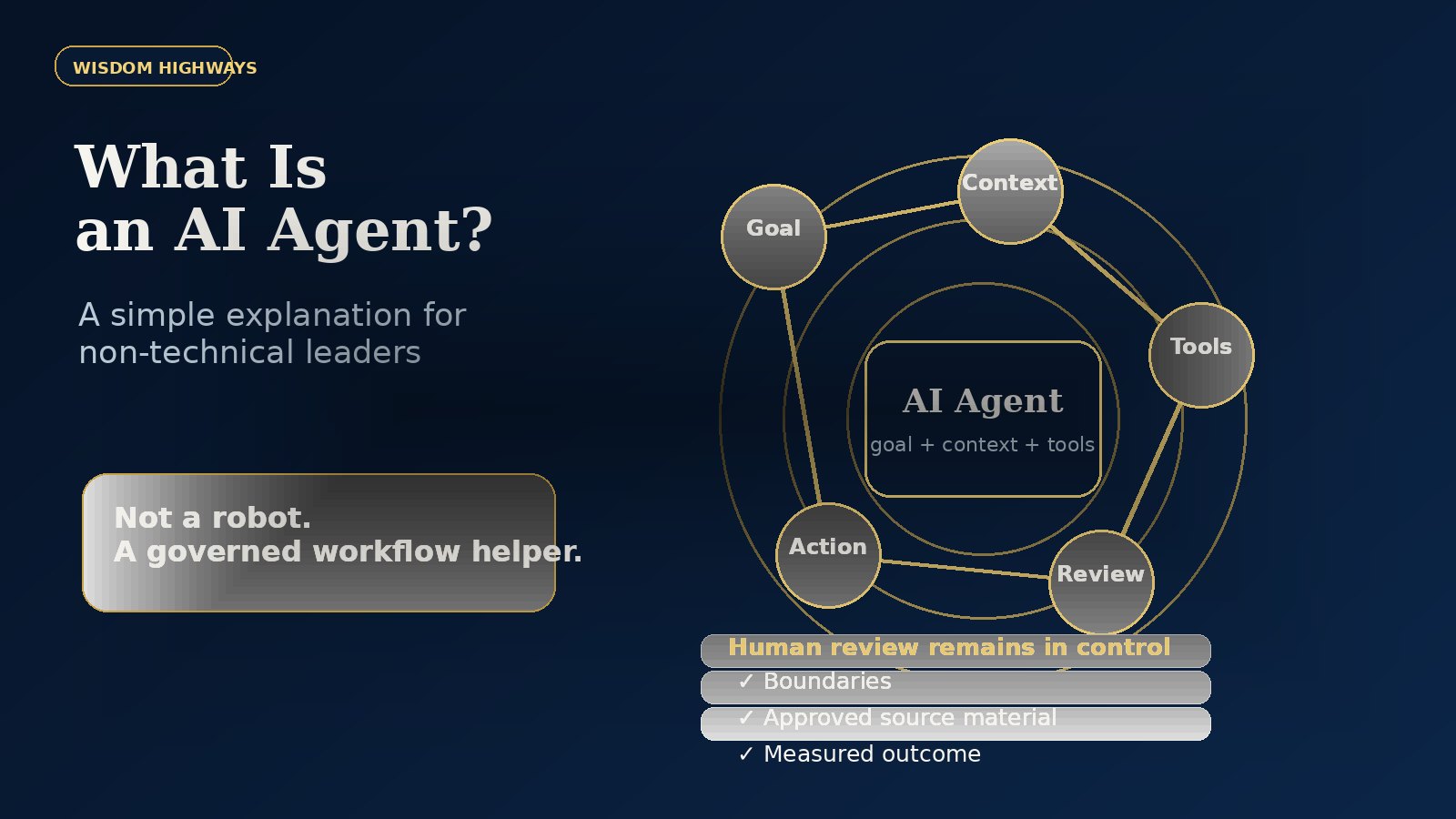
An AI agent is not a robot sitting inside your computer. It is a software-based helper that can pursue a clearly defined goal, follow instructions, use approved information or tools, and prepare useful work for a human being to review.
For a non-technical leader, the important question is not, “How futuristic does this sound?” The better question is: Can this system help us serve people, follow up faithfully, reduce repetitive work and protect human judgment?
This guide explains AI agents in plain language for pastors, founders, SME owners, executives, ministry teams, nonprofits and purpose-driven organizations that want practical clarity without hype.
What is an AI agent?
An AI agent is a digital system designed to work toward a goal within boundaries. A basic chatbot responds to a prompt. A traditional automation follows fixed rules. An AI agent can combine instructions, context, reasoning steps and tools inside a workflow.
For example, an agent-like workflow might review a new enquiry, classify the need, draft a follow-up message, check a calendar rule, update a record and flag the matter for a human team member before anything sensitive is sent.
A chatbot answers. An automation follows rules. An AI agent helps work toward a goal using instructions, context and approved tools.
That does not mean an agent should be trusted blindly. It means the workflow can move beyond isolated answers into guided support — while human leaders remain responsible.
Why leaders are hearing so much about AI agents now
Global AI discussion has moved from “Can AI write text?” to “Can AI help complete work?” Technology providers, research teams and governance bodies are now paying more attention to systems that can use tools, call data, plan steps and operate with varying levels of human supervision.
This creates opportunity and risk. For small businesses, ministries and nonprofits, agent-style systems may reduce bottlenecks in follow-up, admin, content repurposing, reporting and internal knowledge work. But the same systems can create problems if they are given vague goals, excessive access, poor source material or no review boundary.
Wisdom Highways’ position is simple: agents should not replace wisdom, care, leadership or accountability. They should serve them.
AI agent vs chatbot vs automation
Chatbot
A chatbot usually responds to a user’s message. It can draft, summarize, brainstorm, explain and answer questions. It is useful, but the person often has to manage every next step manually.
Traditional automation
Traditional automation follows predictable rules: when this happens, do that. For example, when someone submits a form, add the details to a spreadsheet, send a confirmation email and notify the team. This is powerful where the process is stable.
AI agent
An AI agent can combine reasoning, context and tool-use inside a guided process. It may decide which step comes next within approved boundaries, ask for missing information, prepare a draft, classify a case or call a connected tool.
The strongest practical systems often combine all three: automation for predictable movement, AI for language and interpretation, and human review for judgment.
How an AI agent works in simple terms
Most practical agent workflows have six parts.
1. Goal
The system needs a clear purpose. “Help us respond to new enquiries faster” is much safer and clearer than “Use AI in our organization.”
2. Instructions
The agent needs rules: what to do, what not to do, what tone to use, when to stop, and when to ask a human being.
3. Context
The system needs approved information: FAQs, service descriptions, ministry details, policies, previous notes, templates, knowledge documents or approved response examples.
4. Tools
An agent may connect to forms, calendars, email, spreadsheets, CRM systems, document folders or reporting dashboards. Access should be limited to what the workflow truly needs.
5. Memory or state
Some workflows need to remember where a task is in the process: waiting for a reply, ready for review, missing a document, escalated to a leader, or completed. This should be designed deliberately, not left vague.
6. Review and escalation
Human review protects truth, care, quality, privacy and reputation. The more sensitive the task, the stronger the review point should be.
Practical examples for pastors and ministry teams
- Visitor follow-up preparation: summarize a visitor card, draft a warm message and remind the right leader — but require human approval before sending.
- Sermon repurposing support: turn a sermon transcript into devotional ideas, discussion questions and social captions for review.
- Volunteer coordination: organize recurring volunteer questions into a knowledge base and prepare reminders for service teams.
- Meeting summaries: convert notes into action items, responsible persons and follow-up dates.
- Internal admin support: route common requests to the right ministry team without pretending to provide pastoral counsel.
In ministry, agent design must protect spiritual care. AI may prepare, summarize or organize. It must not become the shepherd, counsellor, prophet, conscience or final authority.
Practical examples for SMEs, founders and nonprofits
- Lead triage: classify new enquiries, identify missing information and prepare a next-step response.
- Client onboarding: generate a draft onboarding checklist based on the chosen service and internal process.
- Operations support: summarize recurring reports and highlight items that need leadership attention.
- Knowledge-base assistance: help staff find approved answers instead of interrupting the founder for every repeated question.
- Content workflow: turn a webinar, meeting or article into draft platform-native pieces for human editing.
For smaller organizations, the best agent is rarely the most complex one. It is the one attached to a real bottleneck, governed by clear rules and measured against practical outcomes.
What an AI agent should not do without human oversight
Some work must remain human-governed. Be especially careful with:
- pastoral care, counselling and sensitive spiritual matters;
- legal, financial, medical, safeguarding or HR decisions;
- public claims, promises or doctrinal statements;
- personal data, confidential documents and private conversations;
- discipline, conflict, complaints or emotionally sensitive situations;
- final decisions that deeply affect people, money, reputation or trust.
AI can prepare and support. It should not become the conscience, pastor, founder, strategist, board or final authority.
The key risks leaders should understand
Reputable AI guidance consistently points leaders toward risk management, accountability, transparency, privacy, security and human oversight. In plain language, the risks are not only technical.
- Wrong output: the agent may produce confident but inaccurate information.
- Wrong access: the agent may be connected to systems it does not need.
- Wrong tone: the system may communicate in a way that damages trust.
- Wrong source: the system may use outdated, unapproved or irrelevant information.
- Wrong authority: people may treat the agent’s output as final when it should be reviewed.
- Wrong measurement: the organization may celebrate novelty instead of real time saved, quality improved or follow-up strengthened.
This is why Wisdom Highways emphasizes readiness before implementation. A poorly governed agent can multiply confusion. A wisely governed agent can reduce repeated work while making responsibility clearer.
The Wisdom Highways agent-readiness checklist
Before building or buying an AI agent, score these areas from 1 to 5.
- Purpose: What real burden, bottleneck or opportunity should this address?
- Workflow clarity: Can we describe the current process from start to finish?
- Human judgment: Which steps must always be reviewed by a person?
- Approved knowledge: What source material should the agent use?
- Access control: Which tools does it need, and which tools should it never touch?
- Data and privacy: What personal or sensitive information could be involved?
- Risk and escalation: What could go wrong, and when must the system stop?
- Measurement: How will we know whether it helped?
If several answers are unclear, the organization may not need an advanced AI agent yet. It may need workflow mapping, source-of-truth cleanup and readiness work first.
A simple decision framework: assist, automate or agent?
Use this simple pathway before choosing technology:
- Use AI assistance when a person needs help drafting, summarizing, brainstorming or clarifying information.
- Use automation when the steps are predictable and rule-based.
- Use an AI agent when the workflow needs context, tool use, flexible next steps and careful review.
- Do not automate yet when the process is unclear, highly sensitive, politically delicate or dependent on deep human discernment.
This avoids the common mistake of using advanced technology to cover an unclear process. Wisdom comes before automation.
Start with one narrow workflow
The best first AI-agent project is usually narrow, repeated and reviewable. Avoid starting with a mission-critical process that touches sensitive data or final decisions.
Good first candidates include enquiry triage, appointment preparation, content repurposing drafts, internal FAQ support, meeting summaries, reporting summaries and onboarding checklists.
Start small enough to verify. Then improve based on evidence.
Where AI agents fit in Wisdom Highways work
Wisdom Highways helps leaders think beyond tool excitement. The question is not only whether an AI agent is possible. The question is whether the organization is ready for that agent to serve mission, people, systems and measurable outcomes.
For some teams, the right next step is not an agent. It is clarifying the workflow. For others, it may be a simple automation. For more mature teams, an AI-powered assistant or agent can become part of a responsible operating system.
Divine wisdom leads. Human leaders govern. Technology serves the mission and the people.
Is your organization ready for AI agents?
Before adding advanced tools, assess your workflows, risks, source material and human-review points.
Sources and careful-use notes
This article uses source-backed themes without overstating statistics: AI risk management and trustworthy AI from the NIST AI Risk Management Framework; responsible AI principles from the OECD AI Principles; privacy and data-protection considerations from the UK Information Commissioner’s Office (ICO) AI guidance; common descriptions of AI-agent tool use and goal-directed workflows from IBM’s AI agents explainer, Google’s Agents whitepaper, and Anthropic’s building effective agents guidance; and application-security caution from the OWASP Top 10 for LLM Applications.
These sources support governance, tool-use, human oversight, privacy and risk themes. They should not be used to promise automatic savings, spiritual outcomes, legal compliance or business growth.
Key takeaway
An AI agent is a digital helper that can work toward a defined goal using instructions, context and tools. The wiser question is not “Can we build one?” but “Can we govern one responsibly so it serves people, mission and measurable outcomes?”