
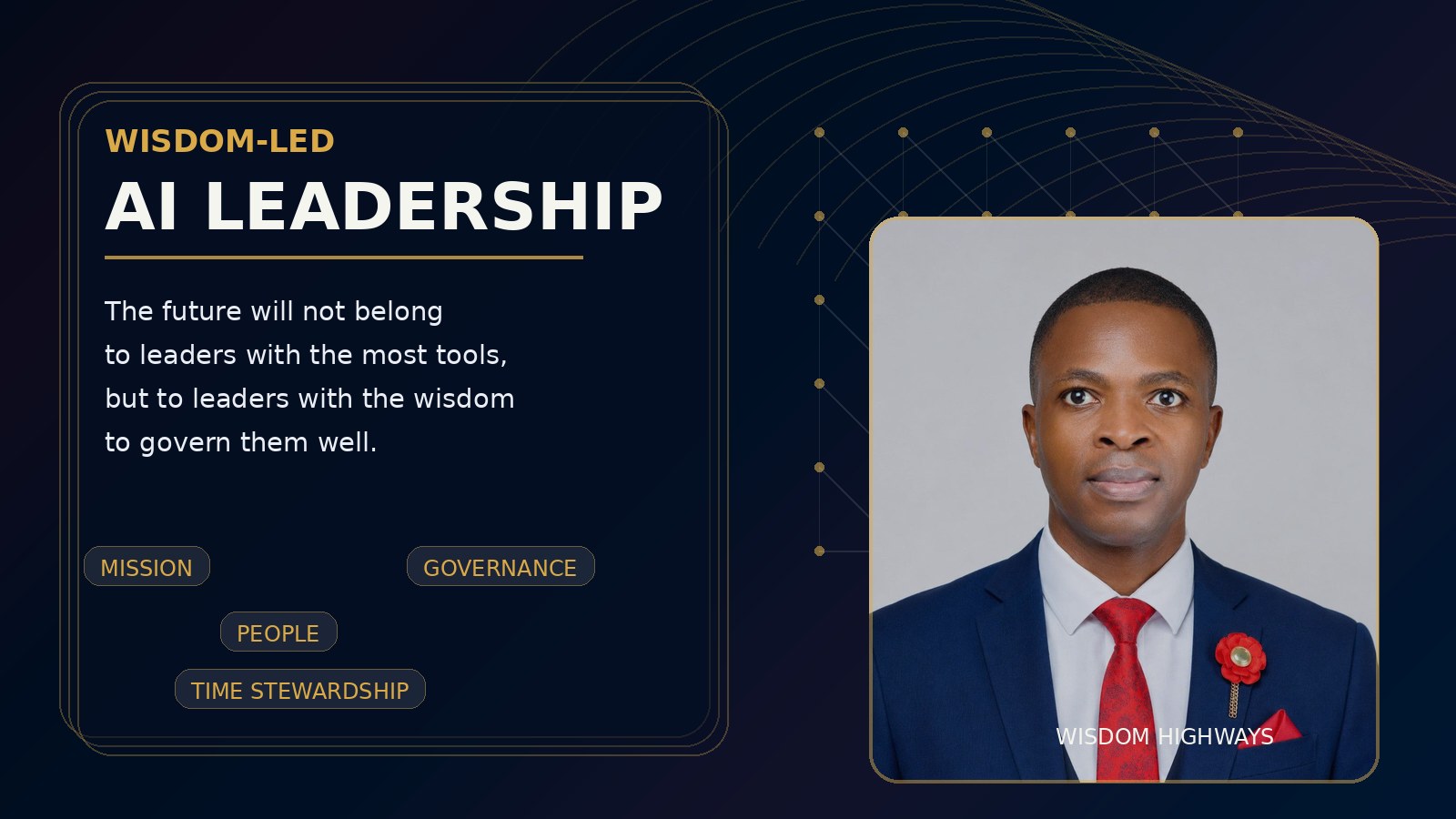
AI Leadership • Wisdom Before Automation
AI Leadership: Why Wisdom Matters More Than Tools
Many leaders are entering the AI conversation through the doorway of tools. They ask, “Which app should we buy? Which chatbot should we use? Which workflow should we automate?” Those questions matter, but they are not the first questions. The first question is deeper: what kind of leadership will govern this power?
Artificial intelligence can accelerate writing, research, analysis, follow-up, administration, learning and operational coordination. It can help a pastor reduce administrative weight, help a founder respond faster to customers, help a nonprofit organize donor communication, and help a team recover hours previously lost to repeated manual work. But speed without wisdom can simply multiply confusion. Automation without discernment can make poor processes move faster. AI without human governance can produce errors, privacy risks, cold communication and decisions that no one feels responsible for.
That is why the next season will not belong merely to organizations that “use AI.” It will belong to leaders who can combine technological capability with judgment, mission, ethics, people-care and disciplined implementation. In the Wisdom Highways language: divine wisdom leads; systems serve; people remain the priority.
The real AI leadership problem
The most common mistake is treating AI adoption as a technology project only. Leaders delegate everything to the tool buyer, the tech-savvy team member, the consultant or the person who seems most excited about automation. Soon the organization has scattered experiments, duplicated subscriptions, unclear standards, and team members quietly using AI in sensitive places without shared rules.
For a church, this may show up as AI-assisted sermon notes, captions, visitor follow-up or pastoral communication without clear review. For a business, it may show up as AI-generated customer responses, sales outreach, hiring filters or internal reporting without data boundaries. For a nonprofit, it may show up as donor messaging, grant writing or beneficiary records being handled through tools no one has evaluated.
The issue is not that AI is bad. The issue is that powerful systems need wise governance. If leadership does not define the boundaries, the organization will create its own informal rules through habits, shortcuts and pressure.
What global guidance consistently points toward
Across current AI governance discussions, several themes repeat: human oversight, transparency, accountability, privacy, reliability, fairness, security and clear risk management. The NIST AI Risk Management Framework emphasizes trustworthy AI and structured risk management. The OECD AI Principles point toward human-centered, transparent, robust and accountable AI. UNESCO’s Recommendation on the Ethics of AI highlights human dignity, oversight and rights-based governance. In faith-sensitive settings, the Vatican’s Antiqua et nova reinforces the need to remember the dignity and irreplaceable depth of human intelligence.
These sources are not saying every small organization needs a complex corporate AI department. They are pointing to a leadership principle: do not give technology authority without responsibility. Even a small church, SME or mission-driven team can ask better questions before deploying AI in real work.
Wisdom-led AI leadership starts with five decisions
Before a leader chooses another platform, they should make five practical decisions.
1. Decide what AI is allowed to help with
Some tasks are appropriate for AI assistance: drafting first versions, summarizing public information, organizing meeting notes, creating checklists, classifying inquiries, preparing content outlines, or routing routine follow-up. Other tasks need more caution: pastoral counsel, confidential member data, employee decisions, legal language, financial promises, medical advice, sensitive customer records or anything that affects trust and dignity.
A wise leader does not simply ask, “Can AI do this?” The better question is, “Should AI assist here, and under what review?”
2. Decide where humans must remain clearly responsible
AI can suggest, but leaders and teams must own the final judgment. A pastor should not outsource shepherding. A founder should not let automation damage a hard-earned customer relationship. A nonprofit should not let speed weaken empathy toward beneficiaries. Human review should be explicit wherever the work affects trust, doctrine, care, money, opportunity, safety or reputation.
3. Decide what data must never be carelessly entered
Privacy is not only a legal topic; it is a trust topic. Churches hold sensitive pastoral and membership information. Businesses hold customer data, employee information and financial details. Nonprofits may hold donor or vulnerable-community data. AI leadership requires practical data rules: what can be used, what must be anonymized, what should stay out of public tools, and who is allowed to approve exceptions.
4. Decide which processes should be fixed before automation
If the process is broken, AI may only make the brokenness faster. Visitor follow-up that has no owner will not become healthy simply because a tool sends reminders. Customer support with unclear policies will not become excellent simply because AI writes faster replies. Content production with no message strategy will not become authoritative simply because AI creates more drafts.
Wisdom-led leaders first clarify the workflow, owner, standard and desired outcome. Then automation can serve the process.
5. Decide how success will be measured
AI adoption should not be measured only by novelty. Better measures include hours reclaimed, response time improved, missed follow-up reduced, content quality increased, team workload lowered, decision speed improved, customer/member experience strengthened, and risk reduced. The goal is not to appear advanced. The goal is to serve mission and people better.
The W.I.S.D.O.M. framework for AI leadership
Use this simple framework before launching an AI initiative.
W — Why are we doing this?
Name the mission problem. Are you trying to reclaim time, improve follow-up, increase consistency, reduce team overload, respond faster, or strengthen decision-making? If the “why” is vague, the tool choice will likely drift.
I — Is this the right level of risk?
Start with lower-risk workflows before sensitive ones. A church might begin with event reminders, volunteer scheduling drafts or public content repurposing. An SME might begin with inquiry triage, invoice reminders or internal knowledge summaries. Do not begin with the most sensitive human situations just because they are interesting.
S — System before software
Write down the process before buying another tool. Who starts the workflow? What information is needed? What does AI draft or classify? Who reviews it? What happens if the output is wrong? What is logged? What is never automated?
D — Discernment and data boundaries
Set rules for confidential information, theological sensitivity, customer records, staff data, financial claims and vulnerable people. If the team cannot explain the boundary, the boundary is not yet operational.
O — Ownership and oversight
Every AI workflow needs an owner. Not a vague “the system handles it,” but a named role responsible for quality, review and improvement. This is especially important in churches, schools, charities, healthcare-adjacent ministries and customer-facing businesses.
M — Measure and mature
Begin small, review results, improve prompts and process steps, then expand. Mature AI leadership is not frantic adoption; it is disciplined learning.
Practical examples for pastors and ministry leaders
A pastor does not need to begin with a complex AI transformation. A wise first step could be a reviewed workflow for newcomer follow-up: the team captures visitor information, AI helps draft a warm message template, a human leader reviews tone and accuracy, and the final message invites the person into a real next step. The system helps prevent people from being forgotten, but pastoral warmth remains human.
Another wise use is sermon repurposing. AI can help turn a preached message into summary notes, small-group questions, captions or devotional prompts. But doctrine, nuance, scripture interpretation and pastoral emphasis should be reviewed by a human leader. The goal is not to let AI preach; it is to help valuable teaching travel further with integrity.
Church administration can also benefit: volunteer reminders, event planning checklists, attendance follow-up, content calendars and routine internal summaries. These are often low-risk places to reclaim time while building team confidence.
Practical examples for SMEs and purpose-driven organizations
A small business may start with lead intake and follow-up. AI can classify inquiries, suggest draft responses, summarize customer needs and alert the team when a lead is high-intent. But a human should still own promises, pricing, exceptions and sensitive conversations.
A nonprofit may use AI to draft grant outlines, summarize program reports or organize donor communication. But beneficiary stories, donor data and claims about impact require careful review. Trust is too valuable to risk through careless automation.
An executive team may use AI to summarize meeting actions, create decision briefs or compare options. But leaders must still bring context, values, courage and accountability. AI can assist thinking; it should not replace responsibility.
A simple first-step checklist
- Choose one workflow where delay or repetition is costing time.
- Write the current process in plain language.
- Identify which step is safe for AI assistance.
- Define what data may and may not enter the tool.
- Name the human reviewer and final decision owner.
- Create a quality standard for tone, accuracy and boundaries.
- Run a small pilot for two to four weeks.
- Measure time saved, errors, response speed and human experience.
- Improve the workflow before expanding.
Common mistakes to avoid
- Buying tools before defining processes. Software cannot compensate for unclear leadership.
- Automating trust-sensitive communication too early. Start with reviewed assistance, not unsupervised replacement.
- Ignoring team training. People need standards, examples and boundaries, not only login access.
- Confusing more content with more authority. Quality, relevance and truth still matter.
- Using AI where confidentiality is unclear. If the data boundary is uncertain, slow down.
- Measuring activity instead of outcomes. Track whether mission, service, clarity and time stewardship improve.
The Wisdom Highways perspective
Wisdom Highways does not teach AI adoption as hype. We teach it as stewardship. Time is stewardship. Attention is stewardship. Trust is stewardship. Leadership is stewardship. Technology should help leaders recover capacity for the work only humans can do: discernment, prayer, empathy, vision, courage, creativity, pastoral care, strategy and relationships.
The organizations that win with AI will not be the ones that automate everything first. They will be the ones that know what should be automated, what should be assisted, what should be protected, and what must remain deeply human.
Ready to lead AI with wisdom instead of guesswork?
Take the Wisdom Highways AI & Systems Readiness Assessment to identify your strongest starting point, your hidden workflow gaps and the leadership safeguards your organization needs before scaling automation.
Related Wisdom Highways insights
- How to Reclaim 10+ Hours Every Week With AI and Automation
- AI May Not Replace You. But Someone Using AI Might.
- How Purpose-Driven Organizations Can Use AI Without Losing Their Human Touch
- AI Automation for Churches: The Complete Beginner’s Guide
Repurposing notes
- LinkedIn: Turn the five AI leadership decisions into a carousel for founders and executives.
- Facebook: Lead with “AI without wisdom only makes confusion faster.”
- Instagram: Use the W.I.S.D.O.M. framework as a six-slide explainer.
- Telegram/WhatsApp: Share the first-step checklist as a practical leadership prompt.
Freshness note: Prepared September 2026. AI governance and workplace adoption guidance continues to evolve; review this article periodically for new regulatory, platform and best-practice developments.