
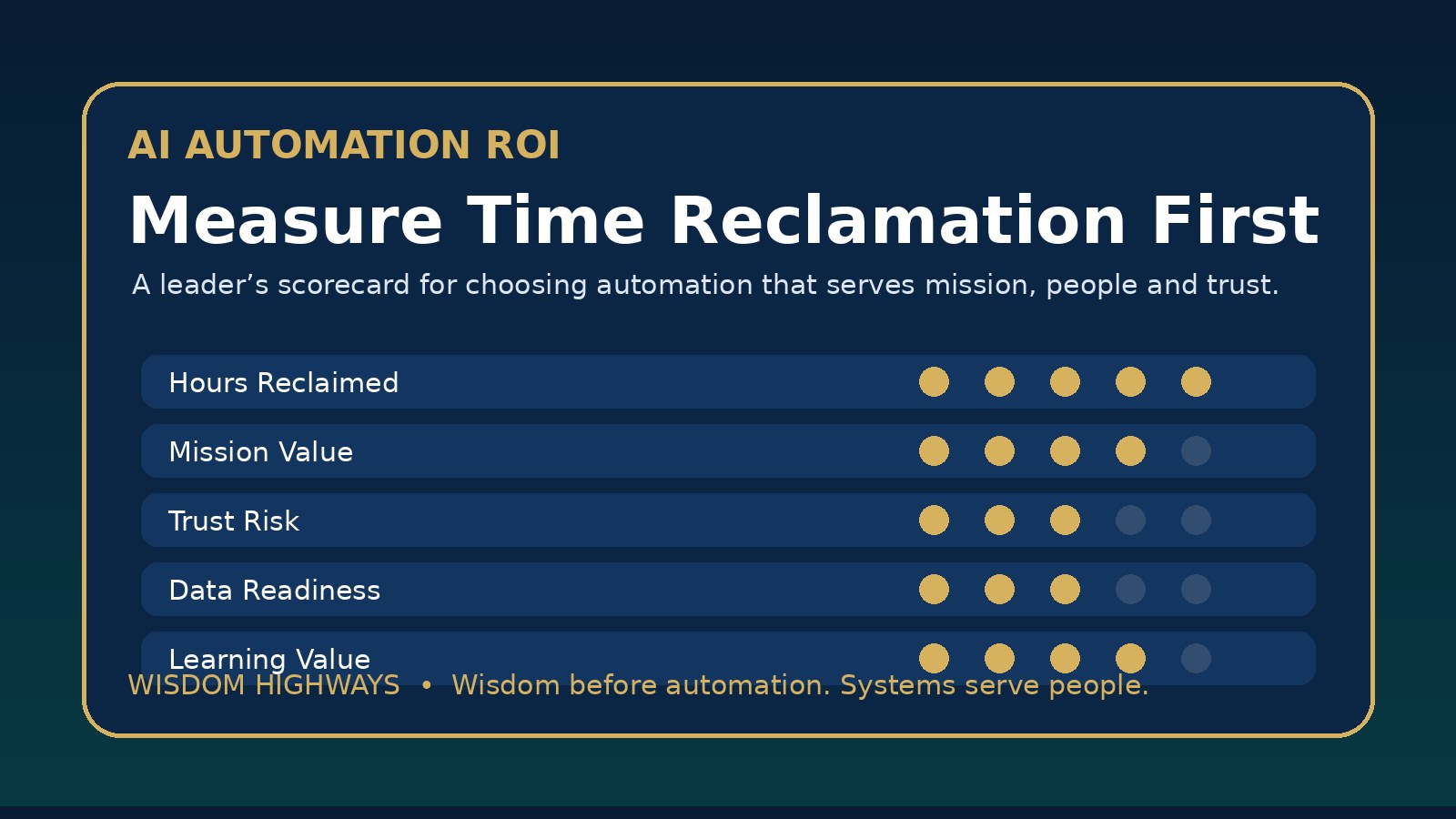
AI automation ROI should not begin with a software invoice. It should begin with the hours, attention and trust your organization is trying to reclaim.
Many churches, SMEs and purpose-driven teams are now asking a sensible question: “Will AI automation pay for itself?” The question matters. But if leaders measure only cost reduction, they can automate the wrong thing, frustrate the team, and still miss the deeper opportunity.
For Wisdom Highways, the better starting point is Time Reclamation: identifying where people are losing energy in repetitive, low-judgment work, then measuring whether automation gives that time back for mission, service, leadership and growth. The goal is not to make people irrelevant. The goal is to free people for the work that requires wisdom, care and human presence.
Why traditional ROI is too narrow for AI automation
Traditional ROI usually compares financial gain with project cost. That is useful, but AI and automation affect more than expense lines. They affect staff attention, response speed, customer or member experience, data quality, risk, accountability and morale.
A church may not “save money” immediately by automating first-time visitor follow-up, but it may respond more consistently, reduce pastoral admin pressure and improve care. A small business may not reduce headcount by automating invoice reminders, but it may recover hours each week, improve cash discipline and reduce emotional friction with clients.
That is why leaders need a broader scorecard: one that measures value without treating people as a cost problem.
The Wisdom Highways ROI question
Before asking, “How much money will this save?” ask:
What valuable human work becomes possible again if this workflow is handled more reliably?
This question protects the organization from two common mistakes. First, it prevents leaders from automating visible work that is not actually costly. Second, it keeps the team focused on mission outcomes, not tool excitement.
A practical AI automation ROI scorecard
Use this scorecard before approving an automation pilot. Rate each area from 1 to 5. A strong first project does not need a perfect score, but it should show meaningful value without high trust or data risk.
1. Time reclaimed
Estimate how many hours the workflow currently consumes each week. Include hidden time: chasing updates, retyping data, correcting mistakes, searching for information and reminding people.
- 1: Less than one hour per week.
- 3: Several hours across one or two people.
- 5: Repeated weekly drain across a team or leader.
2. Frequency and repeatability
Automation works best when a task repeats with a predictable pattern. If every case requires deep judgment, start with a checklist or decision-support tool instead of full automation.
3. Mission or revenue relevance
Ask whether the workflow affects care, service delivery, sales follow-up, cash flow, member communication, donor experience, client onboarding or leadership responsiveness. Reclaimed time is most valuable when it returns capacity to mission-critical work.
4. Error and delay reduction
Some workflows are costly because they are slow or inconsistent. A late follow-up, missed invoice, duplicated record or forgotten volunteer update may look small, but the compound effect can damage trust.
5. Human trust risk
Not every task should be automated first. If the work involves pastoral care, sensitive financial decisions, employment matters, confidential data or vulnerable people, the first step should be governance and human review. NIST’s AI Risk Management Framework and the OECD AI Principles both emphasize trustworthy, accountable and human-centered AI practices. For Wisdom Highways, that means automation must serve people, not hide responsibility.
6. Data readiness
Automation is only as useful as the information flowing through it. If names, emails, statuses, permissions or source records are messy, the first “automation” may need to be data cleanup, standard forms or a shared source of truth.
7. Learning value
A good first pilot teaches the organization how to automate wisely. Prefer a project that builds confidence, reveals integration gaps, and creates a reusable pattern for future workflows.
The simple calculation: hours, value and risk
For a first-pass estimate, use this formula:
Weekly value = hours reclaimed × value of the hour × confidence factor
The “value of the hour” is not always salary. For a pastor, a reclaimed hour may mean counseling, sermon preparation, leadership development or member care. For a founder, it may mean sales conversations, product development or strategic partnerships. For an operations assistant, it may mean fewer interruptions and cleaner handoffs.
Then apply a confidence factor:
- 0.3 if the workflow is unclear or data is weak.
- 0.6 if the process is mostly clear but needs testing.
- 0.8 if the process is stable and low-risk.
This keeps projections honest. It also avoids invented “AI savings” claims that sound impressive but cannot be defended.
Example: church visitor follow-up
A church team collects visitor cards, enters details manually, sends delayed messages and asks pastors to remember follow-up steps. The automation opportunity is not to replace pastoral care. The opportunity is to ensure that basic welcome, routing and reminders happen reliably.
Potential measures include: hours spent entering data, time from visit to first contact, percentage of visitors receiving a follow-up, number of pastoral reminders generated and whether sensitive conversations remain human-led.
If the system gives the team two hours back weekly and improves consistency without pretending to pastor people, that is a wise first ROI case.
Example: SME proposal and invoice follow-up
A small business may lose time and revenue because proposals, invoices and client reminders are handled manually. The team does not need a complicated AI transformation. It may need a simple automation that tracks proposal status, sends respectful reminders, updates the CRM and alerts a human when judgment is needed.
Measures include: hours spent chasing updates, response time, overdue invoice rate, proposal follow-up completion, and fewer “I thought someone handled that” moments.
What not to count as ROI too early
Be careful with claims like “AI will save 40% of our time” unless the organization has measured actual workflow time before and after. Reports such as Microsoft’s Work Trend Index and Asana’s work research point to real pressure around digital work, meetings, interruptions and coordination load, but your organization still needs its own baseline.
For public communication and internal decision-making, separate research-backed trends from your local results. This protects credibility and helps the team learn honestly.
A 14-day measurement plan
- Choose one workflow. Select a frequent, repeatable, low-to-moderate risk task.
- Measure the baseline for one week. Track time spent, delays, errors, handoffs and emotional friction.
- Define the human boundary. Decide what the system may do, what it may suggest, and what must remain human-led.
- Run a small pilot. Automate only the safest part first.
- Compare before and after. Measure hours reclaimed, quality, speed, user experience and new problems created.
- Decide: scale, redesign or stop. A wise stop is not failure; it is governance working.
Leadership questions before approving the pilot
- Whose time are we trying to reclaim?
- What higher-value work should that person return to?
- What decision must stay human-led?
- What data does the workflow depend on?
- How will we know whether trust improved or declined?
- What will we measure after 14 days?
How to present ROI without overpromising
When leaders present an AI automation pilot to a board, ministry team or management group, the safest language is evidence-conscious and local. Say, “This workflow currently appears to consume five to seven staff hours weekly; our pilot goal is to reclaim part of that time and improve follow-up consistency,” rather than promising dramatic savings before measurement.
This matters internationally because AI adoption is moving faster than many governance habits. Reputable guidance from NIST and the OECD keeps returning to the same leadership themes: trustworthy systems, accountability, transparency, risk management and human-centered use. Wisdom Highways translates that into a practical rule for smaller organizations: measure what is real, protect what is human, and scale only after trust improves.
For a church, that may mean reporting improved follow-up reliability and fewer missed pastoral handoffs rather than claiming a financial saving. For a small business, it may mean showing that proposals, invoices or customer enquiries are handled faster while sensitive exceptions still reach a human. For a nonprofit, it may mean donor records are cleaner and staff spend less time reconciling spreadsheets. These are credible ROI signals because they can be observed, measured and discussed without pretending that automation has solved every leadership problem.
A one-page Time Reclamation Scorecard leaders can use this week
- Workflow name: the exact recurring task, not a broad department.
- Current owner: who carries the work and who feels the interruption.
- Weekly frequency: how often the task happens.
- Estimated time drain: hours spent doing, chasing, correcting and reporting.
- Human boundary: what the system may do automatically and what must remain reviewed by a person.
- Trust indicator: one sign that service, care or reliability improved.
- Risk control: the data, approval or escalation rule that prevents harm.
- 14-day decision: continue, redesign, expand or stop.
The Wisdom Highways perspective
AI automation becomes dangerous when leaders chase efficiency without wisdom. It becomes powerful when systems serve mission, people and stewardship.
The best ROI is not merely a smaller workload. It is a healthier organization: fewer repetitive drains, clearer ownership, better follow-up, stronger trust and more time for the work only humans should do.
If your team is unsure where to begin, start with readiness before tools. A readiness lens helps you choose the right workflow, set the right boundaries and measure the right outcomes.
Take the AI & Systems Readiness Assessment
Related Wisdom Highways insights
- What Should You Automate First? A Decision Matrix for Leaders
- How to Build an AI Automation Roadmap: A 30-Day Plan for Leaders
- AI Governance Checklist for Churches and Small Businesses
- How to Know If Your Organization Is Ready for AI Automation
Sources and further reading
- NIST AI Risk Management Framework
- OECD AI Principles
- Microsoft Work Trend Index 2025
- Asana Anatomy of Work resources
Freshness note: Prepared September 2026. Review examples, links and measurement guidance every 6–12 months as AI governance practices, workplace research and platform capabilities evolve.