
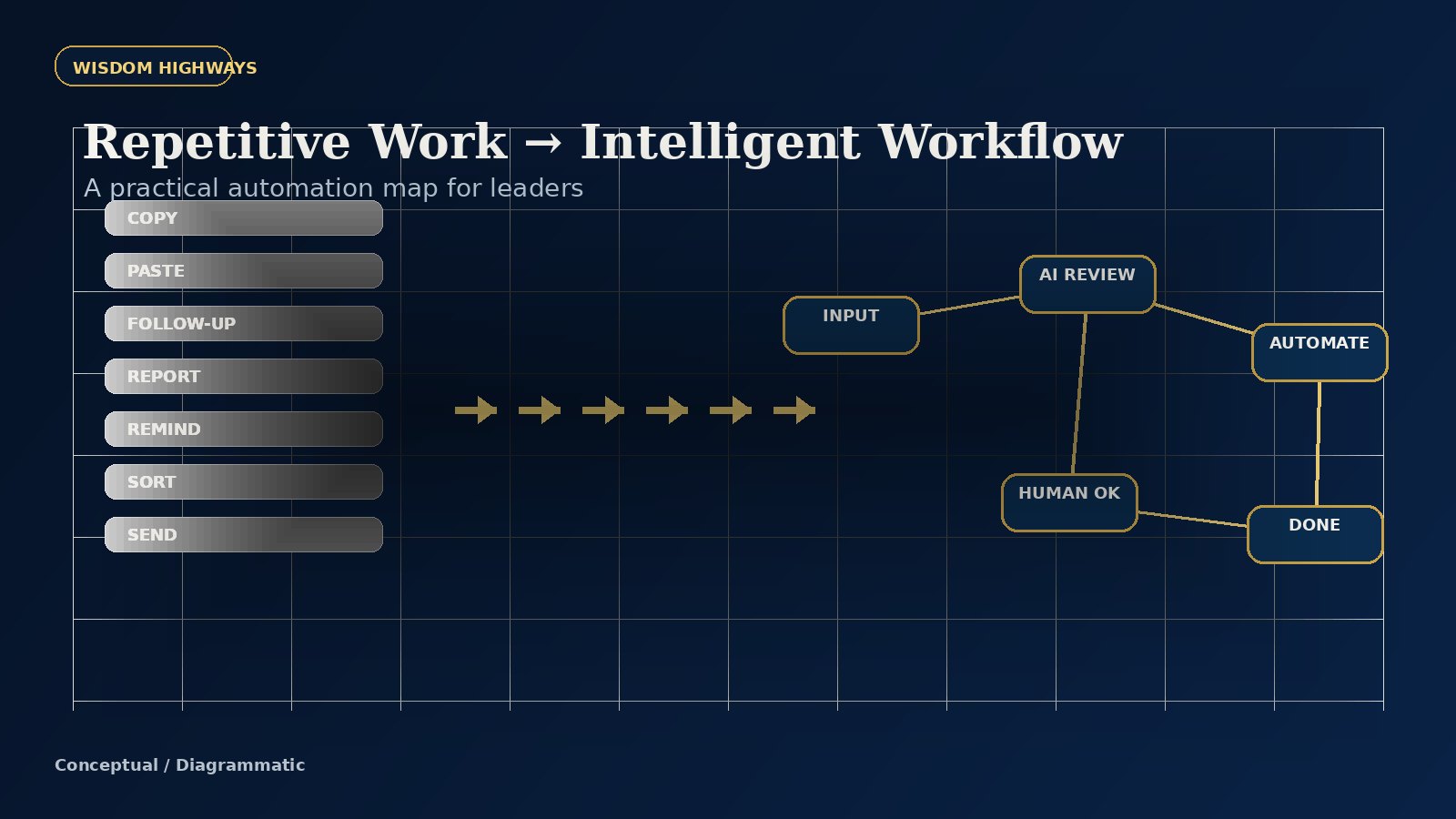
If a task keeps returning every week, it is not only a task. It is a signal. Your business may be asking for a better system.
Many founders, SME owners and organizational leaders spend too much time doing work that is necessary but not leadership-level: chasing updates, sending similar follow-ups, copying information between tools, preparing the same reports, answering the same questions, and rebuilding documents from scratch.
The answer is not to automate everything blindly. The answer is to identify the repeated work that can be systemized safely, then keep human judgment where it belongs.
Before the list: what makes a task worth automating?
A good automation candidate is usually frequent, predictable, low-risk, easy to review and connected to a clear business outcome. A poor automation candidate is sensitive, unusual, high-trust, legally or financially risky, or dependent on deep human judgment.
That distinction matters because AI and automation can speed up both good systems and bad systems. If the process is unclear, automation may simply make the confusion move faster.
Use this filter before changing anything:
- Does this task repeat weekly or daily?
- Does it follow a recognizable pattern?
- Can a person review the output quickly?
- Would faster handling improve response time, consistency, revenue, service or leadership focus?
- Can we define when the system should stop and ask a human?
Not sure which workflow to improve first?
Use the Wisdom Highways AI & Systems Readiness Assessment to identify where automation can create practical value without removing human responsibility.
Take the AI Readiness Assessment1. Lead and enquiry follow-up
Many businesses do not lose leads because nobody cares. They lose leads because follow-up depends on memory, scattered inboxes and busy people.
A better system can capture enquiries, route them by type, notify the right person, prepare a draft reply, remind the team when follow-up is due, and preserve the conversation history. The human still decides what to promise, what to quote and how to handle sensitive requests.
Wisdom Highways builds this kind of thinking into the AI Lead & Follow-Up System: response speed improves without turning people into numbers.
2. Scheduling, confirmations and reminders
Back-and-forth scheduling is one of the quietest drains in a growing organization. Someone proposes a time. Another person misses the message. A reminder is forgotten. A meeting starts with the wrong context.
Automation can support booking links, confirmations, reminders, rescheduling flows and pre-meeting information collection. The leader still decides who should meet, why the meeting matters and what decisions will be made.
3. Meeting notes and action summaries
Meetings often produce value, but the value disappears when nobody turns discussion into decisions, owners and next actions.
AI can help convert notes or transcripts into a draft summary, action-item list and follow-up message. But the final summary should be reviewed by someone who understands what was truly decided. AI can prepare; humans confirm.
4. Repeated customer questions and onboarding explanations
If customers ask the same questions every week, your team should not have to reconstruct the answer every time.
Create an approved response library for common questions: how your service works, what happens next, what clients should prepare, how timelines work, what is included, what is not included, and who to contact. AI can help draft or retrieve the right answer, but leadership should approve the final language.
5. Content repurposing and visibility preparation
Many purpose-driven businesses create valuable knowledge but use it only once. A webinar becomes a recording nobody revisits. A teaching becomes one post. A consultation insight stays in one conversation. A founder’s wisdom never becomes a reusable asset.
AI can help turn approved ideas into newsletters, article outlines, short-form video scripts, social captions, FAQs, checklists and internal training notes. Human review protects accuracy, tone, values and brand trust.
This is the heart of the AI Content & Visibility Engine: turn knowledge into useful visibility without losing substance.
6. Weekly reporting and decision preparation
Leaders need visibility, but they should not have to manually gather the same updates every week. A reporting workflow can collect basic inputs, summarize progress, highlight exceptions and prepare a decision-ready brief.
This is especially useful when the leader needs to see what changed, what is stuck, what needs approval and what should be escalated. The system prepares the signal; the leader applies judgment.
7. Internal handoffs and task routing
Work often slows down when it moves from one person to another. The handoff is unclear. The next owner is not obvious. The task stays inside a chat thread. Nobody knows whether it was completed.
Automation can create tasks, assign owners, send reminders, update status and make the workflow visible. This does not replace leadership. It reduces the amount of leadership energy wasted on chasing basic movement.
What you should not automate blindly
Responsible automation includes boundaries. Some work should remain human-led or human-approved:
- legal, tax, HR, financial or compliance decisions;
- refunds, negotiations and unusual customer complaints;
- public promises and brand-sensitive communication;
- confidential customer or staff matters;
- high-value sales conversations and partnership decisions;
- anything involving sensitive personal data without proper privacy controls.
The NIST AI Risk Management Framework is a useful reminder that trustworthy AI requires governance, risk awareness and human responsibility. For Wisdom Highways, that means AI should support stewardship — not remove accountability.
A simple scoring method for choosing the first task
Score each repeated task from 1 to 5 in five areas:
- Frequency: How often does it repeat?
- Time drain: How much attention does it consume?
- Risk: How dangerous would a mistake be?
- Reviewability: Can a human check the output quickly?
- Business value: Would improving it affect revenue, service, speed, consistency or leadership focus?
Start where frequency, time drain, reviewability and business value are high — and risk is low or manageable.
The Wisdom Highways approach
Wisdom Highways does not begin with a tool list. We begin with how your organization actually works. Where is time being lost? Where is follow-up weak? Where is knowledge trapped? Where are leaders doing support work that a better system could prepare, route or summarize?
Then we design systems that protect people, strengthen follow-through and keep human leadership in the right place.
Choose the right first automation
Before adding another tool, identify the repeated workflow where automation can create the clearest practical value for your organization.
Take the AI & Systems Readiness Assessment
About the author: Pastor Folorunso Alesinloye is the founder of Wisdom Highways. He helps pastors, leaders and purpose-driven organizations use wisdom-first AI, automation and practical systems to reclaim time, increase capacity and amplify impact.